| |
| Categoria |
Album |
Immagini |
|
33 |
3220 |
|
|
|
|
|
|
|
|
|
|
|
|
|
|
|
|
| 33 album su 3 pagina(e) |
1 |
|

|
|
23 |
2204 |
|
|
|
|
|
|
|
|
|
|
|
|
|
|
|
|
| 23 album su 2 pagina(e) |
1 |
|
|
|
24 |
13513 |
|
|
|
|
|
|
|
|
|
|
|
|
|
|
|
|
| 24 album su 2 pagina(e) |
1 |
|
|
|
20 |
4548 |
|
|
|
|
|
|
|
|
|
|
|
|
|
|
|
|
| 20 album su 2 pagina(e) |
1 |
|
|
| DEEP SKYImages From Beyond, Words From Within |
|
4 |
1891 |
|
| 25377 file in 104 album e 5 categorie con 25244 commenti, visti 3156393 volte |
| Immagini a caso |
SOL1200-2P232911622EFFATB4P2367R1M1.jpgMartian Shadows' Parade (2) - Sol 120061 visitenessun commentoMareKromium
|
|

OPP-SOL939-1M211542814EFF75__P2936M2M1.jpgBerries (3) - Sol 93971 visitenessun commento
|
|

SOL297-2.jpgRocky Landscape - Sol 297 (natural colors; credits: Dr G. Barca & Lunexit)68 visitenessun commentoMareKromium
|
|

ZP-vl2_p21873.jpgThe dark Soles of the Martian Winter88 visitenessun commento
|
|

Tempus.jpgOut there...110 visite“…Ecco i doni del Dio:
Iniziare alle danze dei tiasi,
Mescolare le risa al suono dei flauti,
Troncare gli affanni,
Quando lo splendore dei grappoli
Rallegra le mense in onore degli Dei,
E nei conviti ornati di edera
Il vino delle coppe avvolge gli uomini
Nell'abbraccio del sonno.
Bocche senza freno, stoltezza senza limiti
Hanno per esito solo sventura:
Ma la quieta esistenza e il saggio pensare
Resistono saldi e sicuri, tengono unita la casa.
Perché anche di lontano i celesti
Dalle sedi dell'Etere
Vedono le opere degli uomini.
Il semplice sapere non è saggezza,
Non lo è il pensare cose
Che non spettano ai mortali.
Breve è il tempo della vita:
E chi aspira a grandi mète
Non ottiene neppure
Le gioie del presente.
Penso che vivere così
Sia da folli,
Da dissennati.
Vorrei raggiungere Cipro, l'isola di Afrodite,
Dove abita l'Amore che incanta
Le menti dei mortali,
E Pafo, dove le acque di un fiume straniero
Dalle cento bocche
Fecondano una Terra senza Pioggia.
E la regione più bella,
La Pieria, sede delle Muse,
Sacro pendìo dell'Olimpo,
Là conducimi, Bromio, Bromio,
Dio che tra festosi evoè
Guidi e precedi le Baccanti.
Là stanno le Grazie e il
Desiderio: là alle Baccanti è lecito
Celebrare i Sacri Misteri.
Il Dio figlio di Zeus
Si allieta dei banchetti, è amico della pace,
La Dea che nutre gli uomini e dona ricchezza.
Al povero, al ricco
Il Dio, imparziale, concede
Il piacere del vino che allontana il dolore.
Ma odia chi non si cura
Di vivere felice
Nel giorno luminoso e nelle notti amiche,
Serbando nell’Anima e nel Cuore
Una Saggezza intatta dalla superbia degli uomini.
La Fede dei semplici,
La Vita della folla più umile:
Questa è la mia Legge…”
Euripide – “Baccanti” (380 – 432)
MareKromium
|
|
MARS-009.jpgThe "Brown Face" of Mars - Wintertime327 visitenessun commento
|
|

OPP-SOL510-1~0.jpgBerryland... - Sol 510 (possible True Colors; crdits: Dr G. Barca)65 visitenessun commentoMareKromium
|
|

SOL438-2N165249434EFFA900P1625R0M1.jpgUnusual rocks, just rocks... (10)63 visiteUn'immagine "cartolina" che ci offre una veduta dall'alto della pianura su cui Spirit, oltre un anno fa, è felicemente disceso. Una consueta (e costante) foschia ammanta le colline poste sullo sfondo dell'immagine. Un outcrop di discrete dimensioni domina il frame: interessanti le sabbie sottilissime (almeno in apparenza) che ne circondano la base; curiose, come sempre, le forme delle rocce che completano il paesaggio.
|
|
| Ultimi arrivi |
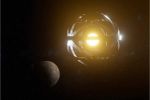
Dyson_Swarm_-_03.jpgThe Dyson Sphere69 visiteHow It Works: each satellite in the Swarm absorbs or reflects the star’s sunlight and beams it to where it is needed—such as to an inhabited planet or orbital space stations.
Uses: the captured energy could power an entire civilization, propel massive spaceships using photon sails, or run planetary-scale supercomputers and artificial intelligence networks.
Materials: constructing a comprehensive Swarm requires a staggering amount of raw materials. Theorists suggest that disassembling an entire rocky planet, like Mercury, could provide enough mass to build the initial stages of a Swarm.
Gradual Build: our Civilization wouldn't build a full Swarm all at once. We would likely start with a "proto-swarm" consisting of space-based solar arrays, expanding it over thousands of years.MareKromiumGiu 01, 2026
|
|

Dyson_Swarm_-_01.jpgThe Dyson Swarm77 visiteSome have suggested that Dyson Sphere habitats could be built around white dwarfs or pulsars.
In 2022 it was suggested that a Dyson Swarm around the Sun could be launched from either Mercury or Mars.
In order to transmit the energy back (Microwaves and high frequency IR Radiations maybe?), far-field radiative wireless power transfer was proposed, a technology that is not yet fully developed. But the question remains open...
A Dyson swarm is a hypothetical megastructure that orbits a star to capture its radiant energy. Proposed as an alternative to the solid, unbuildable "Dyson Sphere," it consists of a vast cloud of independent satellites or habitats that harness massive amounts of stellar power.
The Inspiration: Physicist Freeman Dyson first proposed the concept in 1960. He theorized that highly advanced alien civilizations would require exponentially more energy than a single planet could provide, prompting them to build structures around their host star.
Dyson Sphere vs. Dyson Swarm: Dyson Sphere vs. Dyson Swarm: While a traditional "Dyson sphere" is often imagined in sci-fi as a single, solid shell around a star, this is mechanically impossible due to immense gravitational stresses. A swarm solves this by using millions or billions of independent solar collectors, mirrors, and space habitats traveling in their own individual orbits. MareKromiumGiu 01, 2026
|
|
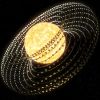
Dyson_Swarm_-_04.jpegThe Dyson Swarm77 visiteBecause these megastructures absorb so much starlight, they would emit a unique infrared signature (waste heat). Astronomers look for these anomalies when searching for highly advanced, Extraterrestrial Civilizations (so-called "Technosignatures").MareKromiumGiu 01, 2026
|
|

Dyson_Sphere_-_07.jpegThe Dyson Sphere86 visiteAlthough Dyson Spheres in the form of a swarm are theoretically possible, building a stable megastructure around the Sun is currently far beyond humanity's engineering capacity. The number of craft required to obtain, transmit, and maintain a complete Dyson sphere exceeds present-day industrial capabilities.
Dyson Spheres have prompted speculation into the feasibility of a class of proposed stellar engines, hypothetical megastructures whose purpose is to extract useful energy from a star, sometimes for specific purposes.
For example, Matrioshka brains have been proposed to use energy extracted by Dyson Spheres for computation, while Shkadov thrusters would extract energy for propulsion. Some proposed stellar engine designs are based on the Dyson Sphere. Futurist George Dvorsky has advocated the use of self-replicating robots to overcome the limitation of humanity's engineering capacity in the relatively near term.MareKromiumGiu 01, 2026
|
|

Dyson_Sphere_-_06.jpegThe Dyson Sphere75 visiteOn October 14, 2015, Planet Hunters' citizen scientists discovered unusual light fluctuations of the star KIC 8462852 raising press speculation that a Dyson sphere may have been discovered. However, subsequent analysis showed that the results were consistent with the presence of dust.
In 2024 there was press speculation that potential signs of interstellar Dyson spheres had been discovered.
The seven objects of interest – all located within a thousand light-years of Earth – were M-dwarfs, a class of stars that are smaller and less luminous than the Sun. However, the authors of the findings were careful not to make any overblown claims. Despite this, many media outlets picked up on the story.
Less fantastical explanations included a suggestion that the detected infrared was caused by distant dust-obscured galaxies.MareKromiumGiu 01, 2026
|
|

Dyson_Sphere_-_03.jpgThe Dyson Sphere (here: Complex and interconnected Dyson Swarm)69 visiteDyson-style energy collectors around a distant star would absorb and re-radiate energy from the star. The wavelengths of such re-radiated energy may be atypical for the star's spectral type, due to the presence of heavy elements not naturally occurring within the star.
If the percentage of such atypical wavelengths were to be significant, an alien megastructure could be detected at interstellar distances. This could indicate the presence of what has been called a Type II Kardashev civilization.
SETI has looked for such infrared-heavy spectra from solar analogs, as has Fermilab. Fermilab discovered 17 potential "ambiguous" candidates, of which four were in 2006 called "amusing but still questionable". Later searches also resulted in several candidates, all of which remain unconfirmed.MareKromiumGiu 01, 2026
|
|

Dyson_Sphere_-_02.jpgThe Dyson Sphere94 visiteSince Dyson's paper, many variant designs involving an artificial structure or series of structures to encompass a star have been proposed in exploratory engineering or described in science fiction, often under the name "Dyson sphere". Fictional depictions often describe a solid shell of matter enclosing a star – an arrangement Dyson himself considered impossible. The sphere he imagined consisted of a loose collection or swarm of objects traveling on independent orbits around the star, an arrangement that has become known as a Dyson Swarm.MareKromiumGiu 01, 2026
|
|

Dyson_Sphere_-_01.jpgThe Dyson Sphere (here: Dyson Revolving Rings)72 visiteDyson speculated that such structures would be the logical consequence of the escalating energy needs of a technological civilization and would be a necessity for its long-term survival. A signature of such spheres detected in astronomical searches would be an indicator of extraterrestrial intelligence.MareKromiumGiu 01, 2026
|
|
|
|