| |

|
|
|
|
|
|
|
|
|
|
|
|
|
|
|
|
| 33 album su 3 pagina(e) |
1 |
|
| Immagini a caso - THE LUNAR EXPLORER ARCHIVES |

as16-113-18303.JPGAS 16-113-18303 - From the window...64 visiteCaption NASA:"John (Young) aimed the camera down at the surface below his window".
MareKromium
|
|

as15-92-12509.JPGAS 15-92-12509 - The "cradle" of the TLP's: Vallis Schroteri (15)66 visiteImage Collection: 70mm Hasselblad
Mission: 15
Magazine: 92
Magazine Letter: OO
Latitude: 25° North
Longitude: 52.5° West
Lens Focal Length: 500 mm
Film Type: 3401
Film Width: 70 mm
Film Color: black & white
Feature(s): VALLIS SCHROTERIMareKromium
|
|

as12-53-7917.JPGAS 12-53-7917 - Just like "2001"!64 visitenessun commentoMareKromium
|
|
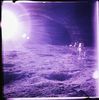
ORIGINAL NASA - APOLLO 12 - AS 12-46-6806.jpgAS 12-46-6806 - Running in the Sun (1)68 visite
|
|

as08-13-2246.jpgAS 08-13-2246 - Highly Cratered Region (3)68 visiteCoord.: approx. 15° South Lat. and 165° West Long.MareKromium
|
|
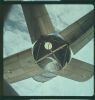
as07-03-1538.jpgAS 07-03-1538 - Training around the Earth63 visiteMareKromium
|
|
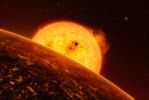
COROT7b-ESO.jpgExo-Planet CoRoT-7b64 visiteHow similar is exoplanet CoRoT-7b to Earth?
The newly discovered Extra-Solar Planet is the closest physical match yet, with a mass about five Earths and a radius of about 1,7 Earths. Also, the home star to CoRoT-7b, although 500 LY distant, is very similar to our Sun.
Unfortunately, the similarities likely end there, as CoRoT-7b orbits its home star well inside the orbit of Mercury, making its year last only 20 hours, and making its peak temperature much hotter than humans might find comfortable. CoRoT-7b was discovered in February by noting a predictable slight decrease in the brightness of its parent star.
Pictured above, an artist's depiction shows how CoRoT-7b might appear in front of its Parent Star. The composition of CoRoT-7b remains unknown, but given its size and mass, it cannot be a gas giant like Jupiter, and is very likely composed predominantly of rock. Future observations will likely narrow the composition of one of the first known rocky planets discovered outside of our Solar System.MareKromium
|
|

Minerals-2F224823069EFFASNUP1214R0M1.jpgMineral Diversity (by Marco Faccin)107 visiteQualcuno dice che "...i colori (di un Mondo), in fondo, sono irrilevanti...". Noi crediamo che questa asserzione sia completamente assurda...
Osservate Voi stessi!MareKromium
|
|
| Ultimi arrivi - THE LUNAR EXPLORER ARCHIVES |
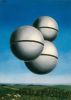
Voices.jpgBe careful, Man...285 visite"...This Society has no centers of power and possesses no type of organization in the terrestrial sense of the term, because, although individuals do exist in some physical, yet exotic, form, there is no such thing as "individual consciousness."
Each individual "participant" (it's an ugly expression, but it's the most appropriate in this context) of this Civilization exists only as a "part of a whole"; as a portion — necessary, but not indispensable — of a "greater body" to which he or she accedes and with which he or she merges and vanishes.
I do not know whether this type of psychological and social architecture is original or whether it — somehow — derived from a series of previous "organizational experiments."
I do not know whether it is a "choice" or a "necessity."
What I do know is that this Civilization has existed for at least twenty billion Earth years, and its "consciousness," if I may call it that, extends to the edges of this Universe.
Maybe even others."
Dr. Paolo C. FiengaMareKromiumApr 07, 2026
|
|
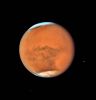
Mars-9~0.jpgMars, Deimos and Phobos177 visitenessun commentoMareKromiumFeb 04, 2024
|
|
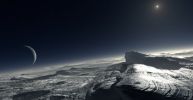
Charon_from_Pluto.jpgCharon from Pluto146 visitenessun commentoMareKromiumDic 17, 2023
|
|
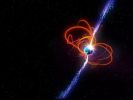
Beacon~1.jpgThe Beacon111 visite"Tout est bien, tout va bien, tout va le mieux qu'il soit possible".
(Voltaire - dal "Candide, ou l'optisme) MareKromiumDic 17, 2023
|
|
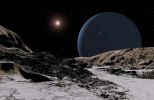
Ariel.jpgUranus from Ariel137 visitenessun commentoMareKromiumDic 17, 2023
|
|
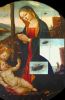
UFO_S__Giovanni.jpgA UFO "watches over" San Giovanni?215 visiteLa meccanica quantistica e' confusa e la coscienza e' confusa, quindi forse sono uguali.
Scott AaronsonMareKromiumDic 13, 2023
|
|

Comparisons.jpgComparisons254 visiteSun - Earth: the average diameter of the Sun is about 1,392,000 km, almost 109 times larger than the Earth (12,742 km). This means that we could put 109 Earths side by side to match the diameter of our star.
Stephenson 2-18 - Sun: the largest known star compared to the Sun. We are talking about a radius of 2,158 solar radii (solar radius equals 696,340 km). If we were to place it at the centre of our Solar System, its photosphere would engulf the orbit of Saturn, the lord of the rings.
Ton 618 - Stephenson 2-18: the largest known black hole compared to the largest star. Ton 618 has a diameter of 2606 astronomical units (1 astronomical unit is equivalent to the distance Earth - Sun or 150 million kilometres). To give a better idea, Saturn (used as a comparison before) is 10 astronomical units away from the Sun.
We are ants in the Universe!MareKromiumOtt 13, 2023
|
|
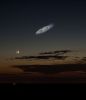
Andromeda.jpgIf our eyes were a CCD Camera... (Credits: Stephen Rahn - Tom Buckley-Houston)321 visiteThis is, of course, a photographic COMPOSITION, but the proportions are exact, and what we would see in the sky if the Andromeda Galaxy were bright enough, would be an object almost as wide as 7 full moons.
The Moon seen from Earth, in fact, occupies about half a degree in the sky. M31 on the other hand, over 2 million light years away, is over 3 degrees wide.MareKromiumOtt 08, 2023
|
|
|
|