| |

|
|
|
|
|
|
|
|
|
|
|
|
|
|
|
|
| 23 album su 2 pagina(e) |
2 |
|
| Immagini a caso - MOON |

ZZ-ZZ-ZZ-APOLLO 14 AS 14-13-3b.jpgA very old - but ORIGINAL - Apollo frame: LM and possible Surface Anomaly (1)144 visiteUn esempio visibile e tangibile delle - purtroppo - orribili condizioni in cui versano molti frames NASA-Apollo Originali: i difetti (graffi e quant'altro) che costellano l'immagine sono davvero tanti e, a nostro parere, sono quasi tutti segni di una conservazione inadeguata del frame originale. Il corpuscolo luminoso che vedete sulla Dx, a ridosso dell'orizzonte, è il LM; l'altro corpuscolo luminoso (ed apparentemente metallico) che invece si vede sulla Sx, a ridosso dell'orizzonte ma non esattamente sul filo dell'orizzonte, è - a nostro parere - una possibile Anomalìa di Superficie. Comunque non dovrebbe essere un photo-artifact.
Ora portate il frame sino al full-size e poi giudicate Voi stessi!...
|
|

APOLLO 16 AS 16 113-18304.jpgAS 16-113-18304 - Moon Panorama147 visiteCon questo frame si apre una serie di 5 immagini che mostrano un curioso fenomeno. Osservate, infatti, alla Sn della fotografia: si può già notare che una parte del panorama risulta "offuscata", come se ci fosse della polvere in sospensione oppure come se il cristallo del finestrino del LM si fosse, in qualche modo e per qualche motivo, appannato.
|
|

APOLLO 11 AS 11-40-5885 HR.jpgAS 11-40-5885 - The Flag and the shadows (HR)210 visiteUn'altra bella "postcard" che ritrae la Bandiera, parte dell'area di lavoro e, soprattutto, il buio dell'ombra proiettata dal LM, nel basso dell'immagine. Notate che il cielo, in tutti i frames "ritoccati", è sempre di un bel nero uniforme. Notate anche la Bandiera: a noi sembra distesa (abbastanza) bene. Come mai nei frames AS 11-37-5480 e seguenti il lato libero appare completamente ripiegato su se stesso? Questione di prospettiva o altro?
|
|

APOLLO 14 AS 14 66-9340.jpgAS 14-66-9340 - The basket is now empty...179 visiteVi rammento inoltre (ed infine) che qualche altro Ricercatore piuttosto "sfrontato" - e che non aveva evidentemente studiato il frame originale - aveva ipotizzato che nel cestello ci sarebbero anche potuti essere dei "reperti archeologici", quali monili, bracciali e collane.
Beh, l'ipotesi era più che affascinante e suggestiva, ma io la ritengo, a questo punto, del tutto superata ed accantonata.
Dato che ora sono in possesso dell'immagine originale la quale, anche se non risolve il mistero al 100%, comunque aiuta a restringere il campo delle ricerche ed a formulare ipotesi che, onestamente, mi sembrano plausibili.
|
|

APOLLO 14 AS 14 66-9289.jpgAS 14-66-9289 - Moon Panorama183 visiteApollo 14 - tanto per cambiare... - fu definita una Routinary Mission. Ed era ovvio: se già l'Apollo 12 lo era stata, figuriamoci l'Apollo 14...
|
|

APOLLO 14 AS 14 66-9269.jpgAS 14-66-9269 - The minus-Y footpad (dust free, of course...)148 visiteClose-up of the minus-Y (south) footpad, showing the left-to-right LM motion ("sliding") at touchdown and right after it.
|
|

APOLLO 11 AS 11-40-5935.jpgAS 11-40-5935 - Up-Sun (1)189 visite...ed è pur vero che il lavoro di ricerca è fatto (anche) di grandi entusiasmi e di grandi errori; di presunte scoperte e di cocentissime delusioni.
Di grandi intuizioni e di colossali stupidaggini.
Ma noi questo lo sappiamo e lo sapete anche Voi.
Il punto focale di tutto non è (solo) nel possesso di conoscenze di base più o meno grandi.
Il punto focale è l'Educazione alla Ricerca unita alla Volontà del Ricercatore ed alla sua Onestà Intellettuale.
Se tutte queste componenti ci sono, allora la...
|
|

APOLLO 17 AS 17-3125.jpgAS 17-3125 - Rimless crater63 visiteThe very young rimless crater near the center of this picture is located near the area where Oceanus Procellarum and Mare Imbrium join. The crater apparently formed in regolith-covered mare basalt. It differs from lunar impact craters of comparable size and age by its lack of a raised rim, surrounding ejecta deposit, or associated secondary impact craters. In addition, its interior walls do not show the steep slopes with craggy outcrops of rock in their upper parts, nor the streams of debris-avalanche deposits and talus that are usually seen in the walls of impact craters of comparable age and size.
Judging from the clear and sharply formed pattern of concentrically curved grooves and scarps that surround the hole, the material near this depression has apparently subsided into a subsurface void. Because of the extreme rarity and inferred short lifetime of steep slopes on the Moon, the latest subsidence must have taken place very recently, after most of the 50- to 300- m diameter craters that densely pepper the nearby mare surface were formed. Movement of the regolithic debris layer during subsidence apparently smoothed out most, if not all, of the craters that must have existed near the depression. Now the depression is surrounded by low, curved fault scarps and narrow, curved grooves that may be fault troughs (grabens) or may represent drainage of regolithic debris into cracks that opened in the underlying sagging basalt rock. The few craters that have formed on the subsided surface compare in density to the craters formed on the cluster (arrow) of Aristarchus secondary impact craters and associated herring- bone ridges; comparable ages for the Aristarchus secondary features and the depression are thus indicated. The subsidence was triggered either by the ground shock or seismic wavetrain generated when Aristarchus was formed 300 km to the west, or by the impacts of the secondary features.
The subdued depression in the upper left may be a similar older feature that was flooded by a later lava flow that now covers the area. The density of craters within the depression and the density on the surrounding lava are comparable. Alternatively, the subsidence there may have been incomplete; however, there is no sign that this subsidence is as young as that in the deeper crater
|
|
| Ultimi arrivi - MOON |
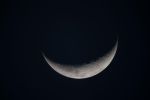
0022-Crescent_Moon.jpgCrescent Moon77 visiteart002e019570 (April 7, 2026) – On flight day seven, following their Lunar Fly-By, the Artemis II crew captured this view of a delicate crescent Moon on their journey back to Earth.
Along the Terminator, where low-angle Sunlight casts long shadows that accentuate craters, ridges, and subtle variations in terrain.
The softly illuminated surface highlights the Moon’s rugged landscape, while much of it remains in shadow.MareKromiumMag 07, 2026
|
|
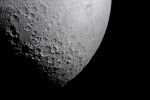
0021-The_Orientale_Basin.jpg79 visiteart002e020686 (April 6, 2026) – A portion of the Moon’s Far Side (a.k.a. "Dark Side") is seen along the Terminator, where low-angle Sunlight casts long shadows across the surface.
A section of the Orientale Basin is visible along the upper right portion of the lunar disk, its structure subtly revealed under grazing illumination. This lighting enhances contrast across the cratered terrain, highlighting variations in Surface Features and providing insight into the Moon’s Geologic History.MareKromiumMag 07, 2026
|
|
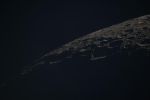
0020-Lunar_Limb.jpgThe Lunar Limb and the Terminator Line77 visiteart002e014045 (April 6, 2026) - This view of the Moon captures the Terminator — the shifting boundary between day and night — where sunlight grazes the surface at a low angle.
Taken by the crew during the Artemis II Mission, the lighting accentuates the Moon’s rugged terrain, casting long shadows that reveal the depth and structure of craters, ridges, and surrounding highlands.MareKromiumMag 07, 2026
|
|
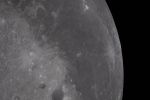
0019-Aristarcus_and_more.jpgA hint of Lunar Geography76 visiteart002e012114 (April 6, 2026) - A diverse set of Lunar Surface Features is visible in this view, including the brightly colored Aristarchus Crater, whose high reflectivity stands out against the surrounding terrain.
Nearby, the Marius Hills Region reveals a field of volcanic domes and cones, evidence of past lunar volcanism.
The sinuous Reiner Gamma swirl contrasts with the darker mare surface, while rays from Glushko crater streak across the plains.
At the bottom of the frame, the dark-floored Grimaldi Crater anchors the scene.MareKromiumMag 07, 2026
|
|
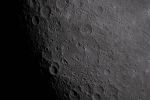
0018-Hertzprung_Basin_Rim.jpgVavilov Crater Along the Hertzsprung Basin Rim85 visiteart002e012093 (April 6, 2026) - Hertzsprung Basin comes into view with its distinctive two concentric rings of mountains, revealing the scale of this ancient impact structure.
Near the lower left, Vavilov crater — identified by its Central Peak — stands out, a feature often described by the Artemis II crew during their Lunar Fly-by.MareKromiumMag 07, 2026
|
|
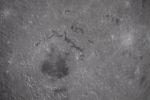
0017-The_Orientale_Basin.jpgThe Orientale Basin92 visiteart002e012090 (April 6, 2026) - In this view of the Moon, the Artemis II crew captured an intricate snapshot of the rings of the Orientale Basin, one of the Moon’s youngest and best-preserved large Impact Craters on his first shift during the Lunar Fly-By observation period.MareKromiumMag 07, 2026
|
|
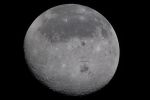
0016-The_Orientale_Basin.jpegThe Orientale Basin85 visiteThe Artemis II crew became the first humans to see the Moon's Orientale Basin, a nearly 600-mile-wide Impact Crater, visible in the bottom half of this image.MareKromiumMag 07, 2026
|
|
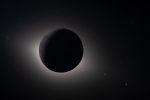
0015-In_the_Night.jpegIn the Night83 visiteFrom the crew’s perspective, the Moon appeared large enough to completely block the Sun, creating nearly 54 minutes of eclipse totality. The corona forms a glowing halo around the dark lunar disk, revealing details of the Sun’s outer atmosphere typically hidden by its brightness. The faint glow of the nearside of the Moon is visible in this image, having been illuminated by light reflected off the Earth.
Moments to honor the past infused the entire day of the lunar flyby, the sixth of the mission. Upon waking, the crew heard a message from Jim Lovell, the astronaut who piloted Apollo 8 and commanded Apollo 13, and who recorded the missive for Artemis II before his death in August 2025. “Welcome to my old neighborhood!” Lovell said. “When Frank Borman, Bill Anders, and I orbited the moon on Apollo 8, we got humanity’s first up-close look at the moon and got a view of the home planet that inspired and united people around the world. I’m proud to pass that torch on to you.”
And in a particularly heartfelt moment, shortly after the crew reached the farthest point ever traveled in space, Canadian Astronaut Jeremy Hansen communicated the crew’s desire to name a crater close to the moon’s nearside-farside boundary after Commander Reid Wiseman’s late wife, Carroll Wiseman who died from cancer in 2020. “It’s a bright spot on the moon,” Hansen said. “We would like to call it Carroll.” And then the crew embraced.MareKromiumMag 07, 2026
|
|
|
|