|
|
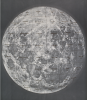
0000-The_Moon.pngThe Moon (Earth-facing Side)114 visiteMareKromium
|
|

0001-Artemis_One-52503823645_68f1fc0f28_o.jpgLift-off: back to the Moon?!?117 visiteThe most powerful rocket in the World, carrying the Orion Spacecraft, goes on the Artemis I flight test, Wednesday, Nov. 16, 2022, from Launch Complex 39B at NASA’s Kennedy Space Center in Florida at 1:47 a.m. EST.MareKromium
|
|

0002-Artemis_One.jpgThe Artemis Mission161 visiteFrame auto-esplicativo.MareKromium
|
|

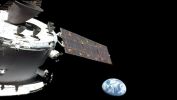
0003-Artemis_One.jpgLook! The Moon, again...119 visiteOn Nov. 20, 2022, such as the fifth day of the 25,5-day Artemis I mission, a camera mounted on the tip of one of Orion’s solar array wings captured this footage of the Spacecraft and the Moon as it continued to grow nearer to our neighbor. The Spacecraft entered the lunar sphere of influence at 2:09 p.m. EST, making the Moon, instead of Earth, the main gravitational force acting on it. Orion completed its first fly-by on the morning of Nov. 21, 2022.MareKromium
|
|
0005-Artemis_One.jpgLook at Us!104 visitenessun commentoMareKromium
|
|

0006-Artemis_One-photo1669025926.jpegHello Moon!104 visitenessun commentoMareKromium
|
|

0008-Artemis_One-photo1669033801.jpegWhat a "Couple"!121 visitenessun commentoMareKromium
|
|

0009-Artemis_One-Far_Side_of_the_Moon.jpgThe bright and yet dark side of the Moon...102 visiteNASA officials say Artemis 1 mission teams are "giddy" after witnessing how well their Orion spacecraft has been performing so far on its way towards Lunar Orbit.
Artemis 1 launched at 01:47 EST (06:47 GMT) on Nov. 16, blasting off from Kennedy Space Center in Florida in a spectacular display of the sheer power of NASA's Space Launch System (SLS) rocket. The Orion spacecraft reached Earth orbit shortly after, and then at 87 minutes after launch performed a so-called Trans Lunar Injection burn to send it hurtling towards the moon. On Monday (Nov. 21), Orion performed another burn to send the Spacecraft close enough to the Lunar Surface to leverage (---> use, take advantage of) the Moon's Gravity to pull the Spacecraft around the Moon itself into a distant retrograde orbit.
After collecting data from that propulsive maneuver, NASA Officials held a briefing Monday evening (Nov. 21) to discuss Orion's powered flyby of the Moon. Judd Frieling, flight director at NASA's Johnson Space Center, said Orion Mission Team Members are "giddy" (to have a sensation of whirling and then a tendency to fall; synonym: dizzy) with the current performance they are seeing from the spacecraft after the flyby, which saw the Spacecraft come within about 80 miles of the Lunar Surface.MareKromium
|
|
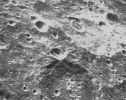
0010-Artemis_One-Surface.jpgIs this a "beautiful" picture?!?97 visiteCaption Originale:"These detailed (where?!?) black and white image was snapped by the Orion Spacecraft's onboard Optical Navigation Camera on day 6 of the Mission, the same day it performed a crucial engine burn".
Nota: foto orribile, sovraesposta e di qualità scadente. Le fotocamere Apollo erano 1000 anni più avanti.MareKromium
|
|

0011-nasa-artemis-orion-flyby-2_gif.gifOrion's Second Lunar Fly-By (GIF-Movie)153 visitenessun commentoMareKromium
|
|
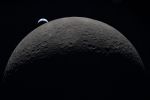
0012-The_Dark_Side-Artemis_2.jpegThe Moon (Dark Side with crescent Earth)140 visiteMareKromium
|
|
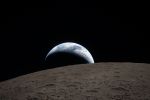
0014-Earthset.jpegEarthset and Ohm Crater122 visiteEarthset captured through the Orion Spacecraft window during the Artemis II crew’s flyby of the Moon.
The dark portion of the Earth is experiencing nighttime. On Earth’s day side, swirling clouds are visible over Australia and Oceania.
In the foreground, Ohm Crater on the Moon has terraced edges and a flat Floor interrupted by Central Peaks.
Artemis II’s historic lunar flyby on Monday was one of new milestones and spaceflight records, but it was also deeply resonant with the past. After flying farther beyond the Earth than any human has ever been before—beating the record set in 1970 during Apollo 13 by about 4,102 miles—and seeing parts of the moon no humans had ever witnessed, the crew recreated “Earthrise,” one of the most famous photographs of all time, with a small twist.
Instead of Earthrise, the Artemis II photo is of Earthset, capturing the surface of the moon and the crescent-lit Earth setting beyond it in the same frame.
In 1968, a year of global political unrest, the crew of Apollo 8 was on a similar flight around the moon, on a test of a spacecraft that would be used for future lunar landings. In an unplanned moment, crew member William “Bill” Anders snapped a photo of the Earth and the moon in the same frame. The photo, called “Earthrise,” would become iconic—inspiring the global environmental movement in the years before the establishment of Earth Day in 1970.MareKromium
|
|
| 20 immagini su 2 pagina(e) |
1 |
|





