| |
| Categoria |
Album |
Immagini |
|
33 |
3219 |
|
|
|
|
|
|
|
|
|
|
|
|
|
|
|
|
| 33 album su 3 pagina(e) |
1 |
|

|
|
23 |
2193 |
|
|
|
|
|
|
|
|
|
|
|
|
|
|
|
|
| 23 album su 2 pagina(e) |
1 |
|
|
|
24 |
13503 |
|
|
|
|
|
|
|
|
|
|
|
|
|
|
|
|
| 24 album su 2 pagina(e) |
1 |
|
|
|
20 |
4515 |
|
|
|
|
|
|
|
|
|
|
|
|
|
|
|
|
| 20 album su 2 pagina(e) |
1 |
|
|
| DEEP SKYImages From Beyond, Words From Within |
|
4 |
1874 |
|
| 25305 file in 104 album e 5 categorie con 25211 commenti, visti 2814252 volte |
| Immagini a caso |

Channels-Unnamed_Channel_in_Stygis_Catena-PIA07133-00.jpgAncient Riverbed in Stygis Catena (Original NASA/MGS/MSSS b/w Frame)58 visiteCaption NASA originale:"This MGS-MOC image shows a Trough (trough---> canale) in the Stygis Catena Region, East of the Martian Volcano Elysium Mons. The Trough probably formed by collapse (collapse--->geol. "cedimento" del terreno). Large, dark Boulders can be seen on the Trough Floor in this Volcanic Region. The image is located near 24,4° North Lat. and 210,4° West Long. The image covers an area about 3 km (approx. 1,9 mi) wide and sunlight illuminates the scene from the lower left".
|
|

Saturn_s Rings-PIA06239.jpgS/2005 S1: The "Wave-Maker" (2)54 visiteCaption NASA originale:"In the vicinity of the newly discovered little moon, the Keeler Gap's edges bear striking similarities to the scalloped edges of the 322 Km-wide (approx. 200-mile) Encke Gap, where the small moon Pan (25 Km, or approx. 16 miles across) resides.
From the size of the waves seen in the scalloped edges of the Encke Gap, imaging scientists were able to estimate the mass of Pan.
They expect to do the same, eventually, with S/2005 S1".
|
|

Craters-Richardson_Crater-20090806a.jpgRichardson Crater (Visible Light and Natural Colors; credits: Lunexit)71 visiteCaption NASA:"This VIS image of Richardson Crater was collected at the same time as yesterday's IR image. While the dunes appeared uniform in temperature in the IR, they are varied in appearance in the visible wavelengths. The sand is darker than the surrounding and covering dust".
Coord.: 72,2° South Lat. and 178,5° East Long.MareKromium
|
|
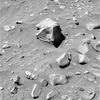
SOL672-2P186025811EFFAJQVP2260L5M1.jpgUnusual-looking stone - Sol 67264 visitenessun commento
|
|
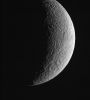
Tethys-PIA06633.jpgTethys (ultraviolet vision) from 200.000 Km54 visiteCaption NASA originale:"This view of Saturn's moon Tethys shows the contrast between the more heavily cratered region near the top and the more lightly cratered (and presumably younger) plains toward the bottom part of the image and near the limb. Some of the larger craters in the latter region appear to be somewhat subdued or filled in. This view shows principally the anti-Saturn hemisphere on Tethys; North is up and tilted 20° to the left.
The image was taken with the Cassini spacecraft narrow-angle camera on March 9, 2005, through a filter sensitive to wavelengths of ultraviolet light centered at 338 nnmts. The view was obtained at a distance of approximately 200.000 Km from Tethys and at a phase angle of 120°. Resolution in the image is 1 Km (approx. 0,6 mile) per pixel".
|
|

OPP-SOL189-1N144962557EFF3457P1966L0M1.jpgDeep inside Endurance Crater: the Dunes in b/w76 visitenessun commento
|
|

APOLLO 15 AS 15-85-11373.jpgAS 15-85-11373 - The Hadley-Apennine, in the distance (10)234 visite...pianeta inospitale quale è la Luna) sono disponibili solo in fotografie scattate dall'alto e cioè durante le orbite. Ne vedremo una, in particolare sempre relativa alla Missione Apollo 15, che lascia davvero sbalorditi. In realtà, se la visione dalla Lune di queste alture che sono poco più di "collinette" è già suggestiva, provate ad immaginare che cosa potrebbe voler dire trovarsi alle pendici di una montagna scoscesa ed imponente, magari di gran lunga più alta del nostro "Tetto del Mondo":l'Everest...
|
|

Eos_Chaos-PIA14046.jpgFeatures of Eos Chaos (Absolute Natural Colors; credits for the additional process. and color.: Dr Paolo C. Fienga - Lunexit Team)56 visitenessun commentoMareKromium
|
|
| Ultimi arrivi |

Mars-9~0.jpgMars, Deimos and Phobos126 visitenessun commentoMareKromiumFeb 04, 2024
|
|
Voyagers-InterstellarSpace9-jpg.jpgVoyager 1 is still alive!105 visitenessun commentoMareKromiumFeb 04, 2024
|
|

Voyagers-InterstellarSpace8d.jpgThe Infinite and Beyond122 visitenessun commentoMareKromiumFeb 04, 2024
|
|

SOL0099-Mars_Perseverance_ZR2_0099_0675742510_553ECM_N0040218ZCAM01000_026080J.jpgSol 99 - Martian Sunny Afternoon97 visiteNASA's Mars Perseverance Rover acquired this image using its Right (Dx) MastCam-Z camera. MastCam-Z is a pair of cameras located high on the Rover's Mast.
This image was acquired on May 31, 2021 (Sol 99) at the Local Mean Solar Time of 16:08:16.MareKromiumGen 02, 2024
|
|

SOL0099-Mars_Perseverance_ZL0_0099_0675742205_223ECM_N0040218ZCAM08060_079085J.jpgSol 99 - Broken...106 visiteNASA's Mars Perseverance rover acquired this image using its Left (Sx) MastCam-Z camera. MastCam-Z is a pair of cameras located high on the Rover's Mast.
This image was acquired on May 31, 2021 (Sol 99) at the Local Mean Solar Time of 16:03:28.MareKromiumGen 02, 2024
|
|

Enceladus-PIA20522enceladusC.jpgCrescent Enceladus (Credits: NASA/JPL/Cassini Imaging Team)113 visitePeering from the shadows, the Saturn-facing hemisphere of tantalizing inner moon Enceladus poses in this Cassini spacecraft image. North is up in the dramatic scene captured during November 2016 as Cassini's camera was pointed in a nearly sunward direction about 130,000 kilometers from the moon's bright crescent. In fact, the distant world reflects over 90 percent of the sunlight it receives, giving its surface about the same reflectivity as fresh snow. A mere 500 kilometers in diameter, Enceladus is a surprisingly active moon. Data and images collected during Cassini's flybys have revealed water vapor and ice grains spewing from south polar geysers and evidence of an ocean of liquid water hidden beneath the moon's icy crust.MareKromiumDic 31, 2023
|
|

Moonlight.jpgDistortions... (Image Credit & Copyright: Giacomo Venturin)126 visite"...L'usanza comune a molti letterati di disprezzare il mondo moderno e' una maniera dissimulata di presumersi degni di un altro migliore..."
Aristide GabelliMareKromiumDic 31, 2023
|
|

SOL0805-WB-Mars_Perseverance_ZR0_0805_0738401772_785EBY_N0391170ZCAM08826_0340LMJ.jpgSol 805 - Dusty Landscape (White-Balanced Colors - Credits for the additional process and color.: Dr Paolo C. Fienga/LXTT/JPL))162 visitenessun commentoMareKromiumDic 31, 2023
|
|
|
|