| Piú votate - The Moon After Apollo 17 |
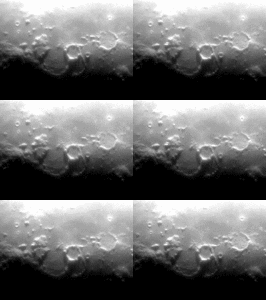
Fra Mauro-GIF.gifFra Mauro...on line!117 visitenessun commento
(6 voti)
|
|

Clavius-6.jpgClavius (3)122 visitenessun commento
(6 voti)
|
|

ZZ-ZZ-Towers on the Moon-5.jpgThe "Towers" of the Moon: Alien artifacts, Myth or Bogus? (4)282 visiteNon siete ancora del tutto convinti? Guardate il frame con una risoluzione di 1 px=2 Km, Lun. Lat. 68 Lun. Long. 240, filtro da 425 nnmts e sensor UVVIS e...sbalordite!!!
C'è una PEZZA COLOSSALE sull'immagine!
(6 voti)
|
|
![The Moon from CLEM-clm_usgs_18[1].jpg](albums/userpics/10008/small_The%20Moon%20from%20CLEM-clm_usgs_18%5B1%5D.jpg "Nome del file=The Moon from CLEM-clm_usgs_18[1].jpg
Dimensione del file=346KiB
Dimensioni=1204x871
Aggiunta il=Gen 28, 2005")
The Moon from CLEM-clm_usgs_18[1].jpgSchrödinger Impact Basin from Clementine152 visiteCaption NASA originale:"Clementine mosaic of the Schrödinger impact basin near the south pole of the Moon. The basin is 312 Km in diameter and centered at 67° S, 132° E.
Note the smooth floor and the large inner ring.
The dark area around the small crater just left of the center of the basin was probably caused by relatively recent volcanic ejecta. The South Pole is just off the upper left corner of the image (Clementine, USGS slide 18)".
(6 voti)
|
|

ZZ-ZZ-U-September-2013.jpgAnother "Meteor Strike"?188 visiteAny type of clustering in sightings would be significant because one would expect a rather random distribution across the surface of the moon. This has not been the case. During Moon-Blink, NASA discovered that almost a third of the known sightings at the time came from the Aristarchus crater. The first known sighting was on February 4th, 1821, by Captain Kater and several more were seen for the next 100 years. Many described the event as resembling a star appearing momentarily in the crater or a wall being illuminated (Armagh, Hanks).
The first notable modern observation of the event took place on October 13, 1959, when E.H. Rowe looked at the crater through his 36-inch telescope. He also saw the white flash, but unlike others, he also spotted a reddish glow that was at the perimeter of the white flash. It lasted a few seconds, then only the normal glow remained. Just over 4 years later, on October 29, 1963, James A, Greenacre and Edward Barr (both at Lowell Observatory) examined the crater. They too saw red, orange, and pink colors but did not secure any pictures. However, Greenacre was established as a well-respected lunar expert, so the findings had some weight to them. And a few days later, on November 1 and 2, 1963 Zdenek Kopal and Thomas Rackham see similar luminescence on the moon and were able to photograph them. These findings were published in Scientific American that year, and more and more sightings of the event were being recorded by others. Astronauts even got a first-hand view of this. During Apollo 11, NASA was told that a TLP was happening at that moment in the crater. They asked the Apollo 11 crew to look at the crater from their vantage point and found that indeed the general area seemed to glow (Seargent 14, Hanks).
The usual theories came into play with the crater to explain its glowing aspects, and it should be noted that Aristarchus has some interesting properties in and of itself that make the seemingly anomalous clustering make more sense. For starts, its albedo (reflectivity) is much higher than its surroundings. Also, it has a central peak in its center that is rather high, catching lots of sunlight and adding to the contrast of its surroundings. And it’s in a prime viewing spot, being easy to spot and also visually interesting to look at. All of these make it a prime location for seeing TLPs.
Hanks, Micah. “The Aristarchus Anomaly: A Beacon on the Moon?” mysteriousuniverse.org. 8th Kind Pty Ltd, 28 Nov. 2013. Web. 25 Sept. 2018MareKromium
(5 voti)
|
|

The_Moon_-_Rupes_Recta-1.jpgRupes Recta320 visiteMareKromium
(5 voti)
|
|

The_Moon_-_Rupes_Recta-2.jpgRupes Recta223 visiteMareKromium
(5 voti)
|
|

The_Moon_-_Rupes_Recta-3.jpgRupes Recta226 visiteMareKromium
(5 voti)
|
|

First Moon.jpgFirst Moon72 visitenessun commento
(5 voti)
|
|

B-ZhiritskiyCrater.jpgZhiritskiy Crater (3D)110 visitenessun commento
(5 voti)
|
|

ZZ-ZZ-ZZ-ZZ-ZZ-ZZ-ZZ-The Moon.jpgThe North Pole of the Moon82 visiteCaption NASA originale:"This arresting image of the third quarter Moon in the excellent skies above the Pine Crest Farm Observatory, Dell Prairie, Wisconsin, was recorded with a 24" telescope and digital camera on October 19, 2000. Marvelously detailed, especially along the terminator or shadow line between lunar night and day, this cropped version of the full mosaicked image shows the cratered North Polar Region and the broad smooth Mare Imbrium. Notable at the northern edge of the Mare Imbrium (Sea of Rains) is the 95 Km wide dark crater Plato, while the dramatic straight "cut" to the right of Plato, (toward the terminator) is the Vallis Alpes (Alpine Valley). The long, graceful arc of the lunar Montes Apenninus in the lower portion of the image sweeps Southward along the boundary of the mare toward the left and ends near the bright ray crater Copernicus at the picture's edge. In 1971, Apollo 15 landed near the gap beyond the opposite (northern) end of the Montes Apenninus arc".
(5 voti)
|
|

ZZ-ZZ-ZZ-ZZ-ZZ-ZZ-ZZ-ZZ-The Moon-1.jpgThe Moon from Galileo96 visiteCaption NASA originale:"The Moon's surface is covered with craters, scars of frequent impacts during the early history of the Solar System. Now, recent results from the Lunar Prospector spacecraft support the idea that the Moon itself formed from the debris of a giant impact of a Mars-sized planetary body with the Earth nearly 4,5 BY ago. The impact theory of lunar origin can explain why Moon rocks returned by the Apollo missions have the same isotopic ratios as Earth rocks while the Moon seems deficient in heavy elements like iron. It can also explain a critical finding of the Lunar Prospector experiments - that the Moon's core is proportionally very small. If the Moon formed simply as a Sister World, its origin paralleling Earth's formation from the primordial Solar Nebula, it should have similar iron content and relative core size. But material blasted from the surface of Earth by an impacting body would lack the iron and heavy elements which had settled to the Earth's core yet retain similar ratios of chemical isotopes. A fraction of this debris cloud would remain in Earth orbit ultimately forming the Moon".
(5 voti)
|
|
| 165 immagini su 14 pagina(e) |
 |
|
|
|
|
8 | |
|
|
|
|








