| Piú votate - The Moon After Apollo 17 |

South Pole - 01.jpgUnusual features and shadows near the South Pole (2)98 visitenessun commento
(6 voti)
|
|

South Pole - 00.jpgUnusual features and shadows near the South Pole (1)91 visitenessun commento
(6 voti)
|
|

Triesnecker-02.jpgTriesnecker (3) - detail mgnf89 visitenessun commento
(6 voti)
|
|
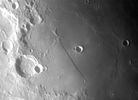
E-RupesRecta.jpgRupes Recta133 visitenessun commento
(6 voti)
|
|

E-Ptolemaeus Crater.jpgPtolemaeus Crater99 visitenessun commento
(6 voti)
|
|

C-La Condamine Crater 06.jpgRays of light through "La Condamine Crater" (5)124 visiteCharles-Marie La Condamine studied at the Jesuit College of Louis-le-Grand in Paris. There he was taught mathematics by Père Louis Castel. On leaving the College he decided to take up a military career and, when war broke out with Spain he joined the army. He distinguished himself with his bravery at the siege of Rosas in 1719 but decided that army life did not suit him.
At this point La Condamine made contact with scientists in Paris and became a member of the Académie Royale des Sciences in 1730. The quiet life in Paris did not suit him either and he sailed on a voyage to Algiers, Alexandria, Palestine, Cyprus and Constantinople (now Istanbul) where he spent five months. On his return to Paris he published mathematical and physical observations of his voyage.
The Académie Royale was impressed and sent him on an expedition to Peru. In April 1735 La Condamine set out on the expedition to Peru to measure the length of a degree of meridian at the equator. Bouguer was a member of the same expedition and its third scientific member was the leader of the expedition Louis Godin. The three finished their journey by different routes, La Condamine going overland from Manta, the other two sailing to Quito where they joined up.
The three were soon involved in disagreements. Godin began to work on his own while La Condamine worked with Bouguer. In 1741 Bouguer discovered a small error in their joint measurements and these two fell out when Bouguer refused to allow La Condamine to recheck the results. All three made independent measurements, the work being completed in 1743. The three returned by different routes.
In 1743 La Condamine began his return journey which included a four month raft journey down the Amazon river. His was the first scientific account of the Amazon which he published as Journal du voyage fait par ordre du roi a l'équateur (1751).
La Condamine spent five months in Cayenne on his journey home and here he repeated Richer's experiments on the variation of weights at different latitudes.
By February 1745 La Condamine was back in Paris after his ten year journey. He returned with many notes, 200 natural history specimens and works of art which he gave to Buffon. Y Laissus writing in the Dictionary of Scientific Biography says:-
The last survivor of the expedition, La Condamine, who was a less gifted astronomer than Godin and a less reliable mathematician than Bouguer often received the major part of the credit, probably because of his amiable nature and his talent as a writer.
La Condamine was a close friend of Maupertuis for many years. He spent much effort in the last part of his life campaigning for inoculation against small-pox. His passion on this topic was partly due to the fact that he had suffered from small-pox as a child.
(6 voti)
|
|

C-La Condamine Crater 04.jpgRays of light through "La Condamine Crater" (4)116 visitenessun commento
(6 voti)
|
|

C-La Condamine Crater 01.jpgRays of light through "La Condamine Crater" (2)150 visitePer Vostra opportuna informazione, infatti, noi riteniamo la Famiglia dei TLP come (essenzialmente, almeno) formata da quattro macro-classi:
1) flash (che possono avere vario colore e diverse provenienze);
2) star-like shining (che possono avere vario colore e varie durate);
3) annebbiamenti (in tali casi i rilievi lunari coinvolti restano comunque visibili);
4) oscuramenti (ed in tal caso i rilievi lunari coinvolti "spariscono", dal punto di vista dell'Osservatore, per qualche momento).
(6 voti)
|
|
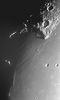
C-La Condamine Crater 00.jpgRays of light through "La Condamine Crater" (1)139 visiteNel novero dei cosiddetti TLP (ovvero Transient Lunar Phoenomena) ci sono anche - secondo alcune Scuole di Pensiero - i cosiddetti "Raggi di Luce" i quali, in situazioni di Sole radente (ovviamente con riferimento ai luoghi Lunari coinvolti ed a prescindersi dalla posizione dell'Osservatore Terrestre), si "intrufolano" - se ci passate questa espressione - attraverso i cracks delle murate (rims) di alcuni crateri e, nel farlo, disegnano inusuali - e temporanee, appunto - strisce di luce sul fondo dei crateri stessi.
Quello che Vi proponiamo in questa sequenza è (sembra essere) proprio uno di questi casi.
Per onestà intellettuale, però, pur proponendoVi questa sequenza e pur rispettando profondamente il lavoro dell'Astronomo Robert Spellman, noi riteniamo che questo tipo di fenomenologia, sebbene curiosamente interessante e suggestiva nelle visioni telescopiche della Luna, NON HA nulla a che spartire con la Famiglia Classica dei TLP.
(6 voti)
|
|

D-MoretusCrater-00.jpgMoretus Crater118 visitenessun commento
(6 voti)
|
|

I-Tycho-01.gifTycho...on line!137 visitenessun commento
(6 voti)
|
|

Hesiodus-00.jpgHesiodus & C.126 visitenessun commento
(6 voti)
|
|
| 165 immagini su 14 pagina(e) |
 |
|
|
|
|
7 | |
|
|
|
|








