| Piú votate - The Moon After Apollo 17 |

ZZ-ZZ-U-March-2013-lunar-impact-as-seen-from-Earth_NASAS-Scientific-Viz-Studio.jpgImpact or Volcanic Residual Activity?204 visiteFor a while now, astronomers with their telescopes pointed at the Moon have noticed short flashes of light, multiple times a week on the Moon's surface. The flashes seemed to begin, light up a part of the moon's landscape and die off in a matter of seconds. Other times, it's the exact opposite: the surface grows darker in a small region than the rest of the Moon very briefly.
Oddly, this phenomena has been observed on-and-off by astronomers for over 60 years, but without an explanation for it. A team of researchers from the Julius-Maximilians-Universitat Wurzburg (JMU) in Bavaria, Germany decided they've had enough of the mystery — they're decoding the strange, regular flashes with the hope of finding what's causing the "transient lunar phenomena".
The team has built a special telescope for the task that uses artificial intelligence (AI) to autonomously watch for and pick up on the light flashes.
The telescope collects video and photographs whenever it picks up on a flash of light, which will then be studied by scientists to decode the underlying cause. The team is planning to upgrade it soon with a neural network that can also filter out false positives, like birds and airplanes, from actual flashes from the lunar surface. For now, researchers do have some ideas about what could be causing them.
One of the causes could be the Moon's seismic activity, Hakan Kayal, professor of space technology at JMU, told Metro. "When the surface moves, gases that reflect sunlight could escape from the interior of the moon. This would explain the luminous phenomena, some of which last for hours".
However, the brief flashes that only last minutes or seconds are less understood. The leading theory for these shorter flashes is meteorite impacts. "Such flashes could also occur when electrically charged particles of the solar wind react with moon dust".MareKromium
(6 voti)
|
|

ZZ-ZZ-U-Lunar_impact_Gif_pillars.gifImpact on the Moon?165 visiteSince March 2017, the NELIOTA project has been monitoring the dark side of the Moon for flashes of light caused by tiny pieces of rock striking the Moon's surface.
This sequence of 12 consecutive frames shows a bright flash detected on 4 frames during observations on 1 March 2017. The red arrows point to the location of the impact flash, near the edge of the frame.MareKromium
(6 voti)
|
|

The_Moon_-_Rupes_Recta-0.jpgRupes Recta408 visiteRupes Recta is a Linear Fault, or Rille, located on the Moon, in the South-Eastern part of the Mare Nubium, at about 22,1° South Latitude and 7,8° West Longitude.
The name is Latin for "Straight Fault", although this feature is more commonly known as "The Straight Wall". This is the most well-known Escarpment existing on the Moon, and it is also a VERY popular target for amateur astronomers. When the Sun illuminates the feature at an oblique angle, around Day 8 of the Moon's orbit, the Rupes Recta casts a wide shadow that gives it the appearance of a Steep Cliff.
This Fault has a length of approx. 110 Km, a typical width of 2–3 Km and a height of approx. 240–300 mt. Even though the Rupes Recta appears to be a Vertical Cliff on the Lunar Surface, the actual grade of the slope is relatively shallow (low).
To the West of the Rupes, lays the Crater Birt, which is about 10,5 miles in diameter. Also to the West is the Rima Birt Rille. At the Southern End of the Fault, there is a group of Hills often called the "Stag's-Horn Mountains", although this name is not officially recognized by the IAU. To the North-East of the Rupes, the Crater Alpetragius can be found, while to the East lays the Crater Thebit.MareKromium
(6 voti)
|
|

Mare_Imbrium.jpgMare Imbrium77 visiteCaption NASA:"Dark, smooth Regions that cover the Moon's familiar face are called by Latin names for oceans and seas. The naming convention is historical, though it may seem a little ironic to denizens of the space age who recognize the Moon as a mostly dry and airless world, and the smooth, dark areas as lava-flooded impact basins. For example, this elegant lunar vista, a careful mosaic of telescopic images, looks across the expanse of the North-Western Mare Imbrium, or Sea of Rains, into the Sinus Iridum - the Bay of Rainbows. Ringed by the Jura Mountains (montes), the bay is about 250 Km across, bounded at the bottom of the rugged arc by Cape (promontorium) Laplace.
The Cape's sunlit face towers nearly 3000 mt above the bay's surface. At the top of the arc is Cape Heraclides, at times seen as a moon maiden".MareKromium
(6 voti)
|
|

ZZ-ZZ-ZZ-ZZ-ZZ-ZZ-ZZ-ZZ-Earth&Moon from Nozomi.jpgThe Earth-Moon System from Nozomi110 visiteCaption NASA originale:"Japan launched its first mission to orbit Mars, Nozomi (Hope), on July 3rd, 1998, from the Kagoshima Space Center on the island of Kyushu. Nozomi's goal is to explore the Martian atmosphere and magnetic field as well as Regions of the Planet's surface and Moons. Formerly known as Planet-B, the spacecraft will use highly elliptical orbits with successive Earth/Moon flybys to help slingshot itself along its ultimate trajectory toward Mars, arriving at the Red Planet in October 1999. This stunning picture of the crescent Earth-Moon system was taken by Nozomi's onboard camera on July 18 from a point in space about 100.000 miles from the Earth and 320.000 miles from the Moon. Vibrant and bright, the reflective clouds and oceans of Earth contrast strongly with the dark, somber tones of the Lunar Surface".
(6 voti)
|
|

The Moon - Near Side - Galileo.JPGThe "Near-Side" of the Moon, from Galileo92 visitenessun commento
(6 voti)
|
|

Posidonius Crater.jpgPosidonius Crater99 visitenessun commento
(6 voti)
|
|

Rheita Valley - 00.jpgRheita Valley (1)109 visitenessun commento
(6 voti)
|
|

Theofilus Crater.jpgTheofilus Crater113 visitenessun commento
(6 voti)
|
|

North Pole.jpgNorth Polar Region91 visitenessun commento
(6 voti)
|
|

Torricelli Crater-01.jpgTorricelli Crater (2)104 visitenessun commento
(6 voti)
|
|
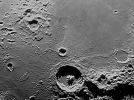
Torricelli Crater-00.jpgTorricelli Crater (1)91 visitenessun commento
(6 voti)
|
|
| 165 immagini su 14 pagina(e) |
 |
|
|
|
6 | |
|
|
|
|
|








