| Piú votate - The Moon After Apollo 17 |
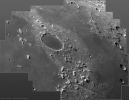
PlatoCrater-00.jpgPlato Crater (1)109 visiteThe dark-floored, 95 Km wide crater Plato (top) and Sunlit Peaks of the Lunar Alps are highlighted in this sharp digital mosaic of the Moon's surface. While the Alps of planet Earth were uplifted over millions of years as continental plates slowly collided, the Lunar Alps were likely formed by a sudden collision that created the giant impact basin known as the Mare Imbrium (Sea of Rains). The mare's generally smooth, lava-flooded floor is seen extending to the left. The prominent straight feature cutting through the mountain range (lower right) is the lunar Alpine Valley, about 160 Km long and up to 10 Km wide. Of course, the large, bright alpine mountain near bottom center is named Mont Blanc and reaches over 3 Km above the Lunar Surface.
(7 voti)
|
|

Triesnecker-01.jpgTriesnecker (2)89 visitenessun commento
(7 voti)
|
|

Triesnecker-00.jpgTriesnecker (1)74 visitenessun commento
(7 voti)
|
|

C-La Condamine Crater 02.jpgRays of light through "La Condamine Crater" (3)129 visitenessun commento
(7 voti)
|
|

FadingMoon-02.gifFading Sun-Lights... (2)95 visitenessun commento
(7 voti)
|
|

D-MoretusCrater-01.gifMoretus Crater...on line!131 visitenessun commento
(7 voti)
|
|

Hesiodus-01.gifHesiodus & C....on line!116 visitenessun commento
(7 voti)
|
|

Clavius-3.jpgClavius (1)150 visiteClavius: uno spettacolare cratere, reso famoso dall'immortale "2001 - A Space Odyssey", così come ci appare dalla Terra, attraverso le eccellenti ottiche di un telescopio riflettore 'Celestron 11'.
Il seeing, con ogni probabilità, non era ottimale - come l'immagine dimostra ampiamente -; ma il risultato ottenuto (grazie anche al gioco di luci e di ombre che si ottiene scattando fotografie di Regioni Lunari che si trovano a ridosso o che sono prossime al terminatore) è - comunque - davvero notevole.
(7 voti)
|
|

ZZ-ZZ-Towers on the Moon-6.jpgThe "Towers" of the Moon: Alien artifacts, Myth or Bogus? (5)308 visiteE con un ulteriore ingrandimento (adesso 1 px= 1 Km) passiamo ora ad una domanda decisamente - a nostro parere - interessante: ma come ha fatto il Dr Skipper a notare le (meno) evidenti cancellazioni delle strutture verticali (situate tutte nella parte inferiore del frame) ed a NON vedere la colossale cancellazione fatta sulla parte superiore del frame?!?
Non fraintendeteci: noi non stiamo dicendo che il Dr Skipper ha visto la pagliuzza e non ha visto la trave - se ci passate questo irriverente paragone...
Noi ci limitiamo a sottolineare una (enorme) stranezza: quella di riuscire a vedere le cancellazioni della parte inferiore del frame (che appaiono nette solo a chi sa già dove andare a guardare...) e di non cogliere quella gigantesca 'pezza' appiccicata sulla parte superiore del frame. Una pezza che anche un occhio stanco e distratto riuscirebbe a vedere senza difficoltà...
Forse si tratta di un particolare irrilevante ed è per questo che il Dr Skipper lo ha tralasciato? Cercheremo di scoprirlo...
(7 voti)
|
|

ZZ-ZZ-Towers on the Moon-3.jpgThe "Towers" of the Moon: Alien artifacts, Myth or Bogus? (2)271 visiteDato che i Ricercatori Lunar Explorer Italia non prendono mai per 'oro colato' il materiale che si riesce a trovare - anche se e quando la fonte è autorevole -, siamo andati sul Sito
http://www.cmf.nrl.navy.mil/clementine/clib (Naval Research Laboratory)
ed abbiamo cercato le immagini che il Dr Skipper ha già analizzato e che ci ha impedito di riprodurre.
Questa è la prima e, come potrete verificare, le 'alterazioni' ci sono, sono quelle già evidenziate dal Dr Skipper nei suoi Reports e sono evidenti ma...Noi non ci siamo fermati e siamo andati avanti.
E quello che abbiamo trovato è, semplicemente, raccapricciante.
Venite con noi...
(7 voti)
|
|

The Moon from Cassini-Huygens.jpgThe Moon from Cassini-Huygens - Lunar fly-by of Aug., 18, 1999121 visiteUna serie di tre fotogrammi montati in sequenza e relativi al passaggio ravvicinato ("fly-by") della Sonda Cassini-Huygens accanto alla Luna. Era il 18 Agosto 1999. Ed eccoVi la "original caption" relativa a questo evento, dal "NASA Picture of the Day" del 10 Settembre 1999: "...the Cassini spacecraft flew by the Earth and Moon, then continued on its way to the outer solar system. Near its closest approach to the Moon, a distance of about 377.000 Km, controllers tested Cassini's imaging systems on this most familiar celestial body. This composite picture shows three resulting lunar images from the green, blue, and ultraviolet regions of the spectrum (left to right). Prominant in the upper right of each image is the dark, round Mare Crisium (Sea of Crises) at the eastern edge of the Moon's near side. With its cameras clearly functioning well, Cassini's (...) expected to arrive at its final destination, the Saturnian system, in 2004".
La storia, come sapete, ha avuto un lieto finale.
(7 voti)
|
|

ZA-Moon from Clementine.jpgThe whole Moon from Clementine208 visiteVeduta globale della Luna (ottenuta con la tecnica del "fotomosaico"), così come ripresa dalla Sonda Clementine, usando la fotocamera ad infrarossi.
Un'immagine interessante e, comunque, utile proprio in quanto globale e panoramica.
(7 voti)
|
|
| 165 immagini su 14 pagina(e) |
 |
|
|
5 | |
|
|
|
|
|
|








