| Piú votate - The Moon After Apollo 17 |
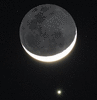
ZZ-ZZ-ZZ-FN-Earthshine.gifCoronal Mass Ejection and Earthsine121 visiteThis photograph was taken by Devgun Chander of Sohna, Haryana, of India. It shows a striking clarity to the earthshine region of the Moon. When I first look at the photograph I was impressed that Aristarchus was standing out so bright even though it very close to the sunset terminator. I sent the photograph to Dr. Anthony Cook the senior recorder for the L.T.P. sections of BAA and ALPO. He sent me the measured brightness of specific lunar formations and of the Lunar Maria.
(...) The Maria across the face of the Moon is uniformly bright except for the formations Mare Humorum, Mare Frigoris and Maria located near Aristarchus. Dr. Anthony Cook believes they are brighter due to the glare from the nearby sunset terminator. (...) The fact that we had a significant coronal mass ejections into space or CME take place on November 8-9,2004 causing aurora reports all over the World. If Solar Excitation is a factor for the extreme brightness of the Earthshine this would be the event to cause it.

(10 voti)
|
|

M-Lobachewsky Anomaly.gifThe Lobachevsky Anomaly, from Clementine (1)208 visiteLa struttura verticale che, nel frame AS 16-121-19407, pareva sovrastare questo crepaccio netto e profondo, non si riesce più a vedere.
Forse - anzi: certamente - si trattava di un photographic artifact (determinato dalla compressione del frame): siamo comunque in attesa di entrare in possesso del frame originale non compresso per verificare meglio.
Tutto ciò che si vede in questo frame è un "seepage" (una "colata" scura) che si diparte dal bordo di un dosso.
NON E', come Hoagland e qualche altro suo seguace sostengono, una sorta di "apertura", decisamente anomala nei contorni e nelle caratteristiche esteriori, che pare "affondare" nella superficie della Luna e condurre nelle profondità del nostro Satellite (praticamente l'imbocco di una miniera).
NON è quello che sembra, insomma, e basta guardare con attenzione e cautela per capirlo.
(10 voti)
|
|

ZZ-ZZ-TC-!cid_000801c53f43_6c932af0_34c33052@xxx90a8d37818b.jpgTsiolkowsky Crater (3D)226 visiteUna bellissima immagine in 3D - cortesemente fornitaci dal Dr Alessio Feltri - che ci mostra uno dei luoghi più enigmatici della Luna: il Cratere Tsiolkowsky.
Questo Cratere, molto noto a tutti i Selenologi, ci mostra una Singolarità così particolare che abbiamo deciso di occuparcene in una Investigation ad hoc!
(10 voti)
|
|

The Far Side Of The Moon - Clem.jpgThe Limb of Gagarin - Far Side231 visiteCi è sempre stato difficile reperire immagini del "lato oscuro" (o "far side" o "dark side") della Luna.
Questa è una delle poche di cui siamo venuti in possesso e che Vi proponiamo: niente di eccezionale, purtroppo, ma si tratta comunque di un'immagine interessante e che riguarda il "volto nascosto" (e, dunque, più affascinante) del nostro Satellite Naturale.
(10 voti)
|
|

X-Moon.jpgX-Moon!354 visiteDa "NASA - Picture of the Day" del giorno 11 Marzo 2009:"The striking "X" near the center of this lunarscape is easily visible in binoculars or a small telescope. Yet, not too many have seen it. The catch is, this Lunar "X" is only apparent during a 4 hour period just before the Moon's first quarter phase.
At the Terminator, or shadow line between lunar day and night, the X illusion is produced by a configuration of the craters Blanchinus, La Caille and Purbach.
Near the Moon's first quarter phase, an astronaut standing close to the craters' position would see the slowly rising Sun very near the horizon. Temporarily, the crater walls would be in sunlight while the crater floors were still in darkness.
Seen from planet Earth, contrasting sections of bright walls against the dark floors by chance look remarkably like an X. This sharp image of the Lunar "X" was captured at approx. 11:59 UT on March 3, 2009. The Moon's first quarter phase was at at 7:46 UT on March 4, AD 2009".MareKromium
(9 voti)
|
|
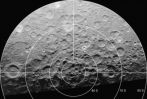
ZZ-ZZ-ZZ-ZZ-ZZ-Lunar South Pole.jpgNo "Lunar Ice" at the South Pole...88 visite"...a new radar survey of the Moon’s Southern Pole has cast doubt on the hope that there might be accessible deposits of water ice in permanently dark craters. This new survey, performed with the Arecibo Observatory in Puerto Rico, found elevated Hydrogen levels in regions of bright sunlight - not just inside the shadowed walls of craters. It seems that scattered rocks associated with impact craters have given previous instruments a false reading...".
(9 voti)
|
|

Mare Imbrium.jpgA "Castle of Shadows" in Mare Imbrium122 visitenessun commento
(9 voti)
|
|

ZZ-ZZ-MoonMirEarth_STS91_big.jpgEarth - Moon - MIR from STS 91188 visiteDa "NASA - Picture of the Day" del 30 Aprile 2005:"While orbiting the planet during their June 1998 mission, the crew of the Space Shuttle Discovery photographed this view of two moons of Earth. Thick storm clouds are visible in the lovely Blue Planet's nurturing atmosphere and, what was then Earth's largest artificial moon, the spindly Russian Mir Space Station can be seen above the Planet's limb. The bright spot to the right of Mir is Earth's very large natural satellite, the Moon. The Mir orbited planet Earth once every 90 minutes about 200 miles above the planet's surface or about 4.000 miles from Earth's center. The Moon orbits once every 28 days at a distance of about 250.000 miles from the center of the Earth".
(9 voti)
|
|

ZZ-Tycho and Copernicus.jpgTycho and Copernicus Crater144 visiteCaption NASA originale:"Dazzling in binoculars or a small telescope, the Moon is pocked with impact craters. During partial lunar phases, the craters along the terminator are cast in dramatic relief by strong shadows. But when the Moon is full, some craters seem to sprout systems of bright radial lines or rays. This detailed close-up of the full Moon features two prominent ray craters, Copernicus (upper left) and Tycho (lower right), each with extensive ray systems of light colored debris blasted out by the crater-forming impacts. In general, ray craters are relatively young as their rays overlay the lunar terrain. In fact, at 85 Km wide, Tycho, with its far reaching rays, is the youngest large crater on the nearside. Crater Copernicus, surrounded by dark mare which contrast nicely with its bright rays, is 93 Km in diameter".
(9 voti)
|
|

00-Libration-250px-Lunar_libration_with_phase2.gifThe "Lunation": such as a full "Lunar Cycle"85 visitenessun commentoMareKromium
(8 voti)
|
|
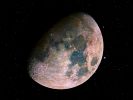
The Moon~0.jpgWonderful, wonderful Moon!... (HR)101 visiteDa "NASA - Picture of the Day", del 7 Settembre 2006:"No single exposure can easily capture faint stars along with the subtle colors of the Moon. But this dramatic composite view highlights both.
The mosaic digitally stitches together fifteen carefully exposed HR images of a bright, gibbous Moon and a representative background star field. The fascinating color differences along the Lunar Surface are real, though highly exaggerated, corresponding to regions with different chemical compositions.
And while these color differences are not visible to the eye even with a telescope, Moon watchers can still see a dramatic lunar presentation tonight: a partial eclipse of the Moon will be visible from Europe, Africa, Asia and Australia".
(8 voti)
|
|

ZZ-ZZ-ZZ-FM-TLP-Proclus-Lunar Flash.jpgLunar "Flash" near the Terminator146 visite"Among the most enigmatic astronomical occurences are Lunar Transient Phenomena, instances of areas on the Moon appearing to brighten, darken, or change color on a time-scale of minutes. The very existence of LTP's is controversial, though they have been reported for 2 centuries (S&T: November, 1988, page 478).
Now a most remarkable one seems to have been photographed. On May 23, 1985, G. Kolovos (University of Thessaloniki) was testing a 4 1/4-inch refractor by taking pictures of the four-day-old Moon from a small village in Northern Greece. One of his seven photographs revealed a bright dot near the Moon's Terminator.
Kovolos and colleagues from the university closely analyzed the image of the dot, near the crater Proclus "C".
They write in the December, 1988 "Icarus", that the oval spot is 22 Km across and seems to conform to the local topography. What could causee such a bright flash on the Moon? The authors consider and dismiss several possibilities. Kodak Laboratories in Athens examined the film and concluded that the spot was not a film defect. It was not a surface reflection, because the illumination pattern implies that the flash occurred ABOVE the lunar surface. A volcanic eruption would have left an obscuring cloud on subsequent photos. So would a meteor impact.
Kovolos and co-workers hazard a guess that the intense heating of the lunar surface after sunrise might force cracks open, allowing trapped gas to escape. As the gas rises and expands, an electrical discharge could conceivably make it glow brightly. Many LTP sightings do occur near the lunar terminator within a day of sunrise. The researchers warn that their theory is far from being an explanation for all LTP's. "We present our results with caution," they write, "and we hope that additional data may lead to their indisputable explanation."
(8 voti)
|
|
| 165 immagini su 14 pagina(e) |
 |
3 | |
|
|
|
|
|
|
|
|








