| Piú votate - The Moon After Apollo 17 |

FadingMoon-03.gifFading Sun-Lights... (3)102 visitenessun commento
(5 voti)
|
|

I-Tycho-00.jpgTycho124 visitenessun commento
(5 voti)
|
|

Fra Mauro.jpgFra Mauro103 visitenessun commento
(5 voti)
|
|

CopernicusSunrise.jpgSunrise on Copernicus Crater102 visitenessun commento
(5 voti)
|
|
ZZ-ZZ-U-Flare.jpgLunar Flare (1953)283 visitenessun commentoMareKromium
(4 voti)
|
|

The_Moon-Aristarchus_Plateau.jpgAristarchus Plateau: the cradle of TLP's91 visiteCaption NASA:"Anchored in the vast lava flows of the Moon's Oceanus Procellarum lies the Aristarchus Plateau. The bright impact crater at the corner of the plateau is Aristarchus, a young crater 42 Km wide and 3 Km deep. Only slightly smaller, lava flooded Herodotus crater is above and to the left.
A valley (or rille) feature likely carved by rapidly flowing lava or a collapsed lava tunnel, Vallis Schroteri begins just to the right of Herodotus and winds across the plateau for about 160 Km, eventually turning toward the top of the picture.
Aristarchus Plateau itself is like a rectangular island about 200 km across, raised up to 2 kilometers or so above the smooth surface of the lunar Ocean of Storms.
Recorded from a backyard observatory in Buffalo, New York, the contrast of light-colored ejecta around Aristarchus with surrounding dark, smooth, lava flooded surfaces suggests more familiar snowy scenes of planet Earth".MareKromium
(4 voti)
|
|
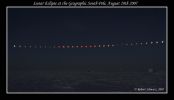
SouthPolarEclipse.jpgLunar Eclipse from the South Pole79 visiteCaption NASA:"The Moon was up continuously for 14 days in August -- when viewed from the South Pole. But during the total Lunar Eclipse on August 28, it circled only about 10° above the horizon. For Robert Scharwz, the resulting long line-of-sight through the atmosphere that blurred his images was a minor problem when he recorded this 4-hour long Lunar Eclipse sequence. A more severe problem was the outdoor air temperature of - 68° C (such as - 90 F). The extreme cold required him to make the series of exposures through a slit in a window from inside a heated room. Though the heat produced convection and further blurring, it was the only way to keep the camera at a reasonable operating temperature for an extended period of time. Still, he was rewarded with this impressive record of August's lunar eclipse from a unique perspective on planet Earth".MareKromium
(4 voti)
|
|

Red_Moon.jpgDark Lunar Eclipse78 visiteCaption NASA:"The Moon passed close to the center of Earth's shadow on August 28th, 2007. Seen best by skywatchers in western North America and the Pacific Region, the resulting Total Lunar Eclipse was a dark one, lasting about 90 minutes. In this telescopic image taken near mid totality from Yass, NSW Australia, the 85 Km wide ray crater Tycho lies near the top right of the shadowed lunar surface.
Of course, even during a Total Lunar Eclipse, the Moon is not completely dark. Instead the Moon remains visible during totality, reflecting reddened light filtering into the Earth's shadow.
The light comes from all the Sunsets and Sunrises, as seen from the lunar perspective, around the edges of a silhouetted Earth".MareKromium
(4 voti)
|
|

Moon-SouthernSide.jpgThe Southern Highlands of the Moon (Moretus and Curtius)92 visiteCaption NASA:"The Moon's South Pole is near the top of this sharp telescopic view looking across the Southern Lunar Highlands. Recorded on August 3rd, 2007, from Tecumseh, Oklahoma, planet Earth, the foreshortened perspective heightens the impression of a dense field of craters and makes the craters themselves appear more oval shaped. The prominent crater in the foreground, Moretus, has a diameter of 114 Km and lies just west (left) of the Moon's Central Meridian. For large lunar craters, Moretus is young and features terraced inner walls and a 2,1 Km high, bright central peak, similar in appearance to the more northerly crater Tycho. Just to the right of Moretus is the 95 Km diameter crater Curtius.
Curtius has older, rounded walls marked by smaller, more recent impact craters".MareKromium
(4 voti)
|
|
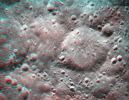
B-Pirquet_3D.jpgPirquet Crater (3D)108 visitenessun commento
(4 voti)
|
|

B-Tsiolkovsky_3D~0.jpgThe Peak of Tsiolkovsky Crater (3D)117 visitenessun commento
(4 voti)
|
|

The Moon-01.jpgThe Moon, in blue-green filters, from Mars Reconnaissance Orbiter (2)75 visitenessun commento
(4 voti)
|
|
| 165 immagini su 14 pagina(e) |
 |
|
|
|
|
|
10 | |
|
|
|








