| Piú votate - The Moon After Apollo 17 |
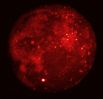
ZZ-ZZ-ZZ-InfraredMoon_msx_big.jpgEclipsed Moon in Infrared: what's inside Tycho Crater?1353 visiteDa "NASA - Picture of the Day" del 23 Aprile 2005:"In September of 1996, the Midcourse Space Experiment (MSX) satellite had a spectacular view of a total lunar eclipse from Earth orbit. SPIRIT III, an on board infrared telescope, was used to repeatedly image the moon during the eclipse. Above is 1 of the images taken during the 70 minutes of totality (...). Infrared light has wavelengths longer than visible light - humans can not see it but feel it as heat. So, the bright spots correspond to the warm areas on the lunar surface and dark areas are cooler. The brightest spot below and left of center is the crater Tycho, while the dark region at the upper right is the Mare Crisium".
La spiegazione fornitaci dalla NASA circa il contenuto e la chiave di lettura dell'immagine è davvero perfetta ed inequivocabile. Ciò che ci lascia perplessi, tuttavia, è l'assoluta non-chalance con cui ci viene detto che il Cratere Tycho "è caldo", mentre quasi tutto il resto della Luna non lo è.
Cosa c'è "dentro" Tycho?!?
(105 voti)
|
|

ZZ-ZZ-ZZ-NSX-InfraredMoon-Edited.jpgEclipsed Moon in infrared - edited275 visiteUn grazie di cuore - come al solito... - al Dr Alessio Feltri il quale, approfittando della splendida immagine della Luna in infrarosso, coglie l'occasione per mostrarci ed illustrarci, in parallelo, qualcuno dei rilievi visibili più interessanti nonchè le aree di landing delle Missioni Apollo.
Inutile dire che c'è già materiale sufficiente per iniziare a riflettere...
(30 voti)
|
|

ZZ-ZZ-Z-Flare from Clem.jpgTransient Lunar Phoenomena (TLP) - 3358 visiteNonostante queste 2 (ma ne esistono migliaia!) testimonianze, i TLP sono rimasti una grande incognita. Per un valido studio sulla materia - che qui non ci è possibile affrontare compiutamente per ragioni di spazio - Vi rimandiamo al Sito "Lunar Anomalies Homepage" del Collega Mike Bara (www.lunaranomalies.com) ed alla relativa Sezione dedicata ai TLP. Noi pubblicheremo qualsiasi immagine ci pervenga e che riguardi questi fenomeni e, ogni volta, cercheremo di spendere qualche parola per spiegare le possibili cause di un simile evento, dalle più ovvie ("outgassing" e "meteor strikes") alle più "esotiche" (eruzioni vulcaniche, cupole di cristallo che brillano ai raggi del Sole, esperimenti nucleari Top Secret ed UFO activity).
Nota: negli ultimi 2 frames un (presunto) TLP ripreso dalla Sonda Clementine (immagine originale e detail mgnf). Certo è che, con tutte le evidenze che abbiamo, il fatto che la natura (genuina) di un simile fenomeno continui ad essere messa in dubbio ci lascia davvero perplessi (sic!)...
(27 voti)
|
|
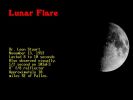
ZZ-ZZ-U-Flare.jpgTransient Lunar Phoenomena (TLP) - 1191 visiteDietro l'acronimo TLP (linguaggio internazionale per "Transient Lunar Phoenomena") o FLT (per "Fenomeni Lunari Transitori") si nasconde, forse, uno dei più grandi - e vicini! - "misteri" ai quali la Scienza Convenzionale ancora NON è riuscita a dare una risposta convincente, sebbene la fenomenologia in oggetto le fosse nota sin dall'Antichità. Ma che cosa sono i TLP?
Sono "Eventi Estemporanei", imprevisti ed imprevedibili, i quali si risolvono - nella maggior parte dei casi - in "brillamenti" (che possono manifestarsi in forma di "sparks"--> scintille o "flares"--> fiammate o fiaccole) della superficie lunare. Si tratta di luci (di colore bianco, rossastro o azzurro, per lo più) che si accendono sulla superficie della Luna e che sono così brillanti da risultare visibili anche dalla Terra e SENZA l'ausilio di particolari strumenti. Questi TLP, come avremo occasione di vedere, si manifestano in alcune zone in particolare (i.a. i Crateri Aristarco ed Alfonso) e sono stati osservati da Astronomi ed Astronauti.
(21 voti)
|
|

00-Lunation.gifA full Lunar Cycle (Lunation)282 visiteDa "Astronomy: Picture of the Day", del 13 Novembre 2005:"Our Moon's appearance changes nightly. This time-lapse sequence shows what our Moon looks like during a lunation, such as a complete Lunar Cycle.
As the Moon orbits the Earth, the half illuminated by the Sun first becomes increasingly visible, then decreasingly visible. The Moon always keeps the same face toward the Earth and its apparent size changes slightly, though, and a slight wobble called "libration" is discernable as it progresses along its elliptical orbit.
During the cycle, sunlight reflects from the Moon at different angles and so illuminates different features differently. A full lunation takes about 29,5 days, such as just under a month (moon-th)".
(20 voti)
|
|

ZZ-ZZ-V-Flare from Clem.jpgTransient Lunar Phoenomena (TLP) - 2188 visiteEccoVi due testimonianze (decisamente autorevoli) riguardo a questi strani fenomeni, estratte dall'articolo 'LTP-Lunar Transient Phoenomena' di W.S. Cameron:"On the night of November 2, 1958, Soviet astronomer Nikolai A. Kozyrev witnessed a strange phenomenon while making spectrograms of the crater Alphonsus with the Crimean Astrophysical Observatory's 50-inch reflector. As he watched through the telescope's guiding eyepiece, he saw the crater's central peak blur and turn an unusual reddish color. The spectrograms confirmed his visual impressions of a volcanic event; they showed an emission spectrum of carbon vapor (S&T: February, 1959, page 184).
On July 19, 1969, the Apollo 11 command module had just achieved orbit around the Moon when the Mission Control Center in Houston received word that amateur astronomers reported a TLP in the vicinity of the crater Aristarchus. Asked to check out the situation, astronaut Neil Armstrong looked out his window toward the earthlit region and observed an "area that is considerably more illuminated than the surrounding area. It just has -- seems to have a slight amount of fluorescence to it." Although he wasn't sure, Armstrong believed the region was Aristarchus".
(20 voti)
|
|

Moon Eclypse - montage.jpgMoon's eclypse219 visiteL'attraversamento del cono d'ombra proiettato dalla Terra ed il progressivo "ambrarsi" della superficie Lunare. Una composizione davvero molto bella dell'Astronomo Francese Sebastien Gauthier.
(16 voti)
|
|

ZB-Moon and Mars.jpgMoon and Mars342 visiteThe Clay Center Observatory expedition to Bonita Springs, Florida - USA - produced this evocative picture of Mars grazing the Moon's dark edge by digitally stacking and processing a series of telescopic images of the event. With the cratered Moon in the foreground, the bright planet Mars seems alarmingly close. Its global scale features and white south polar cap are easily visible.
(16 voti)
|
|

ZZ-ZZ-ZZ-ZZ-ZZ-FastWalker-konig080895.gifFast-walker in transit236 visiteDa una ripresa telescopica ottenuta da Terra, il transito di un Fast-Walker (o meglio: l'ombra di un Fast-Walker in transito che si proietta sulla grigia superficie della Luna).
Ora, come già si disse in passato e come il Dr Fienga scrisse nell'articolo "L'Anno del Centauro" - pubblicato sul Sito UFO-ONLINE - perchè un oggetto "possa/riesca a proiettare la propria ombra sulla superficie della Luna" è ragionevole supporre che:
1) trattasi di un oggetto DECISAMENTE VICINO alla superficie della Luna (e comunque molto più vicino alla Luna di quanto non lo sia alla Terra) e
2) trattasi di un oggetto avente NOTEVOLISSIME DIMENSIONI (così notevoli da poter essere visto - e BENE - anche da oltre 300000 Km di distanza.
E allora? Che cosa stiamo guardando?...
Observer: Mr. Steve Massey
Location: Residence - Dee Why - New South Wales
Time and date of observation: 00.30 to 00.40 Hrs EST 08/08/95
Object's location: Object seen passing over the northern quadrant of the Mare Humorum a little south of the crater "Gassendi". This area is located in the lower south I west quadrant of the Moon.
Object visible for: 0.74 of a second as determined from video sequence at normal running speed.
Equipment used: 10" Meade Reflector Telescope fitted with clock drive unit for tracking. The eyepiece used at the time of observation was a 25 mm focal length of f4.5 rating together with a 2x barlow lens. The telescope mirror was 1l40 mm. In addition to this, a video camcorder set at 8x zoom and was hand-held at the eyepiece to record the moon's surface features. The total magnification ratio was as follows - 1140 mm divided by 25mm = 45.6x + 2x barlow = 91.2x + camcorder 8x zoom = 729.6x.
Moon details: At the time of observation the Moon was in the western quadrant at 39.40 degrees above the horizon. It was 8/10ths illuminated with the full Moon due 110895. See (visual) direction graphic for astronomical position data.
Observation: Steve is a keen amateur astronomer and has been interested in the subject since an early age. He has an excellent knowledge of astronomy and uses a 10" Meade Reflecting Telescope fitted with a drive unit for tracking. At between 30 to 40 minutes after midnight on the 8th of August he was videotaping an area of the Moon known as the Mare Humorum in the general vicinity of the crater Gassendi. He was hand holding a camcorder set at maximum zoom ratio of x8 up to the telescope eyepiece and while watching through the viewfinder, noticed an object enter the field of view from the lower right just above the crater "Konig" moving at extremely high speed to disappear out of the field of view in the upper left.
(15 voti)
|
|
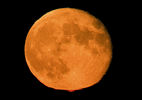
ZZ-ZZ-ZZ-ZZ-ZZ-LunarRedFlash_seip_f.jpgA "red flash" on the Moon162 visiteDa "NASA - Picture of the Day", del 22 Settembre 2005:"This remarkable telescopic image highlights the deep orange cast of a waning gibbous Moon seen very close to the eastern horizon on September 19. In fact, today's equinox at 22:23 UT marks the beginning of Fall in the Northern Hemisphere and makes this view from Stuttgart, Germany an almost Autumn Moon. While the long sight-line through the atmosphere filters and reddens the moonlight, it also bends different colors of light through slightly different angles, producing noticeable red (bottom) and green (top) lunar rims. Also captured here floating just below the Moon is a thin, red mirage (inset) - in this case, an atmospherically magnified and distorted image of the red rim. Of course, this tantalizing lunar 'red flash' is related to the more commonly seen 'green flash' of the Sun".
(14 voti)
|
|

MOON HALO.jpgMoon halo with planets and stars175 visiteUna bellissima - ancorché amatoriale - immagine delle Luna con il suo caratteristico "alone" (che, si dice, essere portatore di maltempo) ed un congruo quantitativo di oggetti celesti (tra cui Giove e Saturno) che la circondano.
(14 voti)
|
|

ZZ-ZZ-ZZ-ZZ-ZZ-FastWalker-konig080896.gifFast-walker in transit118 visiteMappa dei dettagli riconoscibili della superficie Lunare:
1. Mercator
2. Konig
3. Agatharchides
4. Hippalus
5. Cape Kelvin
6. Campanus
Nota: i Curatori del Sito LUNASCAN PROJECT, nel commentare questo straordinario filmato, ritengono che quanto ripreso sia l'OGGETTO EFFETTIVO "in transito" e NON la sua OMBRA che passa sulla superficie lunare. Si tratta, come ovvio, di una opinione rispettabilissima, ma che noi ci sentiamo di non condividere.
Cogliamo l’occasione – fornitaci dalle interessanti ed acute riflessioni svolte dal nostro Amico e Socio “Anakin” in sede di commento al frame – per fare qualche precisazione sul motivo per cui noi abbiamo optato per l’ipotesi che vuole la ripresa di un’“ombra” in transito sulla Superficie Lunare e non la ripresa dell’oggetto che la crea.
Allora: tralasciando la “sensibilità” dell’Osservatore (un dato troppo soggettivo per avere una effettiva rilevanza in questa sede), diciamo che, quando si usa un telescopio, si dispone di una serie di oculari i quali determinano il “livello di ingrandimento” del target osservato.
Ora noi sappiamo che esistono non solo oculari grandi e piccoli ma anche – ed ovviamente – oculari più potenti (e cioè che ingrandiscono di più) ed oculari meno potenti (e cioè che ingrandiscono di meno).
Quanto più un oculare è "potente", tanto più – di regola – la qualità dell’immagine si abbassa e tanto più il campo visivo (l’ampiezza della superficie osservata) si restringe.
Questo particolare, in ipotesi di osservazione di stelle, nebulose o pianeti (da Mercurio a Plutone), può apparire irrilevante (anche se un oculare “forte” può di fatto “risolvere” un Sistema Stellare Multiplo, ad esempio), ma nel caso di osservazione della Luna (un oggetto davvero vicino) esso diventa decisivo.
Perché? Perchè osservando la Luna con un oculare - ad es. - di 4 mm (il quale produce un notevolissimo ingrandimento del target), potremmo riuscire a vedere, in ipotesi di passaggio di un oggetto nei pressi della sua superficie, O l'oggetto, O l’ombra che esso proietta, ma MOLTO difficilmente riusciremmo a vedere entrambi.
Non dimentichiamo, poi, altri due fattori critici: l’altezza del Sole rispetto alla Regione Lunare ripresa (ed è questa altezza che determina la posizione di un’ombra rispetto all’oggetto che la produce) ed il cosiddetto Angolo di Fase e cioè l’angolo descritto – in questo caso – dal Sole, l’Oggetto (ergo anche la Luna) e l’Osservatore (ergo anche la Terra).
Ora l’Angolo di Fase implica e determina (fra l’altro) una Prospettiva di Osservazione la quale, come le immagini degli Anelli di Saturno (e dei loro dettagli) ottenuti dalla Sonda CASSINI-HUYGENS ci insegnano, cambia radicalmente la visuale dell’obbiettivo DAL PUNTO DI VISTA dell’Osservatore.
Tutto ciò premesso, per vedere sia l’Oggetto, sia l’Ombra da esso proiettata al suolo, si sarebbero dovute determinare (congiuntamente), a nostro parere, almeno queste condizioni:
1) uso di un obbiettivo telescopico a potenza bassa (o addirittura di tipo grandangolare);
2) passaggio dell’oggetto a “volo radente” (o, in alternativa, passaggio dell’oggetto sulla perpendicolare dell’Osservatore);
3) Sole allo Zenith (o nei suoi pressi) della Regione Lunare ripresa (o, se si preferisce, Angolo di Fase Basso - diremmo <25°).
(13 voti)
|
|
| 165 immagini su 14 pagina(e) |
1 |
 |
|
|
|
|
|
|
|
|
|








