| Piú votate - The Moon through LRO |
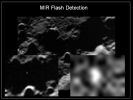
LRO-1010-392933main_LCROSS_5_full.jpgLCROSS impacting the Moon: the "Flash" in MIR Light100 visiteThis Mid-InfraRed (MIR) image was taken in the last minutes of the LCROSS flight mission to the Moon.
The small white spot (enlarged in the insets) seen within the dark shadow of lunar crater walls is the initial flash created by the impact of a spent Centaur upper stage rocket. Traveling at 1,5 mps (miles-per-second), the Centaur rocket hit the Lunar Surface yesterday at 04:31 UT, followed a few minutes later by the shepherding LCROSS Spacecraft.
Earthbound observatories have reported capturing both impacts. But before crashing into the Lunar Surface itself, the LCROSS Spacecraft's instrumentation successfully recorded close-up the details of the rocket stage impact, the resulting crater and debris cloud.
In the coming weeks, data from the challenging mission will be used to search for signs of water in the Lunar Material blasted from the Surface.MareKromium
(3 voti)
|
|
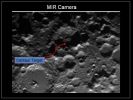
LRO-1014-392915main_LCROSS_3_full.jpgLCROSS Impact Location92 visiteLCROSS impact crater as seen with the Mid InfraRed (MIR) camera.MareKromium
(3 voti)
|
|

LRO-1000-391631-SouthPole.jpgLCROSS Impact Location154 visiteCaption NASA:"About 100 Km from the Lunar South Pole, the about 100 Km wide crater Cabeus is the target for two LCROSS mission spacecraft on course to impact the Moon tomorrow (October, 9th, 2009).
The shadowed crater is strongly foreshortened in this mosaic, a representative view of the Region for earthbound telescopes. The impacts are intended to create billowing debris plumes extending into the sunlight above the Crater Walls, that could reveal signs of water.
First to impact will be the mission's Centaur upper stage rocket at 11:30 UT (07:30 am Eastern Daylight Time - 13:30 Central Europe Time).
The instrumented LCROSS mothership will image the impact and then fly through the resulting debris plume analyzing the material blasted from the crater floor.
Four minutes after the first impact, the LCROSS mothership itself will crash into Cabeus. The plumes are expected to be visible in telescopes about 10" in diameter or larger, with the timing favoring Moon watchers in Western North America and the Pacific. NASA also plans to broadcast live footage from the LCROSS mission on NASA TV starting at 06:15 a.m. EDT - 12:15 CET on October 9, 2009".MareKromium
(3 voti)
|
|

LRO-0008b-369444main_lroc_apollo17_lrg.jpgTaurus-Littrow Highlands: the Apollo 17 Landing Site (edm)63 visitenessun commentoMareKromium
(3 voti)
|
|

LRO-0000-365426main_nacl000000fd_middle.jpgCraters in the Lunar Highlands near Mare Nubium (1)71 visiteThese first two images show cratered regions near the moon's Mare Nubium Region, as photographed by the Lunar Reconnaissance Orbiter's LROC instrument. Impact craters feature prominently in both images. Older craters have softened edges, while younger craters appear crisp.
Each image shows a region 1400 meters (0,87 miles) wide, and features as small as 3 meters (9,8 feet) wide can be discerned. The bottoms of both images face Lunar North.MareKromium
(3 voti)
|
|

00-LRO-0002.jpgLiftoff...To the Moon!70 visitenessun commentoMareKromium
(3 voti)
|
|

LRO-M102215743LC-3-MF-LXTT.jpgOrbital View (2 - Natural Colors; credits for the additionaol process. and color.: Dr Paolo C. Fienga - Lunexit Team)) 230 visitenessun commentoMareKromium
(2 voti)
|
|

LRO-2501-Oceanus_Procellarum.jpgLunar Landslide in an Unnamed Crater of Oceanus Procellarum74 visiteA key part of the LROC science investigation is the imaging and analysis of fresh, Copernican-aged Craters (such as Craters younger than 1,1 Billion Years), like this small (6-Km diameter) example at the edge of Oceanus Procellarum, West of Balboa Crater.
The LROC team has seen a variety of landforms related to these important lunar features. For example, a Landslide on the Crater wall partially covers the solidified impact melts on the floor. The Landslide clearly happened after the Crater initially formed; the materials were likely dislodged by seismic shaking from nearby smaller impacts.
These young, fresh craters preserve an vital record of the impact process.
Where does ejecta come from? How much impact melt is produced? How thick is ejecta? What is the importance of self-secondary impacts?
These are only some of the important scientific questions that lunar scientists can address by studying these craters.
As geologic time progresses, the pristine features in fresh craters are worn down by impacts of all sizes. Understanding young craters help geologists piece together the history of ancient degraded craters, an understanding particularly useful for planning future human missions to the Moon. The best way to explore fresh craters like this one, of course, would be with Astronauts.
However, until humans return to the Moon, lunar geologists will analyze images like this for clues, as well as comparing the landforms like the one visible here with other craters on the Moon, Mars, and impact structures on Earth.MareKromium
(2 voti)
|
|

LRO-1015-Lunar-Plume.jpgAfter the Impact: the "Plume"114 visiteDa "NASA - Picture of the Day" del giorno 18 Novembre 2009:"In October 2009, the LCROSS Mission crashed a large impactor into a permanently shadowed crater near the Lunar South Pole and a "Plume" (---> pennacchio) of dust rose enough to be visible by the LRO, although hard to discern from Earth.
The Plume in question is now shown in this frame - taken in Visible Light.
The results of a preliminary chemical analysis gave a clear indication that such a Dust Plume contained water, and water is of high importance not only for understanding the history of the Moon, but also as a possible reservoir for future astronauts trying to live on the Moon for long periods.
The source of the Lunar Water is still a topic of debate (water could have been carried by many small meteorites, or a comet, or - maybe - it was an inborn component of the Primordial Moon Soil").MareKromium
(2 voti)
|
|

LRO-1012-392894main_LCROSS_full.jpgLCROSS Impact Location131 visiteLCROSS impact crater as seen with the Visible Light (VL) camera.MareKromium
(2 voti)
|
|
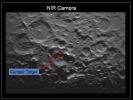
LRO-1013-392902main_LCROSS_2_full.jpgLCROSS Impact Location73 visiteLCROSS impact crater as seen with the Near InfraRed (NIR) camera.MareKromium
(2 voti)
|
|
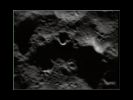
LRO-1007-392833main_vlcsnap-2009-10-09-04h33m37s65_full.jpgLCROSS impacting the Moon84 visiteA closer view of the Moon as the LCROSS Spacecraft approaches impact.MareKromium
(2 voti)
|
|
| 69 immagini su 6 pagina(e) |
 |
|
4 | |
|








