| Piú votate - The Moon through LRO |

LRO-2503-Mare_Moscoviense.jpgMare - Highlands Boundary in Mare Moscoviense84 visiteMare Moscoviense: a "Window" to the Lunar Far-Side Volcanism
It's clear from looking at pictures of the Moon that the Near-Side and the Far-Side are very different from a geologic standpoint.
The darker, basaltic mare deposits dominate the Near-Side, whereas the Far-Side is dominated by bright deposits of anorthosite thought to be remnants of the Moon's original crust. Mare Moscoviense is one of the few (and also the largest) deposits of mare basalts on the Lunar Far-Side.
Why are there so many mare basalts on the Near-Side, but so few on the Far-Side? Lunar scientists simply don't know the answer to that question. One idea is that the Far-Side crust is simply thicker than the near side crust, and rising basaltic magma simply solidified before it was able to push through the thicker Far-Side crust. That's where Moscoviense comes in. We know enough about the Moscoviense Region from previous missions that we have a well-defined set of questions that potential future missions might be able to answer. For example, the Lunar Prospector mission showed that there are high concentrations of thorium in the Moscoviense Basin. Thorium acts as a tracer for the Lunar KREEP (Potassium - K -, Rare Earth Elements and Phosphorus) geochemical component found in abundance on the Near-Side but not on the Far-Side.
Understanding the extent and distribution of thorium in the basin may tell us about the global distribution of the Lunar KREEP component and thus the evolution of the Lunar Mantle. We also know from the Clementine mission that the Moscoviense basalts are rich in both Iron and Titanium. Since basalts form by partial melting of the Lunar Mantle, sampling Moscoviense basalts provides lunar scientists with vital insights into how the Lunar Mantle on the Far-Side differs from the Near-Side one, which in turn would help us to learn why mare basalts are so much rarer on the Far-Side and provide key insights about the formation of all of the terrestrial planets, including Mars and Earth.
For these reasons, a Constellation Program region of interest is located within Mare Moscoviense. The region is at the edge of Moscoviense, allowing explorers to collect samples from both the mare basalts and the surrounding highlands terrain during their traverses.
The materials at the edge of the basin provide important insights into the formation of the Moscoviense Basin itself. By exploring and sampling the Moscoviense Region, we would date the basalt flows and definitively determine their composition. This sampling would let us determine how Moscoviense basalts differ from the near side basalts sampled during Apollo. Age-dating Moscoviense basalts also provides important insights into the history of lunar volcanism by determining whether the Moscoviense basalts are older or younger than Near-Side basalts.
While the scientific goals of exploring the Moscoviense Region are certainly important, no less important is access to key lunar resources. The lunar regolith (the broken-up rocks and impact products that make up the first 10 meters or so of the Lunar Surface) in this region is derived in part from the local titanium-rich Moscoviense basalts. This regolith material could be used for a variety of vital purposes, including the construction of human habitats, radiation shielding, or as feedstock for local resource utilization.
Taking a longer view, Titanium is an important industrial material on Earth, and it will be very important for indigenous lunar industrial development.MareKromium
(4 voti)
|
|

LRO-1011-392970main_LCROSS_9_full.jpgLCROSS impacting the Moon: the "Flash"128 visitenessun commentoMareKromium
(4 voti)
|
|
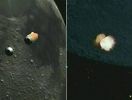
LRO-1009-Crash1.jpgLCROSS impacting the Moon92 visitenessun commentoMareKromium
(4 voti)
|
|

LRO-M102215743LC-1-MF-LXTT.jpgOrbital View (1)97 visitenessun commentoMareKromium
(3 voti)
|
|

LRO-2500-Bessel_Crater.jpgBessel (possible Natural Colors on a Radar Image; credits: Dr Paolo C. Fienga - Lunexit Team)92 visiteMini-RF S-band Zoom Synthetic Aperture Radar (SAR) image strip through central Mare Serenitatis on the Near-Side of the Moon (approx. Long. of the strip ~ 18° East; center Lat. ~ 20° North).
The radar strip runs through the crater Bessel (inset; approx. 15 km (or about 9 mile) diameter; center at 21,8° North Lat. and 17,9° East Long.) and covers the highlands of the Haemus Mountains (on the Rim of the Serenitatis Basin) in its Southern (bottom) third.
The full-resolution SAR data are 30 mt (90 feet). The Streaks of bright and dark material in the Walls of Bessel probably reflect the blockiness of Landslides within the Crater, brighter Streaks having more blocks of the 10-cm (4") scale.
The radar strip covers a major geological boundary in Mare Serenitatis; the darker, lower Maria has higher Titanium content than central Serenitatis. We see this geological boundary in the Mini-RF radar image, caused by higher absorption of RF energy by the high content of the Iron-Titanium Oxide mineral "Ilmenite".
Thus, Mini-RF SAR images can be used to map the Titanium content of the Lunar Maria. The background image is part of the Clementine global mosaic.MareKromium
(3 voti)
|
|
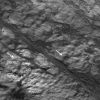
LRO-2500-Epigenes_A_Crater-2.jpgEpigenes A75 visiteAnother example of dark Impact Melt flows channeling through the preexisting material on the Crater Wall.
The white arrow points to the Crater Floor.
(this image is approx. 540 meters wide)MareKromium
(3 voti)
|
|
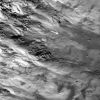
LRO-2500-Epigenes_A_Crater-3.jpgEpigenes A70 visiteImpact Melt (the dark material) flowed around and over Rocky Outcrops on the upper portion of the Crater Wall.
The white arrow points to the Crater Floor.
The initial outward surge of material during the excavation of the crater threw Impact Melt near the Rim and then gravity pulled the Melt downward during the modification stage of the impact.
(this image is approx. 540 meters wide)MareKromium
(3 voti)
|
|

LRO-2500-Epigenes_A_Crater-1.jpgEpigenes A80 visiteA plethora of Boulders surrounds braided flows of impact melt along the Inner Wall of the Crater Epigenes A. As the melt moves toward the Crater Floor (direction indicated by white arrow), the flow buries and moves boulders.
Epigenes A is an about 18-Km-diameter Impact Crater located at 66,9° North and 0,3° West, on the Rim of crater W. Bond.
(this NAC image is 540 meters wide)MareKromium
(3 voti)
|
|

LRO-2500-Marius_Crater.jpgLandslides or unusual Surface-decoloration in Marius Crater?69 visiteImpact Events, Volcanism, and Tectonism form the majority of features found on the Moon. However, Landslides are an important modifier of the landscape at small scales.
Ultimately, the source of Landslides are Seismic Events triggered by Impacts or movements deep inside the Moon. These shaking events cause poorly consolidated material on steep slopes to slide downhill.
In this case the slide spreads out in a complex of narrow finger-like streamers. What controls this distinctive pattern? The process is controlled by the energy of the shaking, the size of particles in the slide, the steepness of the slope, and volume of the source deposit.
Mars also has many Landslide Deposits, so scientists are using the new LROC data to compare with these martian counterparts.
Marius Crater (approx. 41 Km diameter) is located in Oceanus Procellarum (11,9° North and 50,8° West) and is notable for its mare filled floor (unequivocal evidence that it formed before before the surrounding mare basalts flooded the Region).MareKromium
(3 voti)
|
|

LRO-2504-Mare_Moscoviense.jpgMare - Highlands Boundary in Mare Moscoviense113 visitenessun commentoMareKromium
(3 voti)
|
|

LRO-2000-eAGLE-WestCrater-00.jpgThe Lunar Module "Eagle", from LRO (CTX Frame - credits: NASA)101 visite...Due immagini (questa e l'EDM che segue) ASSOLUTAMENTE FANTASTICHE e da guardare, a nostro parere, non solo con Deferenza e grande Rispetto, ma anche dedicando, nel contempo, un pensiero ed una preghiara a coloro che, per realizzare questo Sogno, sono morti e poi sono anche stati - in larga misura - dimenticati (e NON ci riferiamo solamente agli Astronauti Americani, ma a TUTTI i Cosmonauti USA ed URSS i quali, negli Anni d'Oro della "Moon Quest" e poi in seguito, arrivando ai nostri giorni, hanno inseguito un Sogno ed hanno obbedito agli ordini, sino a compiere l'Estremo Sacrificio).MareKromium
(3 voti)
|
|

LRO-2000-eAGLE-WestCrater-01.jpgThe Lunar Module "Eagle", from LRO (EDM - credits: NASA)120 visiteIl dettaglio magnificato del Descent Stage del Modulo Lunare "Eagle", il quale portò sulla Luna gli Astronauti Armstrong ed Aldrin, nel Luglio del 1969.
I "Complottisti", a questo punto, dovrebbero essere stati "serviti", non credete?
Ma è già totalmente ovvio quello che gli irriducibili detrattori della più GRANDE Avventura Umana e Scientifica mai compiuta nella Storia dell'Umanità ci diranno adesso...
Che cosa? Semplice: che ANCHE questi frames sono "tarocchi"...MareKromium
(3 voti)
|
|
| 69 immagini su 6 pagina(e) |
 |
3 | |
|
|








