| Piú viste - The Moon After Apollo 17 |

ZZ-ZZ-ZZ-FQ-BrightAristarchus.gifAristarchus: the TLPs "Hottest Spot" (2)139 visiteEcco come appare Aristarco in una (secondo noi eccellente, a dispetto dell'apparenza un pò sfuocata) ripresa da Terra.
Original caption:"Photograph shown here was taken using a 12.5 F 5 Newtonian reflector, with 12.5mm eyepiece and 2x Barlow. Using digital still camera DSC-P71 mounted for eyepiece projection. The photograph was taken on April 3. 2004 at 1:20 U.T.".
|
|

Copernicus Gif.gifCopernicus...on line!138 visitenessun commento
|
|

FadingMoon-01.gifFading Sun-Lights... (1)138 visiteLa Sonda Clementine orbita intorno alla Luna e, nel farlo, riesce ad immortalare albe e tramonti. Questo, dall'angolo visuale di Clem, è un tramonto.
La luce del Sole (la sua "corona"), lentamente, sbiadisce ed il profilo della Luna si confonde nell'oscurità.
Lo star-like object che vedete in tutti e quattro i frames in alto a Dx, è Venere.
|
|

ZZ-Near Moon, Far Moon (5).jpgNear Moon, far Moon (5)137 visitenessun commento
|
|
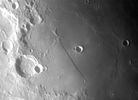
E-RupesRecta.jpgRupes Recta137 visitenessun commento
|
|

ZZ-Near Moon, Far Moon (2).jpgNear Moon, far Moon (2)136 visitePer meglio apprezzare la sensibile differenza di diametro apparente che caratterizza la Luna in queste due fasi del suo ciclo, Vi precisiamo che le 5 istantanee che la ritraggono sono state tutte quante riprese impiegando lo stesso telescopio, il medesimo ingrandimento e la stessa fotocamera.
|
|

D-MoretusCrater-01.gifMoretus Crater...on line!133 visitenessun commento
|
|

Hesiodus-00.jpgHesiodus & C.131 visitenessun commento
|
|

C-La Condamine Crater 02.jpgRays of light through "La Condamine Crater" (3)131 visitenessun commento
|
|

ClaviusCrater.jpgClavius129 visitenessun commento
|
|

Clavius-7.jpgClavius (4)128 visiteLa Regione di Clavius in piena luce: notate come questa immagine - pur restando molto bella - perda di "profondità" rispetto alle precedenti.
|
|

C-La Condamine Crater 06.jpgRays of light through "La Condamine Crater" (5)128 visiteCharles-Marie La Condamine studied at the Jesuit College of Louis-le-Grand in Paris. There he was taught mathematics by Père Louis Castel. On leaving the College he decided to take up a military career and, when war broke out with Spain he joined the army. He distinguished himself with his bravery at the siege of Rosas in 1719 but decided that army life did not suit him.
At this point La Condamine made contact with scientists in Paris and became a member of the Académie Royale des Sciences in 1730. The quiet life in Paris did not suit him either and he sailed on a voyage to Algiers, Alexandria, Palestine, Cyprus and Constantinople (now Istanbul) where he spent five months. On his return to Paris he published mathematical and physical observations of his voyage.
The Académie Royale was impressed and sent him on an expedition to Peru. In April 1735 La Condamine set out on the expedition to Peru to measure the length of a degree of meridian at the equator. Bouguer was a member of the same expedition and its third scientific member was the leader of the expedition Louis Godin. The three finished their journey by different routes, La Condamine going overland from Manta, the other two sailing to Quito where they joined up.
The three were soon involved in disagreements. Godin began to work on his own while La Condamine worked with Bouguer. In 1741 Bouguer discovered a small error in their joint measurements and these two fell out when Bouguer refused to allow La Condamine to recheck the results. All three made independent measurements, the work being completed in 1743. The three returned by different routes.
In 1743 La Condamine began his return journey which included a four month raft journey down the Amazon river. His was the first scientific account of the Amazon which he published as Journal du voyage fait par ordre du roi a l'équateur (1751).
La Condamine spent five months in Cayenne on his journey home and here he repeated Richer's experiments on the variation of weights at different latitudes.
By February 1745 La Condamine was back in Paris after his ten year journey. He returned with many notes, 200 natural history specimens and works of art which he gave to Buffon. Y Laissus writing in the Dictionary of Scientific Biography says:-
The last survivor of the expedition, La Condamine, who was a less gifted astronomer than Godin and a less reliable mathematician than Bouguer often received the major part of the credit, probably because of his amiable nature and his talent as a writer.
La Condamine was a close friend of Maupertuis for many years. He spent much effort in the last part of his life campaigning for inoculation against small-pox. His passion on this topic was partly due to the fact that he had suffered from small-pox as a child.
|
|
| 165 immagini su 14 pagina(e) |
 |
|
|
|
|
8 | |
|
|
|
|








