| Piú viste - The Moon After Apollo 17 |

ZZ-ZZ-ZZ-ZZ-ZZ-ZZ-CTX_Moon_6Oct2004.jpgThe Moon from Mars Reconnaissance Orbiter149 visiteThis image of Earth's moon was acquired by the Mars Reconnaissance Orbiter (MRO) Context Imager (CTX) camera during calibration and testing between 2:00 and 3:00 a.m. Pacific Daylight Time (PDT) on 6 October 2004. The image was taken by CTX before it was delivered and mounted on the MRO spacecraft. It was obtained from the parking lot at the Malin Space Science Systems facility in San Diego, California. In this image, east is toward the top and south is toward the bottom. The image demonstrates the field of view of the MRO CTX camera, which is 5064 pixels across (clicking on the image above will permit download of the full 5064 pixels-wide image). When in its circular mapping orbit about Mars, the 5064 pixels will cover a swath that is about 30 kilometers (~18.6 miles) across. CTX will obtain its 30 km-wide images at a resolution of about 6 meters (~19.7 feet) per pixel. CTX images will be used to provide context for the very high resolution images (better than 1 meter per pixel) to be obtained by the MRO HiRISE camera. CTX data will also provide context for MRO's CRISM infrared imaging spectrometer as well as provide detailed observations of martian landforms and potential, future Mars landing sites.
|
|

PythagorasCrater_smart_m1.jpgPythagoras Crater from Smart 1148 visiteOmbre affilate si stagliano dal picco centrale e dalle pareti "a terrazza" del Cratere Pitagora, uno dei "Grandi Crateri Lunari", avente un diametro di ben 120 Km. Questa visione del Cratere è il risultato di un fotomosaico ottenuto grazie alle immagini ricevute dalla Navicella ESA "SMART-1".
Il "picco centrale" - una caratteristica ripetitiva dei più grandi e complessi "crateri da impatto" Lunari (e non!) - potrebbe essere la conseguenza del "rimbalzo" e del successivo (nonché repentino) solidificarsi di grandi quantitativi di materiale roccioso il quale, a causa delle enormi temperature prodottesi a seguito dell'impatto, si è in parte liquefatto.
Spinta da un "propulsore ionico" di nuova concezione, la Navicella SMART-1 è entrata in orbita attorno alla Luna nel Novembre 2004 dopo una crociera di collaudo durata ben 13 (!) mesi.
SMART-1 (acronimo per Small Missions for Advanced Research in Technology), nei prossimi mesi, passerà ripetutamente accanto alla Luna ad altezze variabili dai 1000 ai 5000 Km.
|
|

ZZ-Tycho and Copernicus.jpgTycho and Copernicus Crater147 visiteCaption NASA originale:"Dazzling in binoculars or a small telescope, the Moon is pocked with impact craters. During partial lunar phases, the craters along the terminator are cast in dramatic relief by strong shadows. But when the Moon is full, some craters seem to sprout systems of bright radial lines or rays. This detailed close-up of the full Moon features two prominent ray craters, Copernicus (upper left) and Tycho (lower right), each with extensive ray systems of light colored debris blasted out by the crater-forming impacts. In general, ray craters are relatively young as their rays overlay the lunar terrain. In fact, at 85 Km wide, Tycho, with its far reaching rays, is the youngest large crater on the nearside. Crater Copernicus, surrounded by dark mare which contrast nicely with its bright rays, is 93 Km in diameter".
|
|

ZZ-ZZ-ZZ-FM-TLP-Proclus-Lunar Flash.jpgLunar "Flash" near the Terminator147 visite"Among the most enigmatic astronomical occurences are Lunar Transient Phenomena, instances of areas on the Moon appearing to brighten, darken, or change color on a time-scale of minutes. The very existence of LTP's is controversial, though they have been reported for 2 centuries (S&T: November, 1988, page 478).
Now a most remarkable one seems to have been photographed. On May 23, 1985, G. Kolovos (University of Thessaloniki) was testing a 4 1/4-inch refractor by taking pictures of the four-day-old Moon from a small village in Northern Greece. One of his seven photographs revealed a bright dot near the Moon's Terminator.
Kovolos and colleagues from the university closely analyzed the image of the dot, near the crater Proclus "C".
They write in the December, 1988 "Icarus", that the oval spot is 22 Km across and seems to conform to the local topography. What could causee such a bright flash on the Moon? The authors consider and dismiss several possibilities. Kodak Laboratories in Athens examined the film and concluded that the spot was not a film defect. It was not a surface reflection, because the illumination pattern implies that the flash occurred ABOVE the lunar surface. A volcanic eruption would have left an obscuring cloud on subsequent photos. So would a meteor impact.
Kovolos and co-workers hazard a guess that the intense heating of the lunar surface after sunrise might force cracks open, allowing trapped gas to escape. As the gas rises and expands, an electrical discharge could conceivably make it glow brightly. Many LTP sightings do occur near the lunar terminator within a day of sunrise. The researchers warn that their theory is far from being an explanation for all LTP's. "We present our results with caution," they write, "and we hope that additional data may lead to their indisputable explanation."
|
|

Moon Eclypse~0.jpgThe "Pumpkin" Moon146 visiteUn altro eccellente lavoro dell'astronomo Sebastien Gauthier il quale, "giocando" con la "Luna arancione" dell'ultima eclisse (Ottobre 2004), si è inventato un grazioso fotomontaggio che fa assomigliare il nostro Satellite alla maschera simbolo della festa di Halloween: la zucca (pumpkin). Una bella immagine ed una prova ulteriore che la Scienza può anche essere inventiva e divertimento (basta avere un pò di passione ed un pizzico di mezzi e di attitudine).
|
|

The Moon from Clem-usgs_19.jpgRising Earth over the Moon's North Pole146 visiteCaption NASA originale:"Clementine colorized image showing the full Earth over the Moon's North Pole. The angular distance between the Earth and the Moon has been reduced for illustration pruposes.
This image was taken by the UV/visible camera at the end of mapping orbit 102 on 13 March 1994.
The 109 km diameter Crater Plaskett is in the foreground at 82° North and 174° East (Clementine, USGS slide 19)".
|
|

ZZ-ZZ-ZZ-FM-TLP.gifTLP or illuminated "peaks" (again)?146 visiteObserver Joshua Try located in Whangarei, New Zealand reported that on 25-09-2001 at 8:30 U.T. he observed two possible L.T.Ps. on the edge of the terminator near the crater Archimedes. They appeared to be 2 bright points of light about the size of Mount Piton. They seem to form a triangle with Mount Piton. He observed them for 2 hours and they were still visible when he ended his observing session.
I had the opportunity to conduct some video tapping of the Moon on 22 January 2002 at 00 hr 18 min U.T. and was able to capture the Moon under similar lighting conditions. The image was taken with SCT C8 using 25mm eyepiece in projections. This image was taken when the Moon was 8.4 days old and the colongitude was 8.92. It may be that since the locations are very close that what Joshua saw was the tops of the mountain peaks just catching the sunlight. My image which is one lunar day later shows the mountains fully illuminated. I have had several reports in the past years that have reported these features as possible L.T.P. It can be very impressive and striking when one first sees these feature just catching the sunlight. It is my opinion that what the observer witness was peaks of these two mountains deep past the sunrise terminator.
|
|

The Moon from ESO.jpgThe Moon from European Space Obs.144 visiteDa "NASA - Picture of the Day" del 12.02.1999: "Late last month, NASA's Lunar Prospector spacecraft moved in for a closer look at the Moon. Now entering an extended mission phase, controllers have reduced the altitude of this polar lunar orbiter from 100 Km to about 30 Km. Having mapped global properties and recorded evidence for water-ice at the lunar poles, the lower orbit allows Prospector's instruments to gather valuable confirming data at higher resolutions. The new orbit is not without some risk, though, and maneuvers are required every 28 days to maintain it. Should the maneuvers fail to be performed, the spacecraft would impact the surface only two days later. This lunar close-up was recorded by the European Southern Observatory's new WFI camera. It shows dramatic shadows and contrasting terrain near the prominent Gassendi crater at the northern edge of the Moon's Mare Humorum".
|
|

Moon Eclypse 2004.3.jpgMoon's eclypse - October 2004 (3)144 visiteImmagine amatoriale, ma di ottima qualità, dell'eclissi dell'Ottobre 2004. La ripresa proviene da Tacoma (Washington - USA). L'Autore della ripresa si è nascosto dietro il nickname di KBoard.
Si tratta forse di un pianista, oltre che di un astro-fotografo di indubbie qualità?!?
|
|
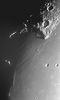
C-La Condamine Crater 00.jpgRays of light through "La Condamine Crater" (1)142 visiteNel novero dei cosiddetti TLP (ovvero Transient Lunar Phoenomena) ci sono anche - secondo alcune Scuole di Pensiero - i cosiddetti "Raggi di Luce" i quali, in situazioni di Sole radente (ovviamente con riferimento ai luoghi Lunari coinvolti ed a prescindersi dalla posizione dell'Osservatore Terrestre), si "intrufolano" - se ci passate questa espressione - attraverso i cracks delle murate (rims) di alcuni crateri e, nel farlo, disegnano inusuali - e temporanee, appunto - strisce di luce sul fondo dei crateri stessi.
Quello che Vi proponiamo in questa sequenza è (sembra essere) proprio uno di questi casi.
Per onestà intellettuale, però, pur proponendoVi questa sequenza e pur rispettando profondamente il lavoro dell'Astronomo Robert Spellman, noi riteniamo che questo tipo di fenomenologia, sebbene curiosamente interessante e suggestiva nelle visioni telescopiche della Luna, NON HA nulla a che spartire con la Famiglia Classica dei TLP.
|
|

I-Tycho-01.gifTycho...on line!139 visitenessun commento
|
|

ZZ-ZZ-ZZ-ZZ-ZZ-Gamma-Ray Moon.jpgGamma Ray Moon139 visiteDa "NASA - Picture of the Day" del 27 Maggio 2006:"If you could see Gamma Rays - photons with a million or more times the energy of visible light - the Moon would appear brighter than the Sun! The startling notion is demonstrated by this image of the Moon from the Energetic Gamma Ray Experiment Telescope (EGRET) in orbit on NASA's Compton Gamma Ray Observatory from April 1991 to June 2000. Then, the most sensitive instrument of its kind, even EGRET could not see the quiet Sun which is extremely faint at gamma-ray energies. So why is the Moon bright? High energy charged particles, known as cosmic rays, constantly bombard the unprotected lunar surface generating gamma-ray photons. EGRET's Gamma-Ray vision was not sharp enough to resolve a lunar disk or any surface features, but its sensitivity reveals the induced gamma-ray moonglow. So far unique, the image was generated from eight exposures made during 1991-1994 and covers a roughly 40° wide field of view with gamma-ray intensity represented in false colors".
|
|
| 165 immagini su 14 pagina(e) |
 |
|
|
|
|
7 | |
|
|
|
|








