| Piú viste - The Moon After Apollo 17 |
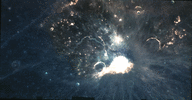
ZZ-ZZ-ZZ-FP-Clem-BrightAristarchus.gifAristarchus: the TLPs "Hottest Spot" (1)164 visiteA mosaic of more than 250 images showing the complex and diverse Aristarchus Region of the Moon in approximately "natural" colors (blue = 415 nanometers, green = 750 nanometers, red = 950 nanometers). The plateau is an uplifted block of complex, highland terrain, partly flooded by later mare basalt lavas. Dark, pyroclastic glasses partly cover the uplifted terrain. The crater Aristarchus (47 Km in diameter) has formed in the South-Western corner of the Plateau, excavating both highlands and mare rocks."
|
|

Albategnius-1.jpgAlbategnius Crater (1)163 visiteAlabategnius: un grande cratere del diametro di circa 120 km e con pareti (o murate) che arrivano sino a 4000 mt. Le sue coordinate sono: Lat. 12° Sud e Long. 4° Est. La sua posizione è nella Regione Centrale della Luna, una Regione caratterizzata (in buona misura) da grandi bacini d'impatto.
Albateignus non è difficile da localizzare - leggermente ad Est del Cratere Ptolemaeus.
|
|

Moon Eclypse 2004.1.jpgMoon's eclypse - October 2004 (1)162 visiteQuesta è la prima di una serie di 4 immagini amatoriali dell'eclisse totale di Luna dell'Ottobre 2004. Le abbiamo recuperate da un Sito chiamato "Universe Today".
Un buon Sito, ci sembra.
|
|
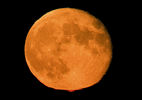
ZZ-ZZ-ZZ-ZZ-ZZ-LunarRedFlash_seip_f.jpgA "red flash" on the Moon162 visiteDa "NASA - Picture of the Day", del 22 Settembre 2005:"This remarkable telescopic image highlights the deep orange cast of a waning gibbous Moon seen very close to the eastern horizon on September 19. In fact, today's equinox at 22:23 UT marks the beginning of Fall in the Northern Hemisphere and makes this view from Stuttgart, Germany an almost Autumn Moon. While the long sight-line through the atmosphere filters and reddens the moonlight, it also bends different colors of light through slightly different angles, producing noticeable red (bottom) and green (top) lunar rims. Also captured here floating just below the Moon is a thin, red mirage (inset) - in this case, an atmospherically magnified and distorted image of the red rim. Of course, this tantalizing lunar 'red flash' is related to the more commonly seen 'green flash' of the Sun".
|
|

ZZ-Near Moon, Far Moon (1).jpgNear Moon, far Moon (1)158 visiteImmagine tratta dal "NASA - Astronomy Picture of the Day" del giorno 21 Ottobre 2004. Si tratta di alcune spettacolari ripresa della Luna effettuate a distanza di 15 giorni esatti l'una dall'altra, all'interno della medesima "lunazione" (o "ciclo lunare"). La differenza è che il primo quarto che vediamo nelle immagini (1) e (2), ritrae la Luna al suo apogeo e cioè nel punto della sua orbita più lontano dalla Terra. Nelle fotografie (3), (4) e (5), invece, la Luna si sta avvicinando al suo perigeo e cioè il punto della sua orbita più vicino alla Terra. Di regola ad occhio nudo - ed a meno che chi guarda non sia un osservatore del cielo davvero eccezionale - la differenza di dimensioni della Luna - che pure è notevole in queste due fasi orbitali! - può sfuggire; ma è sufficiente un modesto telescopio ed una fotocamera (anche di tipo non professionale) per poter far emergere la profonda diversità di diametro apparente del nostro Satellite.
|
|

Moon Eclypse 2004.jpgRed Moon - October, 27, 2004 (5)155 visiteLa "Luna Rossa" del 27 Ottobre 2004.
In accordo allo stile - ormai consolidato - dei fotoamatori esperti nella ripresa dei fenomeni del cielo, si tratta di un suggestivo montaggio relativo alle 3 fasi fondamentali dell'eclisse lunare: la "ramatura" iniziale, l'eclisse piena e l'uscita della Luna dal cono d'ombra (con il susseguente termine della colorazione rossastra del nostro Satellite).
Delle belle immagini, senza dubbio.
|
|
![The Moon from CLEM-clm_usgs_18[1].jpg](albums/userpics/10008/small_The%20Moon%20from%20CLEM-clm_usgs_18%5B1%5D.jpg "Nome del file=The Moon from CLEM-clm_usgs_18[1].jpg
Dimensione del file=346KiB
Dimensioni=1204x871
Aggiunta il=Gen 28, 2005")
The Moon from CLEM-clm_usgs_18[1].jpgSchrödinger Impact Basin from Clementine155 visiteCaption NASA originale:"Clementine mosaic of the Schrödinger impact basin near the south pole of the Moon. The basin is 312 Km in diameter and centered at 67° S, 132° E.
Note the smooth floor and the large inner ring.
The dark area around the small crater just left of the center of the basin was probably caused by relatively recent volcanic ejecta. The South Pole is just off the upper left corner of the image (Clementine, USGS slide 18)".
|
|

Clavius-3.jpgClavius (1)153 visiteClavius: uno spettacolare cratere, reso famoso dall'immortale "2001 - A Space Odyssey", così come ci appare dalla Terra, attraverso le eccellenti ottiche di un telescopio riflettore 'Celestron 11'.
Il seeing, con ogni probabilità, non era ottimale - come l'immagine dimostra ampiamente -; ma il risultato ottenuto (grazie anche al gioco di luci e di ombre che si ottiene scattando fotografie di Regioni Lunari che si trovano a ridosso o che sono prossime al terminatore) è - comunque - davvero notevole.
|
|

The Moon from CLEM-clm_usgs_08.jpgSchröteri Vallis from Clementine152 visiteCaption NASA originale:"Clementine color image of Vallis Schröteri, the largest known sinuous rille on the Moon. Located on the plateau of Aristarchus Crater, near 26° N, 309° E, Vallis Schröteri is about 160 Km long and up to 11 Km wide and 1 Km deep. Note the "cobra head" at the lower right, which is a vent marking the beginning of the rille.
North is up (Clementine, USGS slide 8)".
|
|

C-La Condamine Crater 01.jpgRays of light through "La Condamine Crater" (2)152 visitePer Vostra opportuna informazione, infatti, noi riteniamo la Famiglia dei TLP come (essenzialmente, almeno) formata da quattro macro-classi:
1) flash (che possono avere vario colore e diverse provenienze);
2) star-like shining (che possono avere vario colore e varie durate);
3) annebbiamenti (in tali casi i rilievi lunari coinvolti restano comunque visibili);
4) oscuramenti (ed in tal caso i rilievi lunari coinvolti "spariscono", dal punto di vista dell'Osservatore, per qualche momento).
|
|

Albategnius-2.jpgAlbategnius Crater (2)152 visiteAlbategnius (Al-Battani, Muhammad ibn Jabir) (approx. 850-929)
--------------------------------------------------------------------------------
An Iraqi prince, born in Batan, Mesopotamia (Iraq), who was the leading Astronomer and Mathematician of his time. He drew up improved tables of the Sun and Moon, measured the eccentricity of Earth’s orbit and the inclination of Earth’s Equator to its orbital plane. He was capable of making an extremely accurate measurement of the length of the Earth year - which was also used in the Gregorian reform of the Julian Calendar. His observations at Rakku, made over (probably) a 40-year period, were summarized in his work "Movements of the Stars" (first published in Europe in 1537).
Thanks to his contribution, Johannes Hevelius (1611-1687) was able to theorize and discover the secular variation in the Moon’s motion.
|
|

ZZ-Near Moon, Far Moon (4).jpgNear Moon, far Moon (4)151 visitenessun commento
|
|
| 165 immagini su 14 pagina(e) |
 |
|
|
|
6 | |
|
|
|
|
|








