| Piú viste - The Moon After Apollo 17 |
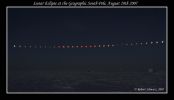
SouthPolarEclipse.jpgLunar Eclipse from the South Pole79 visiteCaption NASA:"The Moon was up continuously for 14 days in August -- when viewed from the South Pole. But during the total Lunar Eclipse on August 28, it circled only about 10° above the horizon. For Robert Scharwz, the resulting long line-of-sight through the atmosphere that blurred his images was a minor problem when he recorded this 4-hour long Lunar Eclipse sequence. A more severe problem was the outdoor air temperature of - 68° C (such as - 90 F). The extreme cold required him to make the series of exposures through a slit in a window from inside a heated room. Though the heat produced convection and further blurring, it was the only way to keep the camera at a reasonable operating temperature for an extended period of time. Still, he was rewarded with this impressive record of August's lunar eclipse from a unique perspective on planet Earth".MareKromium
|
|

PlatoCrater-06.jpgPlato Crater (2)78 visitenessun commento
|
|

Red_Moon.jpgDark Lunar Eclipse78 visiteCaption NASA:"The Moon passed close to the center of Earth's shadow on August 28th, 2007. Seen best by skywatchers in western North America and the Pacific Region, the resulting Total Lunar Eclipse was a dark one, lasting about 90 minutes. In this telescopic image taken near mid totality from Yass, NSW Australia, the 85 Km wide ray crater Tycho lies near the top right of the shadowed lunar surface.
Of course, even during a Total Lunar Eclipse, the Moon is not completely dark. Instead the Moon remains visible during totality, reflecting reddened light filtering into the Earth's shadow.
The light comes from all the Sunsets and Sunrises, as seen from the lunar perspective, around the edges of a silhouetted Earth".MareKromium
|
|

Moon Panorama - 4.jpgMoon Panorama (5)76 visitenessun commento
|
|

The Moon-01.jpgThe Moon, in blue-green filters, from Mars Reconnaissance Orbiter (2)75 visitenessun commento
|
|

Mare_Imbrium.jpgMare Imbrium75 visiteCaption NASA:"Dark, smooth Regions that cover the Moon's familiar face are called by Latin names for oceans and seas. The naming convention is historical, though it may seem a little ironic to denizens of the space age who recognize the Moon as a mostly dry and airless world, and the smooth, dark areas as lava-flooded impact basins. For example, this elegant lunar vista, a careful mosaic of telescopic images, looks across the expanse of the North-Western Mare Imbrium, or Sea of Rains, into the Sinus Iridum - the Bay of Rainbows. Ringed by the Jura Mountains (montes), the bay is about 250 Km across, bounded at the bottom of the rugged arc by Cape (promontorium) Laplace.
The Cape's sunlit face towers nearly 3000 mt above the bay's surface. At the top of the arc is Cape Heraclides, at times seen as a moon maiden".MareKromium
|
|

Triesnecker-00.jpgTriesnecker (1)74 visitenessun commento
|
|

First Moon.jpgFirst Moon72 visitenessun commento
|
|

First Moon-1.jpgFirst Moon69 visitenessun commento
|
|
|
|
|
| 165 immagini su 14 pagina(e) |
 |
|
|
|
|
|
|
|
|
14 |
|








