| Piú viste - The Moon After Apollo 17 |

Posidonius Crater.jpgPosidonius Crater99 visitenessun commento
|
|

ZZ-ZZ-ZZ-ZZ-ZZ-ZZ-ZZ-ZZ-The Moon-1.jpgThe Moon from Galileo98 visiteCaption NASA originale:"The Moon's surface is covered with craters, scars of frequent impacts during the early history of the Solar System. Now, recent results from the Lunar Prospector spacecraft support the idea that the Moon itself formed from the debris of a giant impact of a Mars-sized planetary body with the Earth nearly 4,5 BY ago. The impact theory of lunar origin can explain why Moon rocks returned by the Apollo missions have the same isotopic ratios as Earth rocks while the Moon seems deficient in heavy elements like iron. It can also explain a critical finding of the Lunar Prospector experiments - that the Moon's core is proportionally very small. If the Moon formed simply as a Sister World, its origin paralleling Earth's formation from the primordial Solar Nebula, it should have similar iron content and relative core size. But material blasted from the surface of Earth by an impacting body would lack the iron and heavy elements which had settled to the Earth's core yet retain similar ratios of chemical isotopes. A fraction of this debris cloud would remain in Earth orbit ultimately forming the Moon".
|
|

FadingMoon-02.gifFading Sun-Lights... (2)97 visitenessun commento
|
|

Hyginus-Ariadaeus-Manilius.jpgHyginus and Ariadaeus rilles and Manilius Crater95 visitenessun commento
|
|

Moon-SouthernSide.jpgThe Southern Highlands of the Moon (Moretus and Curtius)95 visiteCaption NASA:"The Moon's South Pole is near the top of this sharp telescopic view looking across the Southern Lunar Highlands. Recorded on August 3rd, 2007, from Tecumseh, Oklahoma, planet Earth, the foreshortened perspective heightens the impression of a dense field of craters and makes the craters themselves appear more oval shaped. The prominent crater in the foreground, Moretus, has a diameter of 114 Km and lies just west (left) of the Moon's Central Meridian. For large lunar craters, Moretus is young and features terraced inner walls and a 2,1 Km high, bright central peak, similar in appearance to the more northerly crater Tycho. Just to the right of Moretus is the 95 Km diameter crater Curtius.
Curtius has older, rounded walls marked by smaller, more recent impact craters".MareKromium
|
|

FadingMoon-04.gifFading Sun-Lights... (4)94 visitenessun commento
|
|

South Pole - 00.jpgUnusual features and shadows near the South Pole (1)94 visitenessun commento
|
|

Rheita Valley - 01.jpgRheita Valley (2)94 visitenessun commento
|
|

The Moon - Near Side - Galileo.JPGThe "Near-Side" of the Moon, from Galileo92 visitenessun commento
|
|

The_Moon-Aristarchus_Plateau.jpgAristarchus Plateau: the cradle of TLP's92 visiteCaption NASA:"Anchored in the vast lava flows of the Moon's Oceanus Procellarum lies the Aristarchus Plateau. The bright impact crater at the corner of the plateau is Aristarchus, a young crater 42 Km wide and 3 Km deep. Only slightly smaller, lava flooded Herodotus crater is above and to the left.
A valley (or rille) feature likely carved by rapidly flowing lava or a collapsed lava tunnel, Vallis Schroteri begins just to the right of Herodotus and winds across the plateau for about 160 Km, eventually turning toward the top of the picture.
Aristarchus Plateau itself is like a rectangular island about 200 km across, raised up to 2 kilometers or so above the smooth surface of the lunar Ocean of Storms.
Recorded from a backyard observatory in Buffalo, New York, the contrast of light-colored ejecta around Aristarchus with surrounding dark, smooth, lava flooded surfaces suggests more familiar snowy scenes of planet Earth".MareKromium
|
|
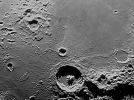
Torricelli Crater-00.jpgTorricelli Crater (1)91 visitenessun commento
|
|

North Pole.jpgNorth Polar Region91 visitenessun commento
|
|
| 165 immagini su 14 pagina(e) |
 |
|
|
|
|
|
|
|
12 | |
|








