| Ultimi arrivi - The Moon After Apollo 17 |

ClaviusCrater.jpgClavius128 visitenessun commentoGen 16, 2006
|
|

ZZ-ZZ-ZZ-FQ-BrightAristarchus.gifAristarchus: the TLPs "Hottest Spot" (2)138 visiteEcco come appare Aristarco in una (secondo noi eccellente, a dispetto dell'apparenza un pò sfuocata) ripresa da Terra.
Original caption:"Photograph shown here was taken using a 12.5 F 5 Newtonian reflector, with 12.5mm eyepiece and 2x Barlow. Using digital still camera DSC-P71 mounted for eyepiece projection. The photograph was taken on April 3. 2004 at 1:20 U.T.".Gen 01, 2006
|
|
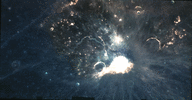
ZZ-ZZ-ZZ-FP-Clem-BrightAristarchus.gifAristarchus: the TLPs "Hottest Spot" (1)162 visiteA mosaic of more than 250 images showing the complex and diverse Aristarchus Region of the Moon in approximately "natural" colors (blue = 415 nanometers, green = 750 nanometers, red = 950 nanometers). The plateau is an uplifted block of complex, highland terrain, partly flooded by later mare basalt lavas. Dark, pyroclastic glasses partly cover the uplifted terrain. The crater Aristarchus (47 Km in diameter) has formed in the South-Western corner of the Plateau, excavating both highlands and mare rocks." Gen 01, 2006
|
|
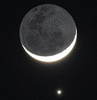
ZZ-ZZ-ZZ-FN-Earthshine.gifCoronal Mass Ejection and Earthsine122 visiteThis photograph was taken by Devgun Chander of Sohna, Haryana, of India. It shows a striking clarity to the earthshine region of the Moon. When I first look at the photograph I was impressed that Aristarchus was standing out so bright even though it very close to the sunset terminator. I sent the photograph to Dr. Anthony Cook the senior recorder for the L.T.P. sections of BAA and ALPO. He sent me the measured brightness of specific lunar formations and of the Lunar Maria.
(...) The Maria across the face of the Moon is uniformly bright except for the formations Mare Humorum, Mare Frigoris and Maria located near Aristarchus. Dr. Anthony Cook believes they are brighter due to the glare from the nearby sunset terminator. (...) The fact that we had a significant coronal mass ejections into space or CME take place on November 8-9,2004 causing aurora reports all over the World. If Solar Excitation is a factor for the extreme brightness of the Earthshine this would be the event to cause it.
Gen 01, 2006
|
|

ZZ-ZZ-ZZ-FM-TLP.gifTLP or illuminated "peaks" (again)?146 visiteObserver Joshua Try located in Whangarei, New Zealand reported that on 25-09-2001 at 8:30 U.T. he observed two possible L.T.Ps. on the edge of the terminator near the crater Archimedes. They appeared to be 2 bright points of light about the size of Mount Piton. They seem to form a triangle with Mount Piton. He observed them for 2 hours and they were still visible when he ended his observing session.
I had the opportunity to conduct some video tapping of the Moon on 22 January 2002 at 00 hr 18 min U.T. and was able to capture the Moon under similar lighting conditions. The image was taken with SCT C8 using 25mm eyepiece in projections. This image was taken when the Moon was 8.4 days old and the colongitude was 8.92. It may be that since the locations are very close that what Joshua saw was the tops of the mountain peaks just catching the sunlight. My image which is one lunar day later shows the mountains fully illuminated. I have had several reports in the past years that have reported these features as possible L.T.P. It can be very impressive and striking when one first sees these feature just catching the sunlight. It is my opinion that what the observer witness was peaks of these two mountains deep past the sunrise terminator.
Gen 01, 2006
|
|

Clavius-7.jpgClavius (4)127 visiteLa Regione di Clavius in piena luce: notate come questa immagine - pur restando molto bella - perda di "profondità" rispetto alle precedenti.Dic 11, 2005
|
|

Clavius-6.jpgClavius (3)124 visitenessun commentoDic 11, 2005
|
|

Clavius-4.jpgClavius (2)120 visitenessun commentoDic 11, 2005
|
|

Clavius-3.jpgClavius (1)153 visiteClavius: uno spettacolare cratere, reso famoso dall'immortale "2001 - A Space Odyssey", così come ci appare dalla Terra, attraverso le eccellenti ottiche di un telescopio riflettore 'Celestron 11'.
Il seeing, con ogni probabilità, non era ottimale - come l'immagine dimostra ampiamente -; ma il risultato ottenuto (grazie anche al gioco di luci e di ombre che si ottiene scattando fotografie di Regioni Lunari che si trovano a ridosso o che sono prossime al terminatore) è - comunque - davvero notevole.Dic 11, 2005
|
|

00-Lunation.gifA full Lunar Cycle (Lunation)281 visiteDa "Astronomy: Picture of the Day", del 13 Novembre 2005:"Our Moon's appearance changes nightly. This time-lapse sequence shows what our Moon looks like during a lunation, such as a complete Lunar Cycle.
As the Moon orbits the Earth, the half illuminated by the Sun first becomes increasingly visible, then decreasingly visible. The Moon always keeps the same face toward the Earth and its apparent size changes slightly, though, and a slight wobble called "libration" is discernable as it progresses along its elliptical orbit.
During the cycle, sunlight reflects from the Moon at different angles and so illuminates different features differently. A full lunation takes about 29,5 days, such as just under a month (moon-th)".Nov 13, 2005
|
|

M-N-O-Lobachevsky.jpgThe Lobachevsky Anomaly, from Clementine (3) - 3D detail mgnf280 visiteUn piccolo (diremmo l'ennesimo) gioiello a 3D che il Dr Feltri ci propone per vedere e riflettere meglio sulla reale natura e configurazione di questa Singolarità la quale, a nostro parere, è ancora quasi del tutto incompresa e, comunque, risulta di difficile collocazione nel già complesso panorama dei rilievi lunari anomali.Ott 11, 2005
|
|
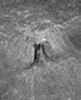
M-N-Lobachewsky.gifThe Lobachevsky Anomaly, from Clementine (2) - detail mgnf234 visitenessun commentoOtt 10, 2005
|
|
| 165 immagini su 14 pagina(e) |
 |
|
|
|
|
9 | |
|
|
|
|








