| Ultimi arrivi - The Moon After Apollo 17 |

First Moon.jpgFirst Moon72 visitenessun commentoOtt 19, 2006
|
|
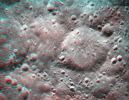
B-Pirquet_3D.jpgPirquet Crater (3D)108 visitenessun commentoSet 11, 2006
|
|

B-ZhiritskiyCrater.jpgZhiritskiy Crater (3D)110 visitenessun commentoSet 11, 2006
|
|

B-Tsiolkovsky_3D~0.jpgThe Peak of Tsiolkovsky Crater (3D)117 visitenessun commentoSet 11, 2006
|
|
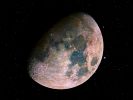
The Moon~0.jpgWonderful, wonderful Moon!... (HR)101 visiteDa "NASA - Picture of the Day", del 7 Settembre 2006:"No single exposure can easily capture faint stars along with the subtle colors of the Moon. But this dramatic composite view highlights both.
The mosaic digitally stitches together fifteen carefully exposed HR images of a bright, gibbous Moon and a representative background star field. The fascinating color differences along the Lunar Surface are real, though highly exaggerated, corresponding to regions with different chemical compositions.
And while these color differences are not visible to the eye even with a telescope, Moon watchers can still see a dramatic lunar presentation tonight: a partial eclipse of the Moon will be visible from Europe, Africa, Asia and Australia".Set 07, 2006
|
|

ZZ-ZZ-ZZ-ZZ-ZZ-ZZ-ZZ-The Moon.jpgThe North Pole of the Moon82 visiteCaption NASA originale:"This arresting image of the third quarter Moon in the excellent skies above the Pine Crest Farm Observatory, Dell Prairie, Wisconsin, was recorded with a 24" telescope and digital camera on October 19, 2000. Marvelously detailed, especially along the terminator or shadow line between lunar night and day, this cropped version of the full mosaicked image shows the cratered North Polar Region and the broad smooth Mare Imbrium. Notable at the northern edge of the Mare Imbrium (Sea of Rains) is the 95 Km wide dark crater Plato, while the dramatic straight "cut" to the right of Plato, (toward the terminator) is the Vallis Alpes (Alpine Valley). The long, graceful arc of the lunar Montes Apenninus in the lower portion of the image sweeps Southward along the boundary of the mare toward the left and ends near the bright ray crater Copernicus at the picture's edge. In 1971, Apollo 15 landed near the gap beyond the opposite (northern) end of the Montes Apenninus arc".Lug 17, 2006
|
|

ZZ-ZZ-ZZ-ZZ-ZZ-ZZ-ZZ-ZZ-The Moon-1.jpgThe Moon from Galileo96 visiteCaption NASA originale:"The Moon's surface is covered with craters, scars of frequent impacts during the early history of the Solar System. Now, recent results from the Lunar Prospector spacecraft support the idea that the Moon itself formed from the debris of a giant impact of a Mars-sized planetary body with the Earth nearly 4,5 BY ago. The impact theory of lunar origin can explain why Moon rocks returned by the Apollo missions have the same isotopic ratios as Earth rocks while the Moon seems deficient in heavy elements like iron. It can also explain a critical finding of the Lunar Prospector experiments - that the Moon's core is proportionally very small. If the Moon formed simply as a Sister World, its origin paralleling Earth's formation from the primordial Solar Nebula, it should have similar iron content and relative core size. But material blasted from the surface of Earth by an impacting body would lack the iron and heavy elements which had settled to the Earth's core yet retain similar ratios of chemical isotopes. A fraction of this debris cloud would remain in Earth orbit ultimately forming the Moon".Lug 17, 2006
|
|

ZZ-ZZ-ZZ-ZZ-ZZ-ZZ-ZZ-ZZ-Earth&Moon from Nozomi.jpgThe Earth-Moon System from Nozomi108 visiteCaption NASA originale:"Japan launched its first mission to orbit Mars, Nozomi (Hope), on July 3rd, 1998, from the Kagoshima Space Center on the island of Kyushu. Nozomi's goal is to explore the Martian atmosphere and magnetic field as well as Regions of the Planet's surface and Moons. Formerly known as Planet-B, the spacecraft will use highly elliptical orbits with successive Earth/Moon flybys to help slingshot itself along its ultimate trajectory toward Mars, arriving at the Red Planet in October 1999. This stunning picture of the crescent Earth-Moon system was taken by Nozomi's onboard camera on July 18 from a point in space about 100.000 miles from the Earth and 320.000 miles from the Moon. Vibrant and bright, the reflective clouds and oceans of Earth contrast strongly with the dark, somber tones of the Lunar Surface".Lug 17, 2006
|
|

ZZ-ZZ-ZZ-ZZ-ZZ-ZZ-ZZ-ZZ-The Moon.jpgMare Imbrium, from Galileo100 visiteCaption NASA originale:"Checking out the Galileo spacecraft's cameras during its December 1992 fly-by of Earth's Moon, controllers took this dramatically illuminated picture through a violet filter. The view looks down on the Moon's North Polar Region with the Sun shining from the left at a low angle and the direction toward the Moon's North Pole toward the lower right.
Across the image upper left stretches the smooth volcanic plain of the Mare Imbrium. Pythagoras crater, 65 miles wide, is near the center of the image -- mostly in shadow, its central peak just catches the sunlight (...)".Lug 17, 2006
|
|

ZZ-ZZ-ZZ-FM-TLP-Proclus-Lunar Flash.jpgLunar "Flash" near the Terminator146 visite"Among the most enigmatic astronomical occurences are Lunar Transient Phenomena, instances of areas on the Moon appearing to brighten, darken, or change color on a time-scale of minutes. The very existence of LTP's is controversial, though they have been reported for 2 centuries (S&T: November, 1988, page 478).
Now a most remarkable one seems to have been photographed. On May 23, 1985, G. Kolovos (University of Thessaloniki) was testing a 4 1/4-inch refractor by taking pictures of the four-day-old Moon from a small village in Northern Greece. One of his seven photographs revealed a bright dot near the Moon's Terminator.
Kovolos and colleagues from the university closely analyzed the image of the dot, near the crater Proclus "C".
They write in the December, 1988 "Icarus", that the oval spot is 22 Km across and seems to conform to the local topography. What could causee such a bright flash on the Moon? The authors consider and dismiss several possibilities. Kodak Laboratories in Athens examined the film and concluded that the spot was not a film defect. It was not a surface reflection, because the illumination pattern implies that the flash occurred ABOVE the lunar surface. A volcanic eruption would have left an obscuring cloud on subsequent photos. So would a meteor impact.
Kovolos and co-workers hazard a guess that the intense heating of the lunar surface after sunrise might force cracks open, allowing trapped gas to escape. As the gas rises and expands, an electrical discharge could conceivably make it glow brightly. Many LTP sightings do occur near the lunar terminator within a day of sunrise. The researchers warn that their theory is far from being an explanation for all LTP's. "We present our results with caution," they write, "and we hope that additional data may lead to their indisputable explanation."
Lug 16, 2006
|
|

ZZ-ZZ-ZZ-Crater 297.jpgCrater 297 and "artificial blurring" over the Moon189 visiteUn bellissimo fotomosaico regalatoci dal Dr Alessio Feltri per vedere non solo la zona sorvolata dall'Apollo 10 al momento del suo 'strano incontro' con quello che abbiamo definito "space debris" (rottame spaziale), ma anche un (nuovo) esempio di come la NASA (o chi per essa...) manipola, altera ed infine confonde le immagini (probabilmente) imbarazzanti della superficie lunare.
Scopo della sfuocatura che vediamo nel frame Clementine alla Vostra Dx? Beh, noi non lo sappiamo, ma Voi potete sempre provare a chiedere lumi alla NASA...Giu 27, 2006
|
|

ZZ-ZZ-ZZ-ZZ-ZZ-Gamma-Ray Moon.jpgGamma Ray Moon135 visiteDa "NASA - Picture of the Day" del 27 Maggio 2006:"If you could see Gamma Rays - photons with a million or more times the energy of visible light - the Moon would appear brighter than the Sun! The startling notion is demonstrated by this image of the Moon from the Energetic Gamma Ray Experiment Telescope (EGRET) in orbit on NASA's Compton Gamma Ray Observatory from April 1991 to June 2000. Then, the most sensitive instrument of its kind, even EGRET could not see the quiet Sun which is extremely faint at gamma-ray energies. So why is the Moon bright? High energy charged particles, known as cosmic rays, constantly bombard the unprotected lunar surface generating gamma-ray photons. EGRET's Gamma-Ray vision was not sharp enough to resolve a lunar disk or any surface features, but its sensitivity reveals the induced gamma-ray moonglow. So far unique, the image was generated from eight exposures made during 1991-1994 and covers a roughly 40° wide field of view with gamma-ray intensity represented in false colors".Mag 27, 2006
|
|
| 165 immagini su 14 pagina(e) |
 |
3 | |
|
|
|
|
|
|
|
|








