| |

| Ultimi arrivi - The Moon After Apollo 17 |

ZZ-ZZ-U-Flash-MeteorImpact-Moon.gifMeteor Strike on the New Moon's limb? (GIF-Movie)205 visiteTLP? No: questo GIF-Movie ci mostra - e MOLTO bene! - l'effetto luminoso prodotto da un bolide che impatta la Luna. Un rapido lampo particolarmente intenso ("Primary Flash" o "bagliore da impatto") e quindi una serie di lampi ulteriori - dovete osservare il filmato varie volte per riuscire a coglierli - che degradano in una debole luminescenza la quale, infine, viene avvolta dall'oscurità ("Secondary Flashes" o "bagliori secondari da impatto").
Ora, la domanda che ci è stata rivolta è questa: i "Lunar Flash" derivanti da (o connessi a) Meteor Strikes (o Impatti Meteorici) possono essere considerati del Transient Lunar Phoenomena?
Ebbene, se - da un certo punto di vista - ogni fenomeno estemporaneo (ergo anche il lampo di luce derivante da un impatto) è, per definizione, un "Evento Transiente", la Verità, se non altro a parere di chi scrive, è che i TLP "Puri" NON RICOMPRENDONO i bagliori da impatto.MareKromiumGiu 11, 2009
|
|

X-Moon.jpgX-Moon!353 visiteDa "NASA - Picture of the Day" del giorno 11 Marzo 2009:"The striking "X" near the center of this lunarscape is easily visible in binoculars or a small telescope. Yet, not too many have seen it. The catch is, this Lunar "X" is only apparent during a 4 hour period just before the Moon's first quarter phase.
At the Terminator, or shadow line between lunar day and night, the X illusion is produced by a configuration of the craters Blanchinus, La Caille and Purbach.
Near the Moon's first quarter phase, an astronaut standing close to the craters' position would see the slowly rising Sun very near the horizon. Temporarily, the crater walls would be in sunlight while the crater floors were still in darkness.
Seen from planet Earth, contrasting sections of bright walls against the dark floors by chance look remarkably like an X. This sharp image of the Lunar "X" was captured at approx. 11:59 UT on March 3, 2009. The Moon's first quarter phase was at at 7:46 UT on March 4, AD 2009".MareKromiumMar 11, 2009
|
|

Mare_Imbrium.jpgMare Imbrium75 visiteCaption NASA:"Dark, smooth Regions that cover the Moon's familiar face are called by Latin names for oceans and seas. The naming convention is historical, though it may seem a little ironic to denizens of the space age who recognize the Moon as a mostly dry and airless world, and the smooth, dark areas as lava-flooded impact basins. For example, this elegant lunar vista, a careful mosaic of telescopic images, looks across the expanse of the North-Western Mare Imbrium, or Sea of Rains, into the Sinus Iridum - the Bay of Rainbows. Ringed by the Jura Mountains (montes), the bay is about 250 Km across, bounded at the bottom of the rugged arc by Cape (promontorium) Laplace.
The Cape's sunlit face towers nearly 3000 mt above the bay's surface. At the top of the arc is Cape Heraclides, at times seen as a moon maiden".MareKromiumFeb 09, 2008
|
|

The_Moon-Aristarchus_Plateau.jpgAristarchus Plateau: the cradle of TLP's91 visiteCaption NASA:"Anchored in the vast lava flows of the Moon's Oceanus Procellarum lies the Aristarchus Plateau. The bright impact crater at the corner of the plateau is Aristarchus, a young crater 42 Km wide and 3 Km deep. Only slightly smaller, lava flooded Herodotus crater is above and to the left.
A valley (or rille) feature likely carved by rapidly flowing lava or a collapsed lava tunnel, Vallis Schroteri begins just to the right of Herodotus and winds across the plateau for about 160 Km, eventually turning toward the top of the picture.
Aristarchus Plateau itself is like a rectangular island about 200 km across, raised up to 2 kilometers or so above the smooth surface of the lunar Ocean of Storms.
Recorded from a backyard observatory in Buffalo, New York, the contrast of light-colored ejecta around Aristarchus with surrounding dark, smooth, lava flooded surfaces suggests more familiar snowy scenes of planet Earth".MareKromiumNov 30, 2007
|
|
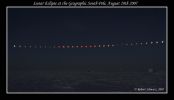
SouthPolarEclipse.jpgLunar Eclipse from the South Pole79 visiteCaption NASA:"The Moon was up continuously for 14 days in August -- when viewed from the South Pole. But during the total Lunar Eclipse on August 28, it circled only about 10° above the horizon. For Robert Scharwz, the resulting long line-of-sight through the atmosphere that blurred his images was a minor problem when he recorded this 4-hour long Lunar Eclipse sequence. A more severe problem was the outdoor air temperature of - 68° C (such as - 90 F). The extreme cold required him to make the series of exposures through a slit in a window from inside a heated room. Though the heat produced convection and further blurring, it was the only way to keep the camera at a reasonable operating temperature for an extended period of time. Still, he was rewarded with this impressive record of August's lunar eclipse from a unique perspective on planet Earth".MareKromiumSet 07, 2007
|
|

Red_Moon.jpgDark Lunar Eclipse78 visiteCaption NASA:"The Moon passed close to the center of Earth's shadow on August 28th, 2007. Seen best by skywatchers in western North America and the Pacific Region, the resulting Total Lunar Eclipse was a dark one, lasting about 90 minutes. In this telescopic image taken near mid totality from Yass, NSW Australia, the 85 Km wide ray crater Tycho lies near the top right of the shadowed lunar surface.
Of course, even during a Total Lunar Eclipse, the Moon is not completely dark. Instead the Moon remains visible during totality, reflecting reddened light filtering into the Earth's shadow.
The light comes from all the Sunsets and Sunrises, as seen from the lunar perspective, around the edges of a silhouetted Earth".MareKromiumSet 01, 2007
|
|

Moon-SouthernSide.jpgThe Southern Highlands of the Moon (Moretus and Curtius)92 visiteCaption NASA:"The Moon's South Pole is near the top of this sharp telescopic view looking across the Southern Lunar Highlands. Recorded on August 3rd, 2007, from Tecumseh, Oklahoma, planet Earth, the foreshortened perspective heightens the impression of a dense field of craters and makes the craters themselves appear more oval shaped. The prominent crater in the foreground, Moretus, has a diameter of 114 Km and lies just west (left) of the Moon's Central Meridian. For large lunar craters, Moretus is young and features terraced inner walls and a 2,1 Km high, bright central peak, similar in appearance to the more northerly crater Tycho. Just to the right of Moretus is the 95 Km diameter crater Curtius.
Curtius has older, rounded walls marked by smaller, more recent impact craters".MareKromiumAgo 23, 2007
|
|

00-Libration-250px-Lunar_libration_with_phase2.gifThe "Lunation": such as a full "Lunar Cycle"85 visitenessun commentoMareKromiumDic 05, 2006
|
|

ZZ-ZZ-ZZ-ZZ-ZZ-FastWalker-konig080896.gifFast-walker in transit113 visiteMappa dei dettagli riconoscibili della superficie Lunare:
1. Mercator
2. Konig
3. Agatharchides
4. Hippalus
5. Cape Kelvin
6. Campanus
Nota: i Curatori del Sito LUNASCAN PROJECT, nel commentare questo straordinario filmato, ritengono che quanto ripreso sia l'OGGETTO EFFETTIVO "in transito" e NON la sua OMBRA che passa sulla superficie lunare. Si tratta, come ovvio, di una opinione rispettabilissima, ma che noi ci sentiamo di non condividere.
Cogliamo l’occasione – fornitaci dalle interessanti ed acute riflessioni svolte dal nostro Amico e Socio “Anakin” in sede di commento al frame – per fare qualche precisazione sul motivo per cui noi abbiamo optato per l’ipotesi che vuole la ripresa di un’“ombra” in transito sulla Superficie Lunare e non la ripresa dell’oggetto che la crea.
Allora: tralasciando la “sensibilità” dell’Osservatore (un dato troppo soggettivo per avere una effettiva rilevanza in questa sede), diciamo che, quando si usa un telescopio, si dispone di una serie di oculari i quali determinano il “livello di ingrandimento” del target osservato.
Ora noi sappiamo che esistono non solo oculari grandi e piccoli ma anche – ed ovviamente – oculari più potenti (e cioè che ingrandiscono di più) ed oculari meno potenti (e cioè che ingrandiscono di meno).
Quanto più un oculare è "potente", tanto più – di regola – la qualità dell’immagine si abbassa e tanto più il campo visivo (l’ampiezza della superficie osservata) si restringe.
Questo particolare, in ipotesi di osservazione di stelle, nebulose o pianeti (da Mercurio a Plutone), può apparire irrilevante (anche se un oculare “forte” può di fatto “risolvere” un Sistema Stellare Multiplo, ad esempio), ma nel caso di osservazione della Luna (un oggetto davvero vicino) esso diventa decisivo.
Perché? Perchè osservando la Luna con un oculare - ad es. - di 4 mm (il quale produce un notevolissimo ingrandimento del target), potremmo riuscire a vedere, in ipotesi di passaggio di un oggetto nei pressi della sua superficie, O l'oggetto, O l’ombra che esso proietta, ma MOLTO difficilmente riusciremmo a vedere entrambi.
Non dimentichiamo, poi, altri due fattori critici: l’altezza del Sole rispetto alla Regione Lunare ripresa (ed è questa altezza che determina la posizione di un’ombra rispetto all’oggetto che la produce) ed il cosiddetto Angolo di Fase e cioè l’angolo descritto – in questo caso – dal Sole, l’Oggetto (ergo anche la Luna) e l’Osservatore (ergo anche la Terra).
Ora l’Angolo di Fase implica e determina (fra l’altro) una Prospettiva di Osservazione la quale, come le immagini degli Anelli di Saturno (e dei loro dettagli) ottenuti dalla Sonda CASSINI-HUYGENS ci insegnano, cambia radicalmente la visuale dell’obbiettivo DAL PUNTO DI VISTA dell’Osservatore.
Tutto ciò premesso, per vedere sia l’Oggetto, sia l’Ombra da esso proiettata al suolo, si sarebbero dovute determinare (congiuntamente), a nostro parere, almeno queste condizioni:
1) uso di un obbiettivo telescopico a potenza bassa (o addirittura di tipo grandangolare);
2) passaggio dell’oggetto a “volo radente” (o, in alternativa, passaggio dell’oggetto sulla perpendicolare dell’Osservatore);
3) Sole allo Zenith (o nei suoi pressi) della Regione Lunare ripresa (o, se si preferisce, Angolo di Fase Basso - diremmo <25°).
Nov 05, 2006
|
|

ZZ-ZZ-ZZ-ZZ-ZZ-FastWalker-konig080895.gifFast-walker in transit232 visiteDa una ripresa telescopica ottenuta da Terra, il transito di un Fast-Walker (o meglio: l'ombra di un Fast-Walker in transito che si proietta sulla grigia superficie della Luna).
Ora, come già si disse in passato e come il Dr Fienga scrisse nell'articolo "L'Anno del Centauro" - pubblicato sul Sito UFO-ONLINE - perchè un oggetto "possa/riesca a proiettare la propria ombra sulla superficie della Luna" è ragionevole supporre che:
1) trattasi di un oggetto DECISAMENTE VICINO alla superficie della Luna (e comunque molto più vicino alla Luna di quanto non lo sia alla Terra) e
2) trattasi di un oggetto avente NOTEVOLISSIME DIMENSIONI (così notevoli da poter essere visto - e BENE - anche da oltre 300000 Km di distanza.
E allora? Che cosa stiamo guardando?...
Observer: Mr. Steve Massey
Location: Residence - Dee Why - New South Wales
Time and date of observation: 00.30 to 00.40 Hrs EST 08/08/95
Object's location: Object seen passing over the northern quadrant of the Mare Humorum a little south of the crater "Gassendi". This area is located in the lower south I west quadrant of the Moon.
Object visible for: 0.74 of a second as determined from video sequence at normal running speed.
Equipment used: 10" Meade Reflector Telescope fitted with clock drive unit for tracking. The eyepiece used at the time of observation was a 25 mm focal length of f4.5 rating together with a 2x barlow lens. The telescope mirror was 1l40 mm. In addition to this, a video camcorder set at 8x zoom and was hand-held at the eyepiece to record the moon's surface features. The total magnification ratio was as follows - 1140 mm divided by 25mm = 45.6x + 2x barlow = 91.2x + camcorder 8x zoom = 729.6x.
Moon details: At the time of observation the Moon was in the western quadrant at 39.40 degrees above the horizon. It was 8/10ths illuminated with the full Moon due 110895. See (visual) direction graphic for astronomical position data.
Observation: Steve is a keen amateur astronomer and has been interested in the subject since an early age. He has an excellent knowledge of astronomy and uses a 10" Meade Reflecting Telescope fitted with a drive unit for tracking. At between 30 to 40 minutes after midnight on the 8th of August he was videotaping an area of the Moon known as the Mare Humorum in the general vicinity of the crater Gassendi. He was hand holding a camcorder set at maximum zoom ratio of x8 up to the telescope eyepiece and while watching through the viewfinder, noticed an object enter the field of view from the lower right just above the crater "Konig" moving at extremely high speed to disappear out of the field of view in the upper left.
Nov 05, 2006
|
|
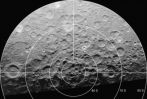
ZZ-ZZ-ZZ-ZZ-ZZ-Lunar South Pole.jpgNo "Lunar Ice" at the South Pole...88 visite"...a new radar survey of the Moon’s Southern Pole has cast doubt on the hope that there might be accessible deposits of water ice in permanently dark craters. This new survey, performed with the Arecibo Observatory in Puerto Rico, found elevated Hydrogen levels in regions of bright sunlight - not just inside the shadowed walls of craters. It seems that scattered rocks associated with impact craters have given previous instruments a false reading...".Ott 19, 2006
|
|

First Moon-1.jpgFirst Moon69 visitenessun commentoOtt 19, 2006
|
|
| 165 immagini su 14 pagina(e) |
2 | |
|
|
|
|
|
|
|
|
|
|
|








