Inizio Registrati Login

Elenco album Ultimi arrivi Ultimi commenti Più viste Più votate Preferiti Cerca

Inizio > THE LUNAR EXPLORER ARCHIVES > A Tribute To Mars Global Surveyor
Ritorna alla pagina delle miniature FILE 488/512 Torna all'inizio Guarda foto precedente Guarda foto successiva Salta alla fine
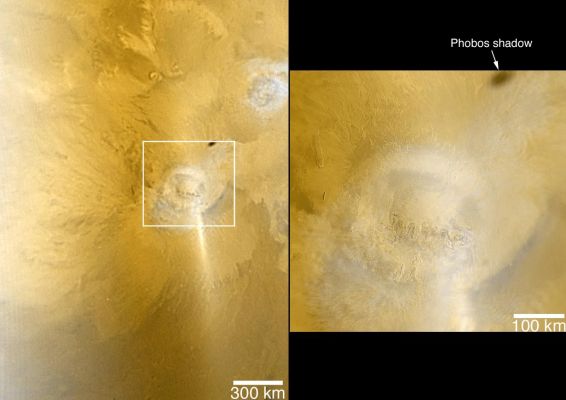
Arsia Mons with Water-Ice Clouds and the shadow of Phobos (credits NASA/JPL/MSSS)
Caption originale:"This pair of MGS-MOC color images shows early Autumn Clouds over the Arsia Mons Volcano, plus the shadow of the innermost of the Martain Moon Phobos. The picture on the left is taken from the MOC daily global map acquired at 7,5 km (~4,7 mi) per pixel on 28 January 2006, about a week after the start of Southern Autumn. 
The picture on the right was taken at the same time, but at a higher resolution of 489 mt (~1604 ft) per pixel. 
Both pictures are composites of MOC red and blue wide angle images, and both are oriented such that North is up and East is to the right. Arsia Mons and the other large Tharsis volcanoes commonly develop afternoon orographic (i.e., topographically-controlled) water ice clouds at this time of year. The equatorial Tharsis volcano, Pavonis Mons, is also under a deck of Water-Ice Clouds; it is located toward the upper right corner of the left, lower-resolution image. 
Sunlight glints off the dusty Surface and the Clouds and Aerosols in the Atmosphere, producing the bright diagonal Streak located just South/East (lower right) of Arsia Mons. A Water-Ice Haze is seen on the left side of the lower-resolution image. The dark oval to the North-East of Arsia Mons, as noted above, is the shadow of Phobos".
Parole chiave: Mars from orbit - Arsia Mons

Arsia Mons with Water-Ice Clouds and the shadow of Phobos (credits NASA/JPL/MSSS)

Caption originale:"This pair of MGS-MOC color images shows early Autumn Clouds over the Arsia Mons Volcano, plus the shadow of the innermost of the Martain Moon Phobos. The picture on the left is taken from the MOC daily global map acquired at 7,5 km (~4,7 mi) per pixel on 28 January 2006, about a week after the start of Southern Autumn.
The picture on the right was taken at the same time, but at a higher resolution of 489 mt (~1604 ft) per pixel.
Both pictures are composites of MOC red and blue wide angle images, and both are oriented such that North is up and East is to the right. Arsia Mons and the other large Tharsis volcanoes commonly develop afternoon orographic (i.e., topographically-controlled) water ice clouds at this time of year. The equatorial Tharsis volcano, Pavonis Mons, is also under a deck of Water-Ice Clouds; it is located toward the upper right corner of the left, lower-resolution image.
Sunlight glints off the dusty Surface and the Clouds and Aerosols in the Atmosphere, producing the bright diagonal Streak located just South/East (lower right) of Arsia Mons. A Water-Ice Haze is seen on the left side of the lower-resolution image. The dark oval to the North-East of Arsia Mons, as noted above, is the shadow of Phobos".

Volcanoes-Arsia_Mons-E05-1721_1722_arsia100.jpg Volcanoes-Arsia_Mons-PIA07298-PCF-LXTT.jpg Volcanoes-Arsia_Mons.jpg Volcanoes-Ascraeus_Mons-PIA07149-PCF-LXTT-1.jpg Volcanoes-Ceraunius_Tholus-MGS.jpg
Informazioni sul file
Nome del file:Volcanoes-Arsia_Mons.jpg
Nome album:A Tribute To Mars Global Surveyor
Valutazione (9 voti):55555(Mostra dettagli)
Parole chiave:Mars / from / orbit / - / Arsia / Mons
Copyright:NASA/JPL/Malin Space Science Systems
Dimensione del file:116 KiB
Data di inserimento:Feb 06, 2006
Dimensioni:1230 x 869 pixels
Visualizzato:99 volte
URL:https://www.lunexit.it/gallery/displayimage.php?pid=9576
Preferiti:Aggiungi ai preferiti

Commento 1 a 13 di 13
Pagina: 1

Paolo C. Fienga   [Gen 22, 2022 at 05:59 PM]
QUESTE sono "nuvolette"!
Anakin   [Gen 25, 2022 at 09:28 AM]
Questo è il classico pennacchio di un vulcano o caldera attiva. Punto.
Ma siccome non fa soldi o forse li fa fare nella direzione non voluta, allora nel nome ormai sacrilego di scienza, si dice e fa tutto
Paolo C. Fienga   [Gen 25, 2022 at 12:58 PM]
Taccio.
walthari   [Gen 28, 2022 at 04:49 PM]
così sembra, concordo anche se dobbiamo ammettere un'attività saltuaria o comunque ridotta
Paolo C. Fienga   [Gen 28, 2022 at 05:27 PM]
Il Lander In-Sight dice che l'attività sismica su Marte è intensa e costante. Marte è ancora "attivo". Senza dubbi.

Dunque, mi chiedo, perché escludere il "Vulcanismo", ancorché residuale? Ho scritto alla NASA (più di tre mesi fa), facendo questa stupida domanda. Pensi che mi abbiano risposto?...
walthari   [Gen 28, 2022 at 05:30 PM]
ma poi perchè non rispondere...ridicoli!
Paolo C. Fienga   [Gen 28, 2022 at 05:34 PM]
Probabilmente perché è una domanda stupida Walt...
walthari   [Gen 28, 2022 at 05:37 PM]
"le domande non sono mai indiscrete, ma spesso lo sono le risposte" cit.
Paolo C. Fienga   [Gen 28, 2022 at 05:38 PM]
Ed infatti la mia domanda non è "indiscreta". E' stupida. La Tua citazione viene da "Per qualche Dollaro in più". La pronuncia Lee Van Cleef. :-)
walthari   [Gen 28, 2022 at 05:39 PM]
eggià...il capolavoro di Leone...
Paolo C. Fienga   [Gen 28, 2022 at 05:41 PM]
"...E la nostra società?..." (Clint Eastwood) "...un'altra volta..." (Lee Van Cleef). Capolavoro. Davvero.
Anakin   [Gen 31, 2022 at 09:41 AM]
un pianeta fatto passare per totalmente morto, attira meno l'attenzione di uno geologicamente attivo.
Paolo C. Fienga   [Gen 31, 2022 at 11:08 AM]
...ovviamente... ;-)

Commento 1 a 13 di 13
Pagina: 1


Powered by Coppermine Photo Gallery