Inizio Registrati Login

Elenco album Ultimi arrivi Ultimi commenti Più viste Più votate Preferiti Cerca

Inizio > SOLAR SYSTEM > Asteroids and Comets
Ritorna alla pagina delle miniature FILE 73/282 Torna all'inizio Guarda foto precedente Guarda foto successiva Salta alla fine
The "Hyakutake" Comet
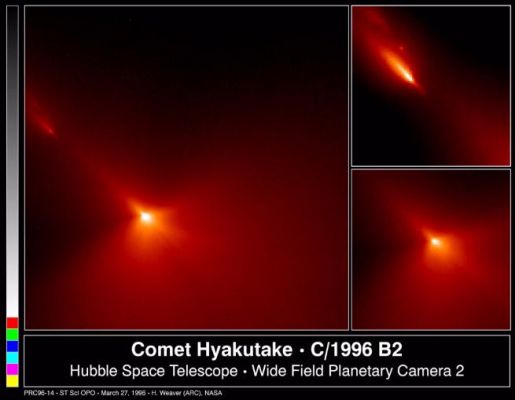
FULL-FIELD VIEW (Left)--->This image is 3340 Km acroos and shows that most of the dust is being produced on the sunward-facing hemisphere of the comet. Also at upper left are 3 small pieces which have broken off the comet and are forming there own tails. Icy regions on the nucleus are activated as they rotate into sunlight, ejecting large amounts of dust in the jets that are faintly visible in this image. Sunlight striking this dust eventually turns it around and "blows" it into the tailward hemisphere. What might be another jet is emanating from the nightside of the nucleus, but this direction might be misleading due to the angle of the jet relative to our line-of-site.
CLOSE-UP OF NUCLEUS (Bottom Right) This expanded view of the near-nucleus region is only 760 Km across. The nucleus is near the center of the frame, but the brightest area is probably the tip of the strongest dust jet rather than the nucleus itself. Presumably, the nucleus surface lies just below this bright jet.
CLOSE-UP OF COMET FRAGMENTS (Top Right) This image shows pieces of the nucleus that apparently broke off and were first detected during ground-based observations on March 24. The Hubble image shows at least three separate objects that are probably made up of coarse-grained dust. Large fragments of the nucleus would not be accelerated into the tail, which appears to be the case in this image.


Parole chiave: Hubble Images - Comet Hyakutake

The "Hyakutake" Comet

FULL-FIELD VIEW (Left)--->This image is 3340 Km acroos and shows that most of the dust is being produced on the sunward-facing hemisphere of the comet. Also at upper left are 3 small pieces which have broken off the comet and are forming there own tails. Icy regions on the nucleus are activated as they rotate into sunlight, ejecting large amounts of dust in the jets that are faintly visible in this image. Sunlight striking this dust eventually turns it around and "blows" it into the tailward hemisphere. What might be another jet is emanating from the nightside of the nucleus, but this direction might be misleading due to the angle of the jet relative to our line-of-site.
CLOSE-UP OF NUCLEUS (Bottom Right) This expanded view of the near-nucleus region is only 760 Km across. The nucleus is near the center of the frame, but the brightest area is probably the tip of the strongest dust jet rather than the nucleus itself. Presumably, the nucleus surface lies just below this bright jet.
CLOSE-UP OF COMET FRAGMENTS (Top Right) This image shows pieces of the nucleus that apparently broke off and were first detected during ground-based observations on March 24. The Hubble image shows at least three separate objects that are probably made up of coarse-grained dust. Large fragments of the nucleus would not be accelerated into the tail, which appears to be the case in this image.

Comets-Comet_Holmes.jpg Comets-Comet_Hyakutake-PIA01288_modest.jpg Comets-Comet_Hyakutake-PIA01290_modest.jpg Comets-Comet_Hyakutake.jpg Comets-Comet_ISON-4-10-2013-HST.jpg
Informazioni sul file
Nome del file:Comets-Comet_Hyakutake-PIA01290_modest.jpg
Nome album:Asteroids and Comets
Valutazione (11 voti):55555(Mostra dettagli)
Parole chiave:Hubble / Images / - / Comet / Hyakutake
Copyright:H. A. Weaver (Applied Research Corp.), HST Comet Hyakutake Observing Team, and NASA
Dimensione del file:29 KiB
Data di inserimento:Gen 28, 2005
Dimensioni:655 x 508 pixels
Visualizzato:54 volte
URL:https://www.lunexit.it/gallery/displayimage.php?pid=4194
Preferiti:Aggiungi ai preferiti


Powered by Coppermine Photo Gallery