Inizio Registrati Login

Elenco album Ultimi arrivi Ultimi commenti Più viste Più votate Preferiti Cerca

Inizio > SOLAR SYSTEM > Asteroids and Comets
Ritorna alla pagina delle miniature FILE 22/282 Torna all'inizio Guarda foto precedente Guarda foto successiva Salta alla fine
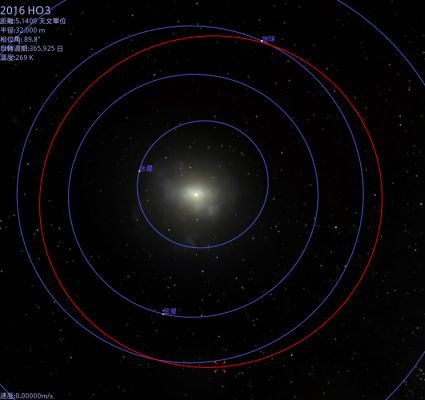
Kamo'oalewa
The size of Kamo'oalewa has not yet been firmly established, but it is likely that it is approximately 40-to-100 meters (130–330 feet).Based on an assumed standard albedo for stony S-type asteroids of 0.20 and an absolute magnitude of 24.3, it measures 41 meters (135 ft) in diameter. Photometric observations in April 2017 revealed that Kamoʻoalewa is a fast rotator. Lightcurve analysis gave a rotation period of 0.467 ± 0.008 hours (28.02 ± 0.48 minutes) and a brightness variation of 0.80±0.05 magnitude (U=2). In 2021, a comprehensive physical characterization of Kamoʻoalewa was conducted using the Large Binocular Telescope and the Lowell Discovery Telescope, which found that the asteroid is composed of lunar-like silicates and may be an impact fragment from the Moon. 

During the 2017 Astrodynamics Specialist Conference held in Stevenson in the U.S. state of Washington, a team composed of graduate research assistants from the University of Colorado Boulder and the São Paulo State University (UNESP) was awarded for presenting a project denominated "Near-Earth Asteroid Characterization and Observation (NEACO) Mission to Asteroid (469219) 2016 HO3", providing the first baselines for the investigation of this celestial object using a spacecraft. Recently, another version of this work was presented adopting different constraints in the dynamics.
The China National Space Administration (CNSA) is planning a robotic mission that would return samples from Kamoʻoalewa. Currently, this mission, via ZhengHe, is planned to launch in 2025.
Parole chiave: Asteroids

Kamo'oalewa

The size of Kamo'oalewa has not yet been firmly established, but it is likely that it is approximately 40-to-100 meters (130–330 feet).Based on an assumed standard albedo for stony S-type asteroids of 0.20 and an absolute magnitude of 24.3, it measures 41 meters (135 ft) in diameter. Photometric observations in April 2017 revealed that Kamoʻoalewa is a fast rotator. Lightcurve analysis gave a rotation period of 0.467 ± 0.008 hours (28.02 ± 0.48 minutes) and a brightness variation of 0.80±0.05 magnitude (U=2). In 2021, a comprehensive physical characterization of Kamoʻoalewa was conducted using the Large Binocular Telescope and the Lowell Discovery Telescope, which found that the asteroid is composed of lunar-like silicates and may be an impact fragment from the Moon.

During the 2017 Astrodynamics Specialist Conference held in Stevenson in the U.S. state of Washington, a team composed of graduate research assistants from the University of Colorado Boulder and the São Paulo State University (UNESP) was awarded for presenting a project denominated "Near-Earth Asteroid Characterization and Observation (NEACO) Mission to Asteroid (469219) 2016 HO3", providing the first baselines for the investigation of this celestial object using a spacecraft. Recently, another version of this work was presented adopting different constraints in the dynamics.
The China National Space Administration (CNSA) is planning a robotic mission that would return samples from Kamoʻoalewa. Currently, this mission, via ZhengHe, is planned to launch in 2025.

Asteroids-3753-Cruithne-2.gif Asteroids-469219-Kamo_oalewa-1.jpg Asteroids-469219-Kamo_oalewa-2.jpg Asteroids-Annefrank_Asteroid-PIA02885_modest.jpg Asteroids-Asteroid_1994-CC-PIA12134.gif
Informazioni sul file
Nome del file:Asteroids-469219-Kamo_oalewa-2.jpg
Nome album:MareKromium / Asteroids and Comets
Valutazione (4 voti):55555(Mostra dettagli)
Parole chiave:Asteroids
Copyright:Wikipedia
Dimensione del file:213 KiB
Data di inserimento:Nov 16, 2021
Dimensioni:744 x 700 pixels
Visualizzato:91 volte
URL:https://www.lunexit.it/gallery/displayimage.php?pid=31586
Preferiti:Aggiungi ai preferiti


Powered by Coppermine Photo Gallery