|
|
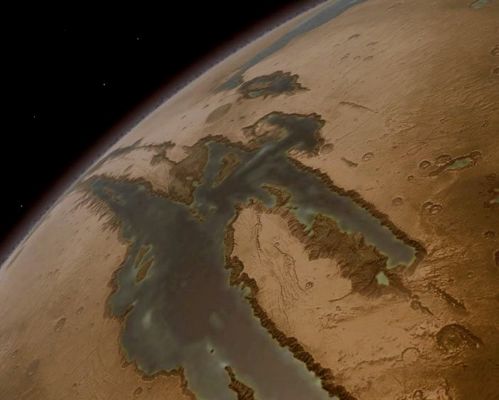
The Last Days of Mars: The Great Valles Marineris Region (Credits: Don Edwards and Paolo C. Fienga)
|
Dear Friends of Lunar Explorer Italia and the Italian Planetary Foundation,
starting from yesterday, January, 13th, 2014, we have decided to submit to your careful attention and consideration, 5 (five) "Martian Fantasies" which, in our opinion, may give you an idea about how Mars could have looked like near the end of its "Life" (as we know it, of course). We imagined the existence of some residual Wet-Lands (for instance, a few Lakes with some small River nearby), and a little Vegetation, located just in their immediate proximities.
And then ... a boundless Desert. In other words, only a few "Oasis of Life", made of residual Waters and a minimal Local Vegetation, and both completely surrounded by the yellow and orange Sands of a Desert which, in a (we believe, relatively) short amount of time, would have covered the entire Planet, and turned it into what we can see today.
This "Computer-made Reconstruction" shows you a portion of the Great Valles Marineris Canyon System, when some Residual Waters and Vegetation were still inside and near (in the close proximities of) this extremely famous Martian Geological Feature.
Note: for a better understanding of what we have been trying to show you here, please consider that in the locations where the color of the Residual Waters tends towards the green and a very light blue, it means that said Residual Waters are already very shallow; on the other hand, the darker the color of the Residual Waters gets, then the greater is their actual depth.
Please, some feedback on your side will be deeply appreciated and, therefore, do not hesitate to write to us and let us know what you think of these "Fantasies" which we have decided to entitle "The Last Days of Mars".
Thanks and enjoy!
Dr Paolo C. Fienga (PhD) - E-mail: alphacentauri@intercom.it
|
|










http:// mars.jpl.nasa.gov/ msl/multimedia/ raw/ ?s=613&camera =NAV_RIGHT_
http:// mars.jpl.nasa.gov/ msl/ multimedia/raw/ ?rawid=NRB_ 451932328EDR_ S0311330NCAM00554M_&s =613
http:// mars.jpl.nasa.gov/ msl/ multimedia/raw/ ?rawid=NRB_ 451932094EDR_ S0311330NCAM00554M_&s =613
Se si prende come riferimento l'ora relativa allo scatto, l'oggetto scende in picchiata, pertanto è una meteora