Inizio Registrati Login

Elenco album Ultimi arrivi Ultimi commenti Più viste Più votate Preferiti Cerca

Inizio > SOLAR SYSTEM > Asteroids and Comets
Ritorna alla pagina delle miniature FILE 197/282 Torna all'inizio Guarda foto precedente Guarda foto successiva Salta alla fine
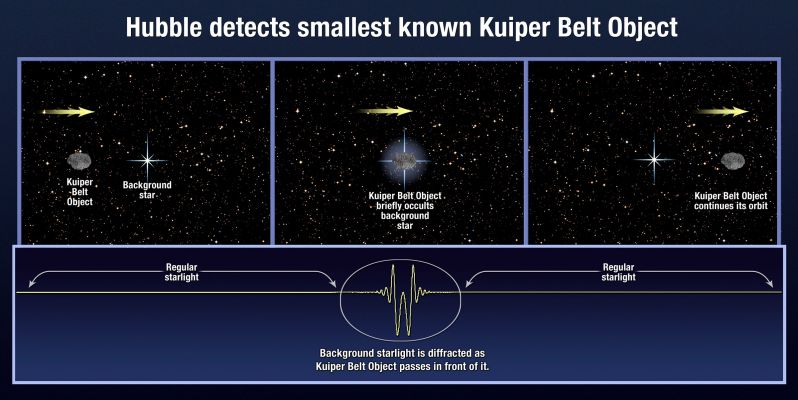
Kuiper's Belt Object occulting a Star
In a paper published in the December 17th issue of the journal Nature, Hilke Schlichting of the California Institute of Technology in Pasadena, Calif., and her collaborators are reporting that the telltale signature of the small vagabond was extracted from Hubble's pointing data, not by direct imaging.

Hubble has three optical instruments called Fine Guidance Sensors (FGS). The FGSs provide high-precision navigational information to the space observatory's attitude control systems by looking at select guide stars for pointing. The sensors exploit the wavelike nature of light to make precise measurement of the location of stars.

Schlichting and her co-investigators determined that the FGS instruments are so good that they can see the effects of a small object passing in front of a star. This would cause a brief occultation and diffraction signature in the FGS data as the light from the background guide star was bent around the intervening foreground KBO.

They selected 4,5 years of FGS observations for analysis. Hubble spent a total of 12.000 hours during this period looking along a strip of sky within 20° of the Solar System's Ecliptic Plane, where the majority of KBOs should dwell. The team analyzed the FGS observations of 50.000 guide stars in total.
Scouring the huge database, Schlichting and her team found a single 0,3-second-long occultation event. This was only possible because the FGS instruments sample changes in starlight 40 times a second. The duration of the occultation was short largely because of the Earth's orbital motion around the Sun.

They assumed the KBO was in a circular orbit and inclined 14° to the Ecliptic. The KBO's distance was estimated from the duration of the occultation, and the amount of dimming was used to calculate the size of the object. "I was very thrilled to find this in the data", says Schlichting.

Hubble observations of nearby stars show that a number of them have Kuiper Belt–like disks of icy debris encircling them. These disks are the remnants of planetary formation. The prediction is that over billions of years the debris should collide, grinding the KBO-type objects down to ever smaller pieces that were not part of the original Kuiper Belt population.

The finding is a powerful illustration of the capability of archived Hubble data to produce important new discoveries. In an effort to uncover additional small KBOs, the team plans to analyze the remaining FGS data for nearly the full duration of Hubble operations since its launch in 1990.
Parole chiave: Drawings

Kuiper's Belt Object occulting a Star

In a paper published in the December 17th issue of the journal Nature, Hilke Schlichting of the California Institute of Technology in Pasadena, Calif., and her collaborators are reporting that the telltale signature of the small vagabond was extracted from Hubble's pointing data, not by direct imaging.

Hubble has three optical instruments called Fine Guidance Sensors (FGS). The FGSs provide high-precision navigational information to the space observatory's attitude control systems by looking at select guide stars for pointing. The sensors exploit the wavelike nature of light to make precise measurement of the location of stars.

Schlichting and her co-investigators determined that the FGS instruments are so good that they can see the effects of a small object passing in front of a star. This would cause a brief occultation and diffraction signature in the FGS data as the light from the background guide star was bent around the intervening foreground KBO.

They selected 4,5 years of FGS observations for analysis. Hubble spent a total of 12.000 hours during this period looking along a strip of sky within 20° of the Solar System's Ecliptic Plane, where the majority of KBOs should dwell. The team analyzed the FGS observations of 50.000 guide stars in total.
Scouring the huge database, Schlichting and her team found a single 0,3-second-long occultation event. This was only possible because the FGS instruments sample changes in starlight 40 times a second. The duration of the occultation was short largely because of the Earth's orbital motion around the Sun.

They assumed the KBO was in a circular orbit and inclined 14° to the Ecliptic. The KBO's distance was estimated from the duration of the occultation, and the amount of dimming was used to calculate the size of the object. "I was very thrilled to find this in the data", says Schlichting.

Hubble observations of nearby stars show that a number of them have Kuiper Belt–like disks of icy debris encircling them. These disks are the remnants of planetary formation. The prediction is that over billions of years the debris should collide, grinding the KBO-type objects down to ever smaller pieces that were not part of the original Kuiper Belt population.

The finding is a powerful illustration of the capability of archived Hubble data to produce important new discoveries. In an effort to uncover additional small KBOs, the team plans to analyze the remaining FGS data for nearly the full duration of Hubble operations since its launch in 1990.

KBO-1-Artist_Conception.jpg KBO-2-Artist_Conception.jpg KBO-3-Artist_Conception.jpg L-Itokawa.jpg LL-Itokawa.jpg
Informazioni sul file
Nome del file:KBO-3-Artist_Conception.jpg
Nome album:MareKromium / Asteroids and Comets
Valutazione (3 voti):55555(Mostra dettagli)
Parole chiave:Drawings
Copyright:NASA, ESA, and A. Feild (STScI)NASA - HST
Dimensione del file:450 KiB
Data di inserimento:Dic 21, 2009
Dimensioni:2400 x 1203 pixels
Visualizzato:55 volte
URL:https://www.lunexit.it/gallery/displayimage.php?pid=25989
Preferiti:Aggiungi ai preferiti


Powered by Coppermine Photo Gallery