Inizio Registrati Login

Elenco album Ultimi arrivi Ultimi commenti Più viste Più votate Preferiti Cerca

Inizio > SOLAR SYSTEM > Asteroids and Comets
Ritorna alla pagina delle miniature FILE 74/282 Torna all'inizio Guarda foto precedente Guarda foto successiva Salta alla fine
Comet Hyakutake
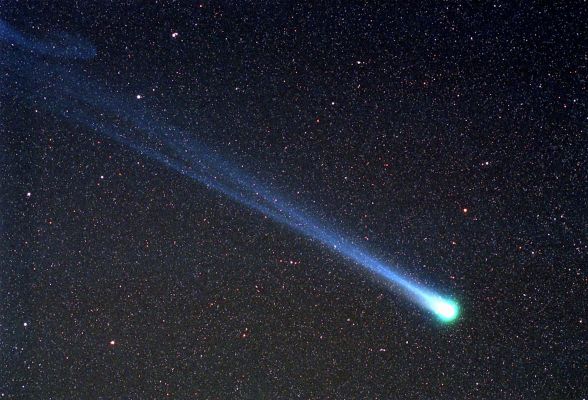
Da "NASA - Picture of the Day" del giorno 16 Dicembre 2009:"In 1996, an unexpectedly bright comet passed by planet Earth. Discovered less than two months before, Comet C/1996 B2 Hyakutake came within only 1/10th of the Earth-Sun distance from the Earth in late March. At that time, Comet Hyakutake, dubbed the Great Comet of 1996, became the brightest comet to grace the skies of Earth in 20 years. During its previous visit, Comet Hyakutake may well have been seen by the stone age Magdalenian culture, who 17.000 years ago were possibly among the first humans to live in tents as well as caves. 
Pictured above near closest approach as it appeared on 1996 March 26, the long Ion and Dust Tails of Comet Hyakutake are visible flowing off to the left in front of a distant star field that includes both the Big and Little Dippers. 

On the far left, the blue Ion Tail appears to have recently undergone a magnetic disconnection event. On the far right, the Comet's green-tinted Coma obscures a dense nucleus of melting dirty ice estimated to be about 5 Km across. A few months later, Comet Hyakutake began its long trek back to the outer Solar System. 

Because of being gravitationally deflected by massive planets, Comet Hyakutake is not expected back for about 100.000 years...".
Parole chiave: From Earth Pictures - Professional Pictures

Comet Hyakutake

Da "NASA - Picture of the Day" del giorno 16 Dicembre 2009:"In 1996, an unexpectedly bright comet passed by planet Earth. Discovered less than two months before, Comet C/1996 B2 Hyakutake came within only 1/10th of the Earth-Sun distance from the Earth in late March. At that time, Comet Hyakutake, dubbed the Great Comet of 1996, became the brightest comet to grace the skies of Earth in 20 years. During its previous visit, Comet Hyakutake may well have been seen by the stone age Magdalenian culture, who 17.000 years ago were possibly among the first humans to live in tents as well as caves.
Pictured above near closest approach as it appeared on 1996 March 26, the long Ion and Dust Tails of Comet Hyakutake are visible flowing off to the left in front of a distant star field that includes both the Big and Little Dippers.

On the far left, the blue Ion Tail appears to have recently undergone a magnetic disconnection event. On the far right, the Comet's green-tinted Coma obscures a dense nucleus of melting dirty ice estimated to be about 5 Km across. A few months later, Comet Hyakutake began its long trek back to the outer Solar System.

Because of being gravitationally deflected by massive planets, Comet Hyakutake is not expected back for about 100.000 years...".

Comets-Comet_Hyakutake-PIA01288_modest.jpg Comets-Comet_Hyakutake-PIA01290_modest.jpg Comets-Comet_Hyakutake.jpg Comets-Comet_ISON-4-10-2013-HST.jpg Comets-Comet_ISON-HST-30Apr-V_I-L-800.jpg
Informazioni sul file
Nome del file:Comets-Comet_Hyakutake.jpg
Nome album:MareKromium / Asteroids and Comets
Valutazione (7 voti):55555(Mostra dettagli)
Parole chiave:From / Earth / Pictures / - / Professional / Pictures
Copyright:Doug Zubenel (TWAN)
Dimensione del file:669 KiB
Data di inserimento:Dic 16, 2009
Dimensioni:2120 x 1440 pixels
Visualizzato:56 volte
URL:https://www.lunexit.it/gallery/displayimage.php?pid=25957
Preferiti:Aggiungi ai preferiti

Commento 1 a 2 di 2
Pagina: 1

walthari   [Dic 23, 2013 at 07:54 PM]
Buone feste Paolo e a tutti gli amici di Lunexit!!Che gli Dei ci siano sempre propizi!!Valete omnes!!
AndreaGG   [Dic 23, 2013 at 08:38 PM]
Grazie e buone feste a te ed a tutti voi!

Commento 1 a 2 di 2
Pagina: 1


Powered by Coppermine Photo Gallery