Inizio Registrati Login

Elenco album Ultimi arrivi Ultimi commenti Più viste Più votate Preferiti Cerca

Inizio > THE LUNAR EXPLORER ARCHIVES > The Universe in Super Definition
Ritorna alla pagina delle miniature FILE 19/157 Torna all'inizio Guarda foto precedente Guarda foto successiva Salta alla fine
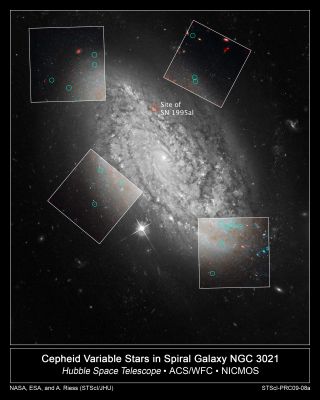
Refined Hubble Constant narrows possible explanations for Dark Energy
Whatever Dark Energy is, explanations for it have less wiggle room following a Hubble Space Telescope observation that has refined the measurement of the Universe's present Expansion Rate to a precision where the error is smaller than 5%. The new value for the Expansion Rate, known as the "Hubble Constant", or "H0" (after Edwin Hubble who first measured the expansion of the universe nearly a century ago), is 74,2 Km-per-second-per-megaparsec (with an error margin of ± 3,6). 

The results agree closely with an earlier measurement gleaned from Hubble of 72 ± 8 km/sec/megaparsec, but are now more than twice as precise.
The Hubble measurement, conducted by the SHOES (Supernova H0 for the Equation of State) Team and led by Adam Riess, of the Space Telescope Science Institute and the Johns Hopkins University, uses a number of refinements to streamline and strengthen the construction of a cosmic "Distance Ladder", a Billion LY in length, that astronomers use to determine the Universe's Expansion Rate.

Hubble observations of pulsating stars called "Cepheid Variables" in a nearby cosmic mile marker, the galaxy NGC 4258, and in the host galaxies of recent supernovae, directly link these distance indicators. The use of Hubble to bridge these rungs in the ladder eliminated the systematic errors that are almost unavoidably introduced by comparing measurements from different telescopes.
Riess explains the new technique: "It's like measuring a building with a long tape measure instead of moving a yard stick end over end. You avoid compounding the little errors you make every time you move the yardstick. The higher the building, the greater the error".
Lucas Macri, professor of physics and astronomy at Texas A&M, and a significant contributor to the results, said, "Cepheids are the backbone of the distance ladder because their pulsation periods, which are easily observed, correlate directly with their luminosities. Another refinement of our ladder is the fact that we have observed the Cepheids in the Near-InfraRed parts of the electromagnetic spectrum where these variable stars are better distance indicators than at optical wavelengths."

This new, more precise value of the Hubble Constant was used to test and constrain the properties of Dark Energy, the form of energy that produces a repulsive force in space, which is causing the expansion rate of the Universe to accelerate.
By bracketing the expansion history of the universe between today and when the universe was only approx. 380.000 years old, the astronomers were able to place limits on the nature of the Dark Energy that is causing the expansion to speed up. 
(The measurement for the far, early universe is derived from fluctuations in the Cosmic Microwave Background (---> Radiazione di Fondo), as resolved by NASA's Wilkinson Microwave Anisotropy Probe, WMAP, in 2003.)

Their result is consistent with the simplest interpretation of Dark Energy: that it is mathematically equivalent to Albert Einstein's hypothesized Cosmological Constant, introduced a century ago to push on the fabric of space and prevent the Universe from collapsing under the pull of gravity. (Einstein, however, removed the Constant once the expansion of the universe was discovered by Edwin Hubble.)

"If you put in a box all the ways that Dark Energy might differ from the Cosmological Constant, that box would now be 3 times smaller", says Riess. "That's progress, but we still have a long way to go to pin down the nature of Dark Energy".

Though the cosmological constant was conceived of long ago, observational evidence for Dark Energy didn't come along until 11 years ago, when two studies, one led by Riess and Brian Schmidt of Mount Stromlo Observatory, and the other by Saul Perlmutter of Lawrence Berkeley National Laboratory, discovered Dark Energy independently, in part with Hubble observations. Since then astronomers have been pursuing observations to better characterize Dark Energy.
Riess's approach to narrowing alternative explanations for Dark Energy — whether it is a static Cosmological Constant or a dynamical field (like the repulsive force that drove inflation after the Big Bang) — is to further refine measurements of the Universe's expansion history.

Before Hubble was launched in 1990, the estimates of the Hubble Constant varied by a factor of two. In the late 1990s the Hubble Space Telescope Key Project on the Extragalactic Distance Scale refined the value of the Hubble constant to an error of only about 10%. This was accomplished by observing Cepheid variables at optical wavelengths out to greater distances than obtained previously and comparing those to similar measurements from ground-based telescopes.
The SHOES team used Hubble's Near Infrared Camera and Multi-Object Spectrometer (NICMOS) and the Advanced Camera for Surveys (ACS) to observe 240 Cepheid variable stars across 7 galaxies. One of these galaxies was NGC 4258, whose distance was very accurately determined through observations with radio telescopes. The other 6 galaxies recently hosted Type Ia Supernovae that are reliable distance indicators for even farther measurements in the Universe. 
Type Ia Supernovae all explode with nearly the same amount of energy and therefore have almost the same intrinsic brightness.

By observing Cepheids with very similar properties at Near-InfraRed wavelengths in all 7 galaxies and using the same telescope and instrument, the team was able to more precisely calibrate the luminosity of Supernovae. 
With Hubble's powerful capabilities, the team was able to sidestep some of the shakiest rungs along the previous Distance Ladder involving uncertainties in the behavior of Cepheids. Riess would eventually like to see the Hubble constant refined to a value with an error of no more than 1%, to put even tighter constraints on solutions to Dark Energy.
Parole chiave: From Space Images - Hubble Space Telescope (HST) Images

Refined Hubble Constant narrows possible explanations for Dark Energy

Whatever Dark Energy is, explanations for it have less wiggle room following a Hubble Space Telescope observation that has refined the measurement of the Universe's present Expansion Rate to a precision where the error is smaller than 5%. The new value for the Expansion Rate, known as the "Hubble Constant", or "H0" (after Edwin Hubble who first measured the expansion of the universe nearly a century ago), is 74,2 Km-per-second-per-megaparsec (with an error margin of ± 3,6).

The results agree closely with an earlier measurement gleaned from Hubble of 72 ± 8 km/sec/megaparsec, but are now more than twice as precise.
The Hubble measurement, conducted by the SHOES (Supernova H0 for the Equation of State) Team and led by Adam Riess, of the Space Telescope Science Institute and the Johns Hopkins University, uses a number of refinements to streamline and strengthen the construction of a cosmic "Distance Ladder", a Billion LY in length, that astronomers use to determine the Universe's Expansion Rate.

Hubble observations of pulsating stars called "Cepheid Variables" in a nearby cosmic mile marker, the galaxy NGC 4258, and in the host galaxies of recent supernovae, directly link these distance indicators. The use of Hubble to bridge these rungs in the ladder eliminated the systematic errors that are almost unavoidably introduced by comparing measurements from different telescopes.
Riess explains the new technique: "It's like measuring a building with a long tape measure instead of moving a yard stick end over end. You avoid compounding the little errors you make every time you move the yardstick. The higher the building, the greater the error".
Lucas Macri, professor of physics and astronomy at Texas A&M, and a significant contributor to the results, said, "Cepheids are the backbone of the distance ladder because their pulsation periods, which are easily observed, correlate directly with their luminosities. Another refinement of our ladder is the fact that we have observed the Cepheids in the Near-InfraRed parts of the electromagnetic spectrum where these variable stars are better distance indicators than at optical wavelengths."

This new, more precise value of the Hubble Constant was used to test and constrain the properties of Dark Energy, the form of energy that produces a repulsive force in space, which is causing the expansion rate of the Universe to accelerate.
By bracketing the expansion history of the universe between today and when the universe was only approx. 380.000 years old, the astronomers were able to place limits on the nature of the Dark Energy that is causing the expansion to speed up.
(The measurement for the far, early universe is derived from fluctuations in the Cosmic Microwave Background (---> Radiazione di Fondo), as resolved by NASA's Wilkinson Microwave Anisotropy Probe, WMAP, in 2003.)

Their result is consistent with the simplest interpretation of Dark Energy: that it is mathematically equivalent to Albert Einstein's hypothesized Cosmological Constant, introduced a century ago to push on the fabric of space and prevent the Universe from collapsing under the pull of gravity. (Einstein, however, removed the Constant once the expansion of the universe was discovered by Edwin Hubble.)

"If you put in a box all the ways that Dark Energy might differ from the Cosmological Constant, that box would now be 3 times smaller", says Riess. "That's progress, but we still have a long way to go to pin down the nature of Dark Energy".

Though the cosmological constant was conceived of long ago, observational evidence for Dark Energy didn't come along until 11 years ago, when two studies, one led by Riess and Brian Schmidt of Mount Stromlo Observatory, and the other by Saul Perlmutter of Lawrence Berkeley National Laboratory, discovered Dark Energy independently, in part with Hubble observations. Since then astronomers have been pursuing observations to better characterize Dark Energy.
Riess's approach to narrowing alternative explanations for Dark Energy — whether it is a static Cosmological Constant or a dynamical field (like the repulsive force that drove inflation after the Big Bang) — is to further refine measurements of the Universe's expansion history.

Before Hubble was launched in 1990, the estimates of the Hubble Constant varied by a factor of two. In the late 1990s the Hubble Space Telescope Key Project on the Extragalactic Distance Scale refined the value of the Hubble constant to an error of only about 10%. This was accomplished by observing Cepheid variables at optical wavelengths out to greater distances than obtained previously and comparing those to similar measurements from ground-based telescopes.
The SHOES team used Hubble's Near Infrared Camera and Multi-Object Spectrometer (NICMOS) and the Advanced Camera for Surveys (ACS) to observe 240 Cepheid variable stars across 7 galaxies. One of these galaxies was NGC 4258, whose distance was very accurately determined through observations with radio telescopes. The other 6 galaxies recently hosted Type Ia Supernovae that are reliable distance indicators for even farther measurements in the Universe.
Type Ia Supernovae all explode with nearly the same amount of energy and therefore have almost the same intrinsic brightness.

By observing Cepheids with very similar properties at Near-InfraRed wavelengths in all 7 galaxies and using the same telescope and instrument, the team was able to more precisely calibrate the luminosity of Supernovae.
With Hubble's powerful capabilities, the team was able to sidestep some of the shakiest rungs along the previous Distance Ladder involving uncertainties in the behavior of Cepheids. Riess would eventually like to see the Hubble constant refined to a value with an error of no more than 1%, to put even tighter constraints on solutions to Dark Energy.

COROT7b-ESO.jpg Cassiopeia_A-PIA11748.jpg Cepheid-HST-2009-08-a-print.jpg DR22.jpg Dark_Matter.jpg
Informazioni sul file
Nome del file:Cepheid-HST-2009-08-a-print.jpg
Nome album:MareKromium / The Universe in Super Definition
Valutazione (2 voti):55555(Mostra dettagli)
Parole chiave:From / Space / Images / - / Hubble / Space / Telescope / (HST) / Images
Copyright:NASA, ESA, and A. Riess (STScI/JHU)
Dimensione del file:1485 KiB
Data di inserimento:Mag 10, 2009
Dimensioni:2400 x 3000 pixels
Visualizzato:57 volte
URL:https://www.lunexit.it/gallery/displayimage.php?pid=24431
Preferiti:Aggiungi ai preferiti


Powered by Coppermine Photo Gallery