Inizio Registrati Login

Elenco album Ultimi arrivi Ultimi commenti Più viste Più votate Preferiti Cerca

Inizio > THE LUNAR EXPLORER ARCHIVES > The Universe in Super Definition
Ritorna alla pagina delle miniature FILE 24/157 Torna all'inizio Guarda foto precedente Guarda foto successiva Salta alla fine
Starbursts in Dwarf Galaxies are a Global Affair
Bursts of star making in a galaxy have been compared to a Fourth of July fireworks display: They occur at a fast and furious pace, lighting up a region for a short time before winking out.

But these fleeting starbursts are only pieces of the story, astronomers say. An analysis of archival images of small, or dwarf, galaxies taken by NASA's Hubble Space Telescope suggests that starbursts, intense regions of star formation, sweep across the whole galaxy and last 100 times longer than astronomers thought. The longer duration may affect how dwarf galaxies change over time, and therefore may shed light on galaxy evolution.

"Our analysis shows that starburst activity in a dwarf galaxy happens on a global scale", explains Kristen McQuinn of the University of Minnesota in Minneapolis and leader of the study. "There are pockets of intense star formation that propagate throughout the galaxy, like a string of firecrackers going off". According to McQuinn, the duration of all the starburst events in a single dwarf galaxy would total 200 to 400 MYs.
These longer timescales are vastly more than the 5 to 10 MYs proposed by astronomers who have studied star formation in dwarf galaxies. "They were only looking at individual clusters and not the whole galaxy, so they assumed starbursts in galaxies lasted for a short time".
Dwarf galaxies are considered by many astronomers to be the building blocks of the large galaxies seen today, so the length of starbursts is important for understanding how galaxies evolve.
"Astronomers are really interested to find out the steps of galaxy evolution", McQuinn says. "Exploring these smaller galaxies is important because, according to popular theory, large galaxies are created from the merger of smaller, dwarf galaxies. So understanding these smaller pieces is an important part of filling in that scenario".

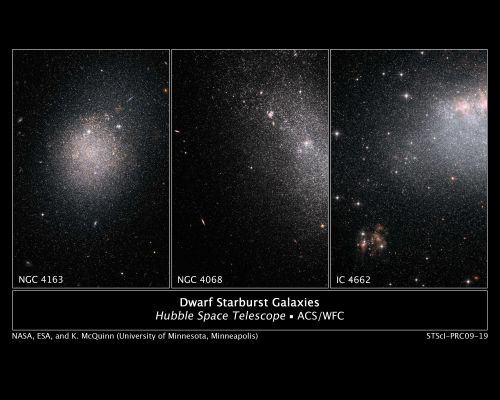
McQuinn's team analyzed archival Advanced Camera for Surveys data of three dwarf galaxies, NGC 4163, NGC 4068 and IC 4662. Their distances range from 8 to 14 MLYs away. The trio is part of a survey of starbursts in 18 nearby dwarf galaxies. Hubble's superb resolution allowed McQuinn's team to pick out individual stars in the galaxies and measure their brightness and color, two important characteristics astronomers use to determine stellar ages. 
By determining the ages of the stars, the astronomers could reconstruct the starburst history in each galaxy.

Two of the galaxies, NGC 4068 and IC 4662, show active, brilliant starburst regions in the Hubble images. The most recent starburst in the third galaxy, NGC 4163, occurred 200 MYs ago and has faded from view. The team looked at regions of high and low densities of stars, piecing together a picture of the starbursts. The galaxies were making a few stars, when something, perhaps an encounter with another galaxy, pushed them into high star-making mode. Instead of forming eight stars every thousand years, the galaxies started making 40 stars every thousand years, which is a lot for a small galaxy, McQuinn says. The typical dwarf is 10 to 30.000 LYs wide. By comparison, a normal-sized galaxy such as our Milky Way is about 100.000 LYs wide.

About 300 to 400 MYs ago star formation occurred in the outer areas of the galaxies. Then it began migrating inward as explosions of massive stars triggered new star formation in adjoining regions. Starbursts are still occurring in the inner parts of NGC 4068 and IC 4662.

The total duration of starburst activity depends on many factors, including the amount of gas in a galaxy, the distribution and density of the gas, and the event that triggered the starburst. A merger or an interaction with a large galaxy, for example, could create a longer starburst event than an interaction with a smaller system.
McQuinn plans to expand her study to a larger sample of more than 20 galaxies. "Studying nearby dwarf galaxies, where we can see the stars in great detail, will help us interpret observations of galaxies in the distant universe, where starbursts were much more common because galaxies had more gas with which to make stars".

McQuinn's results appeared in the April 10 issue of The Astrophysical Journal.
Parole chiave: From Space Images - Hubble Space Telescope (HST) Images

Starbursts in Dwarf Galaxies are a Global Affair

Bursts of star making in a galaxy have been compared to a Fourth of July fireworks display: They occur at a fast and furious pace, lighting up a region for a short time before winking out.

But these fleeting starbursts are only pieces of the story, astronomers say. An analysis of archival images of small, or dwarf, galaxies taken by NASA's Hubble Space Telescope suggests that starbursts, intense regions of star formation, sweep across the whole galaxy and last 100 times longer than astronomers thought. The longer duration may affect how dwarf galaxies change over time, and therefore may shed light on galaxy evolution.

"Our analysis shows that starburst activity in a dwarf galaxy happens on a global scale", explains Kristen McQuinn of the University of Minnesota in Minneapolis and leader of the study. "There are pockets of intense star formation that propagate throughout the galaxy, like a string of firecrackers going off". According to McQuinn, the duration of all the starburst events in a single dwarf galaxy would total 200 to 400 MYs.
These longer timescales are vastly more than the 5 to 10 MYs proposed by astronomers who have studied star formation in dwarf galaxies. "They were only looking at individual clusters and not the whole galaxy, so they assumed starbursts in galaxies lasted for a short time".
Dwarf galaxies are considered by many astronomers to be the building blocks of the large galaxies seen today, so the length of starbursts is important for understanding how galaxies evolve.
"Astronomers are really interested to find out the steps of galaxy evolution", McQuinn says. "Exploring these smaller galaxies is important because, according to popular theory, large galaxies are created from the merger of smaller, dwarf galaxies. So understanding these smaller pieces is an important part of filling in that scenario".

McQuinn's team analyzed archival Advanced Camera for Surveys data of three dwarf galaxies, NGC 4163, NGC 4068 and IC 4662. Their distances range from 8 to 14 MLYs away. The trio is part of a survey of starbursts in 18 nearby dwarf galaxies. Hubble's superb resolution allowed McQuinn's team to pick out individual stars in the galaxies and measure their brightness and color, two important characteristics astronomers use to determine stellar ages.
By determining the ages of the stars, the astronomers could reconstruct the starburst history in each galaxy.

Two of the galaxies, NGC 4068 and IC 4662, show active, brilliant starburst regions in the Hubble images. The most recent starburst in the third galaxy, NGC 4163, occurred 200 MYs ago and has faded from view. The team looked at regions of high and low densities of stars, piecing together a picture of the starbursts. The galaxies were making a few stars, when something, perhaps an encounter with another galaxy, pushed them into high star-making mode. Instead of forming eight stars every thousand years, the galaxies started making 40 stars every thousand years, which is a lot for a small galaxy, McQuinn says. The typical dwarf is 10 to 30.000 LYs wide. By comparison, a normal-sized galaxy such as our Milky Way is about 100.000 LYs wide.

About 300 to 400 MYs ago star formation occurred in the outer areas of the galaxies. Then it began migrating inward as explosions of massive stars triggered new star formation in adjoining regions. Starbursts are still occurring in the inner parts of NGC 4068 and IC 4662.

The total duration of starburst activity depends on many factors, including the amount of gas in a galaxy, the distribution and density of the gas, and the event that triggered the starburst. A merger or an interaction with a large galaxy, for example, could create a longer starburst event than an interaction with a smaller system.
McQuinn plans to expand her study to a larger sample of more than 20 galaxies. "Studying nearby dwarf galaxies, where we can see the stars in great detail, will help us interpret observations of galaxies in the distant universe, where starbursts were much more common because galaxies had more gas with which to make stars".

McQuinn's results appeared in the April 10 issue of The Astrophysical Journal.

EpsilonEridani-PIA11375.jpg Epsilon_Eridani-PIA11376.JPG From_HST-2009-19-a-print.jpg GALEX Portrait-PIA03295.jpg GLS-SDSSJ0946+1006.jpg
Informazioni sul file
Nome del file:From_HST-2009-19-a-print.jpg
Nome album:MareKromium / The Universe in Super Definition
Valutazione (4 voti):55555(Mostra dettagli)
Parole chiave:From / Space / Images / - / Hubble / Space / Telescope / (HST) / Images
Copyright:NASA, ESA, and K. McQuinn (University of Minnesota, Minneapolis)
Dimensione del file:1284 KiB
Data di inserimento:Mag 02, 2009
Dimensioni:3000 x 2400 pixels
Visualizzato:55 volte
URL:https://www.lunexit.it/gallery/displayimage.php?pid=24347
Preferiti:Aggiungi ai preferiti


Powered by Coppermine Photo Gallery