|
|
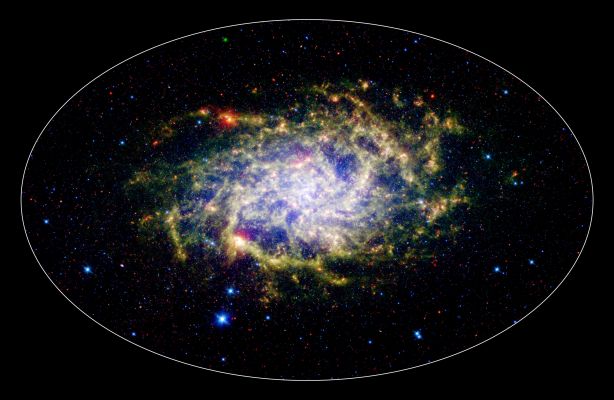
M 33 - Spiral Galaxy (3-color composite)
|
One of our closest galactic neighbors shows its awesome beauty in this new image from NASA's Spitzer Space Telescope. M 33, also known as the "Triangulum Galaxy", is a member of what's known as our Local Group of galaxies.
Along with our own Milky Way, this group travels together in the universe, as they are gravitationally bound. In fact, M 33 is one of the few galaxies that is moving toward the Milky Way despite the fact that space itself is expanding, causing most galaxies in the universe to grow farther and farther apart.
When viewed with Spitzer's InfraRed eyes, this elegant spiral galaxy sparkles with color and detail. Stars appear as glistening blue gems (several of which are actually foreground stars in our own galaxy), while dust rich in organic molecules glows green. The diffuse orange-red glowing areas indicate star-forming regions, while small red flecks outside the spiral disk of M 33 are most likely distant background galaxies. But not only is this new image beautiful, it also shows M 33 to be surprising large — bigger than its Visible-Light appearance would suggest.
With its ability to detect cold, dark dust, Spitzer can see emission from cooler material well beyond the visible range of M 33's disk. Exactly how this cold material moved outward from the galaxy is still a mystery, but winds from giant stars or supernovas may be responsible.
M 33 is located about 2,9 MLY away in the constellation Triangulum. This is a three-color composite image showing InfraRed observations from two of Spitzer instruments. Blue represents combined 3.6- and 4.5-micron light and green shows light of 8 microns, both captured by Spitzer's IRAC.
Red is 24-micron light detected by Spitzer's Multiband Imaging Photometer.
|
|