Inizio Registrati Login

Elenco album Ultimi arrivi Ultimi commenti Più viste Più votate Preferiti Cerca

Inizio > THE LUNAR EXPLORER ARCHIVES > The Universe in Super Definition
Ritorna alla pagina delle miniature FILE 90/157 Torna all'inizio Guarda foto precedente Guarda foto successiva Salta alla fine
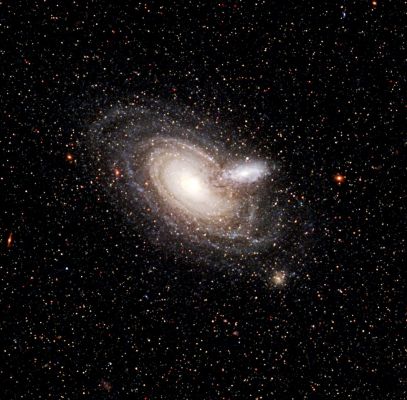
Cosmic Alignment! (2MASX J00482185-2507365)
NASA's Hubble Space Telescope has captured a rare alignment between two spiral galaxies. The outer rim of a small, foreground galaxy is silhouetted in front of a larger background galaxy. Skeletal tentacles of dust can be seen extending beyond the small galaxy's disk of starlight.

Such outer dark dusty structures, which appear to be devoid of stars, like barren branches, are rarely so visible in a galaxy because there is usually nothing behind them to illuminate them. Astronomers have never seen dust this far beyond the visible edge of a galaxy. They do not know if these dusty structures are common features in galaxies.

Understanding a galaxy's color and how dust affects and dims that color are crucial to measuring a galaxy's true brightness. By knowing the true brightness, astronomers can calculate the galaxy's distance from Earth.

Astronomers calculated that the background galaxy is 780 MLY away. They have not as yet calculated the distance between the two galaxies, although they think the two are relatively close, but not close enough to interact. The background galaxy is about the size of the Milky Way Galaxy and is about 10 times larger than the foreground galaxy.

Most of the stars speckled across this image belong to the nearby spiral galaxy NGC 253, which is out of view to the right. Astronomers used Hubble's Advanced Camera for Surveys to snap images of NGC 253 when they spied the two galaxies in the background. From ground-based telescopes, the two galaxies look like a single blob. But the Advanced Camera's sharp "eye" distinguished the blob as two galaxies, cataloged as 2MASX J00482185-2507365. The images were taken on Sept. 19, 2006.

The results have been submitted for publication in The Astronomical Journal.

For additional information, contact:

Donna Weaver/Ray Villard
Space Telescope Science Institute, Baltimore, Md.
410-338-4493 / 410-338-4514
dweaver@stsci.edu / villard@stsci.edu

Benne Holwerda
Space Telescope Science Institute, Baltimore, Md.
/University of Cape Town, South Africa
holwerda@stsci.edu

Object Name: 2MASX J00482185-2507365


Parole chiave: From Space Images - Hubble Space Telescope (HST) Images

Cosmic Alignment! (2MASX J00482185-2507365)

NASA's Hubble Space Telescope has captured a rare alignment between two spiral galaxies. The outer rim of a small, foreground galaxy is silhouetted in front of a larger background galaxy. Skeletal tentacles of dust can be seen extending beyond the small galaxy's disk of starlight.

Such outer dark dusty structures, which appear to be devoid of stars, like barren branches, are rarely so visible in a galaxy because there is usually nothing behind them to illuminate them. Astronomers have never seen dust this far beyond the visible edge of a galaxy. They do not know if these dusty structures are common features in galaxies.

Understanding a galaxy's color and how dust affects and dims that color are crucial to measuring a galaxy's true brightness. By knowing the true brightness, astronomers can calculate the galaxy's distance from Earth.

Astronomers calculated that the background galaxy is 780 MLY away. They have not as yet calculated the distance between the two galaxies, although they think the two are relatively close, but not close enough to interact. The background galaxy is about the size of the Milky Way Galaxy and is about 10 times larger than the foreground galaxy.

Most of the stars speckled across this image belong to the nearby spiral galaxy NGC 253, which is out of view to the right. Astronomers used Hubble's Advanced Camera for Surveys to snap images of NGC 253 when they spied the two galaxies in the background. From ground-based telescopes, the two galaxies look like a single blob. But the Advanced Camera's sharp "eye" distinguished the blob as two galaxies, cataloged as 2MASX J00482185-2507365. The images were taken on Sept. 19, 2006.

The results have been submitted for publication in The Astronomical Journal.

For additional information, contact:

Donna Weaver/Ray Villard
Space Telescope Science Institute, Baltimore, Md.
410-338-4493 / 410-338-4514
dweaver@stsci.edu / villard@stsci.edu

Benne Holwerda
Space Telescope Science Institute, Baltimore, Md.
/University of Cape Town, South Africa
holwerda@stsci.edu

Object Name: 2MASX J00482185-2507365

Mira-PIA09961.jpg N76-PIA08516-2.jpg NGC-0253-HST.jpg NGC-0346-PIA11227.jpg NGC-0362-PIA09653.jpg
Informazioni sul file
Nome del file:NGC-0253-HST.jpg
Nome album:MareKromium / The Universe in Super Definition
Valutazione (6 voti):55555(Mostra dettagli)
Parole chiave:From / Space / Images / - / Hubble / Space / Telescope / (HST) / Images
Copyright:NASA, ESA, and The Hubble Heritage Team (STScI/AURA)
Dimensione del file:225 KiB
Data di inserimento:Set 21, 2008
Dimensioni:975 x 958 pixels
Visualizzato:55 volte
URL:https://www.lunexit.it/gallery/displayimage.php?pid=21945
Preferiti:Aggiungi ai preferiti


Powered by Coppermine Photo Gallery