Inizio Registrati Login

Elenco album Ultimi arrivi Ultimi commenti Più viste Più votate Preferiti Cerca

Inizio > SOLAR SYSTEM > Asteroids and Comets
Ritorna alla pagina delle miniature FILE 57/282 Torna all'inizio Guarda foto precedente Guarda foto successiva Salta alla fine
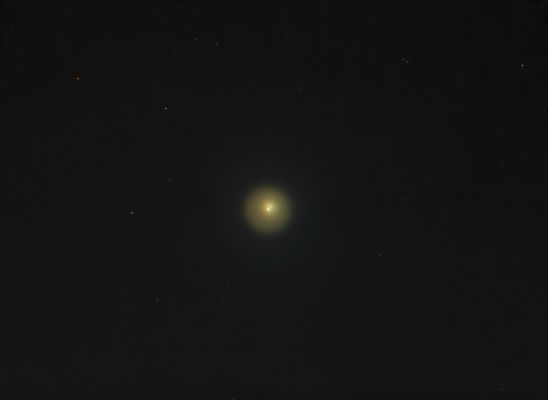
Telescopic View of the Comet Holmes
Caption NASA, da "NASA - Picture of the Day" del 29 Ottobre 2007:"What's happened to Comet Holmes? A normally docile comet discovered over 100 years ago, Comet 17P/Holmes suddenly became nearly one million times brighter last week, possibly over just a few hours. In astronomical terms, the comet brightened from magnitude 17, only visible through a good telescope, to magnitude 3, becoming visible with the unaided eye. Comet Holmes had already passed its closest to the Sun in 2007 May outside the orbit of Mars and was heading back out near Jupiter's orbit when the outburst occurred. The comet's sudden brightening is likely due to some sort of sunlight-reflecting outgassing event, possibly related to ice melting over a gas-filled cavern, or possibly even a partial breakup of the comet's nucleus. Pictured above through a small telescope, Comet Holmes appeared as a fuzzy yellow spot, significantly larger in angular size than Earth-atmosphere blurred distant stars. Although Comet Holmes' orbit will place it in northern hemisphere skies for the next two years, whether it will best be viewed through a telescope or sunglasses remains unknown".
Parole chiave: From Earth Images - Amatorial Images

Telescopic View of the Comet Holmes

Caption NASA, da "NASA - Picture of the Day" del 29 Ottobre 2007:"What's happened to Comet Holmes? A normally docile comet discovered over 100 years ago, Comet 17P/Holmes suddenly became nearly one million times brighter last week, possibly over just a few hours. In astronomical terms, the comet brightened from magnitude 17, only visible through a good telescope, to magnitude 3, becoming visible with the unaided eye. Comet Holmes had already passed its closest to the Sun in 2007 May outside the orbit of Mars and was heading back out near Jupiter's orbit when the outburst occurred. The comet's sudden brightening is likely due to some sort of sunlight-reflecting outgassing event, possibly related to ice melting over a gas-filled cavern, or possibly even a partial breakup of the comet's nucleus. Pictured above through a small telescope, Comet Holmes appeared as a fuzzy yellow spot, significantly larger in angular size than Earth-atmosphere blurred distant stars. Although Comet Holmes' orbit will place it in northern hemisphere skies for the next two years, whether it will best be viewed through a telescope or sunglasses remains unknown".

Comets-Comet_Hartley_2-NASA-2.jpg Comets-Comet_Holmes-0.jpg Comets-Comet_Holmes-TView.jpg Comets-Comet_Holmes-TW-P17HolmesWeb3_goldman.jpg Comets-Comet_Holmes-UV.gif
Informazioni sul file
Nome del file:Comets-Comet_Holmes-TView.jpg
Nome album:MareKromium / Asteroids and Comets
Valutazione (9 voti):55555(Mostra dettagli)
Parole chiave:From / Earth / Images / - / Amatorial / Images
Copyright:Igor Chekalin
Dimensione del file:314 KiB
Data di inserimento:Ott 29, 2007
Dimensioni:1524 x 1112 pixels
Visualizzato:56 volte
URL:https://www.lunexit.it/gallery/displayimage.php?pid=18502
Preferiti:Aggiungi ai preferiti


Powered by Coppermine Photo Gallery