Inizio Registrati Login

Elenco album Ultimi arrivi Ultimi commenti Più viste Più votate Preferiti Cerca

Inizio > THE LUNAR EXPLORER ARCHIVES > The Universe in Super Definition
Ritorna alla pagina delle miniature FILE 156/157 Torna all'inizio Guarda foto precedente Guarda foto successiva Salta alla fine
The "O"-Star
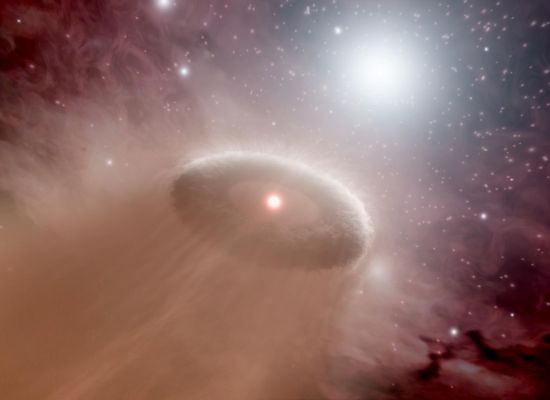
"The further on the edge, the hotter the intensity," sings Kenny Loggins in "Danger Zone," a song made famous by the movie "Top Gun." The same words ring true for young, cooler stars like our sun that live in the danger zones around scorching hot stars, called O-stars. The closer a young, maverick star happens to be to a super hot O-star, the more likely its burgeoning planets will be blasted into space. 

This artist's animation illustrates how this process works. The movie begins by showing an O-star in a murky star-forming region. It then pans out to show a young, cooler star and its swirling disk of planet-forming material. Disks like this one, called protoplanetary disks, are where planets are born. Gas and dust in a disk clumps together into tiny balls that sweep through the material, growing in size to eventually become full-grown planets. 

The young star happens to lie within the "danger zone" around the O-star, which means that it is too close to the hot star to keep its disk. Radiation and winds from the O-star boil and blow away the material, respectively. This process, called photoevaporation, is sped up here but takes anywhere from 100,000 to about 1,000,000 years. Without a disk, the young star will not be able to produce planets. 

Our own sun and its suite of planets might have grown up on the edge of an O-star's danger zone before migrating to its current, spacious home. However, we know that our young sun didn't linger for too long in any hazardous territory, or our planets, and life, wouldn't be here today. 

NASA's Spitzer Space Telescope surveyed the danger zones around five O-stars in the Rosette nebula. It was able to determine that the zones are spheres with a radius of approximately 1.6 light-years, or 10 trillion miles. 


Parole chiave: Artistic Interpretations of the Universe

The "O"-Star

"The further on the edge, the hotter the intensity," sings Kenny Loggins in "Danger Zone," a song made famous by the movie "Top Gun." The same words ring true for young, cooler stars like our sun that live in the danger zones around scorching hot stars, called O-stars. The closer a young, maverick star happens to be to a super hot O-star, the more likely its burgeoning planets will be blasted into space.

This artist's animation illustrates how this process works. The movie begins by showing an O-star in a murky star-forming region. It then pans out to show a young, cooler star and its swirling disk of planet-forming material. Disks like this one, called protoplanetary disks, are where planets are born. Gas and dust in a disk clumps together into tiny balls that sweep through the material, growing in size to eventually become full-grown planets.

The young star happens to lie within the "danger zone" around the O-star, which means that it is too close to the hot star to keep its disk. Radiation and winds from the O-star boil and blow away the material, respectively. This process, called photoevaporation, is sped up here but takes anywhere from 100,000 to about 1,000,000 years. Without a disk, the young star will not be able to produce planets.

Our own sun and its suite of planets might have grown up on the edge of an O-star's danger zone before migrating to its current, spacious home. However, we know that our young sun didn't linger for too long in any hazardous territory, or our planets, and life, wouldn't be here today.

NASA's Spitzer Space Telescope surveyed the danger zones around five O-stars in the Rosette nebula. It was able to determine that the zones are spheres with a radius of approximately 1.6 light-years, or 10 trillion miles.

W5-PIA11047.jpg W5-SST.jpg Wasp_12b-PIA13691.jpg YoungStar-PIA09266.jpg Z-Camelopardalis-PIA09219.jpg
Informazioni sul file
Nome del file:YoungStar-PIA09266.jpg
Nome album:MareKromium / The Universe in Super Definition
Valutazione (7 voti):55555(Mostra dettagli)
Parole chiave:Artistic / Interpretations / of / the / Universe
Copyright:NASA/JPL-Caltech
Dimensione del file:238 KiB
Data di inserimento:Apr 20, 2007
Dimensioni:3300 x 2400 pixels
Visualizzato:69 volte
URL:https://www.lunexit.it/gallery/displayimage.php?pid=16558
Preferiti:Aggiungi ai preferiti

Commento 1 a 4 di 4
Pagina: 1

MareKromium   [Feb 18, 2020 at 05:36 PM]
Amici, mi assento qualche giorno. Domani ho un impegno grave che avrei preferito non avere, ma....c'est la Vie. Poi mi assenteṛ per 4/5 giorni. Un Abbraccio Circolare! - paolo
Ufologo   [Feb 18, 2020 at 06:17 PM]
Quindi, un saluto siderale con relativo abbraccio!
Anakin   [Feb 19, 2020 at 09:40 AM]
Grande abbraccio. Ti aspettiamo
walthari   [Feb 19, 2020 at 11:23 AM]
un abbraccio Paolo

Commento 1 a 4 di 4
Pagina: 1


Powered by Coppermine Photo Gallery