Inizio Registrati Login

Elenco album Ultimi arrivi Ultimi commenti Più viste Più votate Preferiti Cerca

Inizio > THE LUNAR EXPLORER ARCHIVES > The Universe in Super Definition
Ritorna alla pagina delle miniature FILE 25/157 Torna all'inizio Guarda foto precedente Guarda foto successiva Salta alla fine
Portrait of the Universe
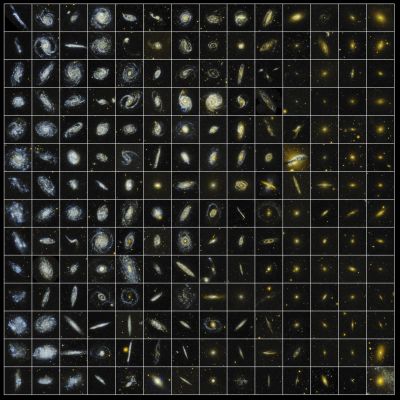
From sparkling blue rings to dazzling golden disks, Galaxy Evolution Explorer (Galex) scientists are handing out a collection of their finest galactic treasures at the January 2006 American Astronomical Society meeting in Washington, D.C. 

Mined from the mission's Survey of Nearby Galaxies data, these cosmic gems were collected with the telescope's sensitive ultraviolet instruments. The gallery of galaxies has been made into a poster for meeting attendees visiting the mission's booth. Organized from far-ultraviolet to near-ultraviolet bright galaxies, this poster encapsulates the heart of the mission to study how galaxies and star formation rates have changed over the past 10 billion years. 

Events in space take millions or billions of years to unfold, which means that astronomers can't watch individual galaxies and stars age over time. Luckily, because the physics of light travel dictates that the farther away an object is from Earth, the longer it takes for its light to travel to us, the universe can be thought of as a time machine. By building telescopes sensitive enough to capture objects that are 10 billion light-years away, astronomers can essentially see an object the way it looked 10 billion years ago. Galex astronomers are using this phenomenon to their advantage by taking snapshots of different galaxies at various distances in space. By comparing portraits of numerous objects at various times in the universe's history, the team can begin to piece together the life cycle of stars and galaxies. 

For the poster, Galex scientists organized 196 different nearby galaxies in bins of increasing ultraviolet color. By placing the various snapshots side by side, astronomers can see how galaxies age differently. When viewed in ultraviolet, active star-forming regions in galaxies can be seen as glittering blue structures, while a soft, golden glow indicates the presence of older stars. 

The 196 galaxies represented in the poster were selected from more than 1,000 galaxies in the "Ultraviolet Atlas of Nearby Galaxies." So far, the Galex mission has surveyed more than 100 million galaxies.

Parole chiave: From Space Images - GALEX

Portrait of the Universe

From sparkling blue rings to dazzling golden disks, Galaxy Evolution Explorer (Galex) scientists are handing out a collection of their finest galactic treasures at the January 2006 American Astronomical Society meeting in Washington, D.C.

Mined from the mission's Survey of Nearby Galaxies data, these cosmic gems were collected with the telescope's sensitive ultraviolet instruments. The gallery of galaxies has been made into a poster for meeting attendees visiting the mission's booth. Organized from far-ultraviolet to near-ultraviolet bright galaxies, this poster encapsulates the heart of the mission to study how galaxies and star formation rates have changed over the past 10 billion years.

Events in space take millions or billions of years to unfold, which means that astronomers can't watch individual galaxies and stars age over time. Luckily, because the physics of light travel dictates that the farther away an object is from Earth, the longer it takes for its light to travel to us, the universe can be thought of as a time machine. By building telescopes sensitive enough to capture objects that are 10 billion light-years away, astronomers can essentially see an object the way it looked 10 billion years ago. Galex astronomers are using this phenomenon to their advantage by taking snapshots of different galaxies at various distances in space. By comparing portraits of numerous objects at various times in the universe's history, the team can begin to piece together the life cycle of stars and galaxies.

For the poster, Galex scientists organized 196 different nearby galaxies in bins of increasing ultraviolet color. By placing the various snapshots side by side, astronomers can see how galaxies age differently. When viewed in ultraviolet, active star-forming regions in galaxies can be seen as glittering blue structures, while a soft, golden glow indicates the presence of older stars.

The 196 galaxies represented in the poster were selected from more than 1,000 galaxies in the "Ultraviolet Atlas of Nearby Galaxies." So far, the Galex mission has surveyed more than 100 million galaxies.

Epsilon_Eridani-PIA11376.JPG From_HST-2009-19-a-print.jpg GALEX Portrait-PIA03295.jpg GLS-SDSSJ0946+1006.jpg GRB-080319B.jpg
Informazioni sul file
Nome del file:GALEX Portrait-PIA03295.jpg
Nome album:The Universe in Super Definition
Valutazione (9 voti):55555(Mostra dettagli)
Parole chiave:From / Space / Images / - / GALEX
Copyright:NASA - Galaxy Evolution Explorer (GALEX)
Dimensione del file:769 KiB
Data di inserimento:Apr 27, 2006
Dimensioni:2264 x 2260 pixels
Visualizzato:55 volte
URL:https://www.lunexit.it/gallery/displayimage.php?pid=14305
Preferiti:Aggiungi ai preferiti

Commento 1 a 5 di 5
Pagina: 1

walthari   [Mar 03, 2016 at 04:57 PM]
http: // www. livescience .com/ 49958-theory-no-big-bang . html Articolo molto stimolante.Secondo le formulazioni quantistiche il Big Bang potrebbe non essersi mai verificato e l'universo potrebbe esistere da sempre.....
Anakin   [Mar 04, 2016 at 06:52 AM]
potrebbe anche essere.
Io, che mi rifaccio ai testi Vedici, invece, credo nell'esistenza sia del Big Bang che del Big Crunch
Ufologo   [Mar 06, 2016 at 05:10 PM]
(... Quando andremo di lą ... lo capiremo)
Anakin   [Mar 07, 2016 at 08:17 AM]
Quando andremo di la non ce ne fregherą pił nulla di come funziona
KKK   [Mar 18, 2016 at 06:08 PM]
Quoto. La Veritą ci apparirą ovvia.... Forse perché lo é.....

Commento 1 a 5 di 5
Pagina: 1


Powered by Coppermine Photo Gallery