Inizio Registrati Login

Elenco album Ultimi arrivi Ultimi commenti Più viste Più votate Preferiti Cerca

Inizio > MOON > The Lunar Surface in HR
Ritorna alla pagina delle miniature FILE 39/86 Torna all'inizio Guarda foto precedente Guarda foto successiva Salta alla fine
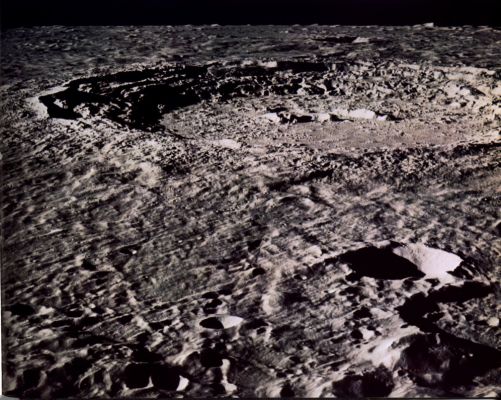
AS 17-151-23260 - Copernicus Crater
The large Crater Copernicus has served as a type example of Lunar Impact Craters since the classic analysis was made by E. M. Shoemaker in 1962. Bright rays of ejecta radiate outward from Copernicus across a large part of the Moon's Near-Side. Material from one of the rays may have been sampled at the Apollo 12 Landing Site, 370 Km South of the center of the crater. This photograph shows how the Crater appeared from the Apollo 17 spacecraft looking Southward over the Montes Carpatus (Carpathian Mountains). 
Notice that the rim deposits immediately adjacent to the Crater have a very crisp, blocky appearance in contrast to the softer appearance of the rest of the ejecta blanket. This crisp zone is also found on many other craters and suggests the ejecta here was swept clean by some erosion process late in the cratering event. The terraced slumps on the Crater wall appear like giant stair steps leading to the floor, 3 to 4 Km below the rim. The 1-Km-high central peaks were made famous in 1966 by a "Picture of the century" view looking into the crater from the south by Lunar Orbiter 2. Now Apollo has given us scores of even more spectacular photographs.
Parole chiave: The Moon from orbit - Craters - Copernicus

AS 17-151-23260 - Copernicus Crater

The large Crater Copernicus has served as a type example of Lunar Impact Craters since the classic analysis was made by E. M. Shoemaker in 1962. Bright rays of ejecta radiate outward from Copernicus across a large part of the Moon's Near-Side. Material from one of the rays may have been sampled at the Apollo 12 Landing Site, 370 Km South of the center of the crater. This photograph shows how the Crater appeared from the Apollo 17 spacecraft looking Southward over the Montes Carpatus (Carpathian Mountains).
Notice that the rim deposits immediately adjacent to the Crater have a very crisp, blocky appearance in contrast to the softer appearance of the rest of the ejecta blanket. This crisp zone is also found on many other craters and suggests the ejecta here was swept clean by some erosion process late in the cratering event. The terraced slumps on the Crater wall appear like giant stair steps leading to the floor, 3 to 4 Km below the rim. The 1-Km-high central peaks were made famous in 1966 by a "Picture of the century" view looking into the crater from the south by Lunar Orbiter 2. Now Apollo has given us scores of even more spectacular photographs.

APOLLO 16-4136-B.jpg APOLLO 17 AS 17-149-22838.jpg APOLLO 17 AS 17-151-23260.jpg APOLLO 17 AS 17-1672.jpg APOLLO 17 AS 17-2265.jpg
Informazioni sul file
Nome del file:APOLLO 17 AS 17-151-23260.jpg
Nome album:The Lunar Surface in HR
Valutazione (2 voti):55555(Mostra dettagli)
Parole chiave:The / Moon / from / orbit / - / Craters / - / Copernicus
Copyright:NASA - Apollo Programme - Apollo 17
Dimensione del file:198 KiB
Data di inserimento:Ago 27, 2006
Dimensioni:996 x 795 pixels
Visualizzato:62 volte
URL:https://www.lunexit.it/gallery/displayimage.php?pid=12513
Preferiti:Aggiungi ai preferiti


Powered by Coppermine Photo Gallery