Inizio Registrati Login

Elenco album Ultimi arrivi Ultimi commenti Più viste Più votate Preferiti Cerca

Inizio > MOON > The Lunar Surface in HR
Ritorna alla pagina delle miniature FILE 27/86 Torna all'inizio Guarda foto precedente Guarda foto successiva Salta alla fine
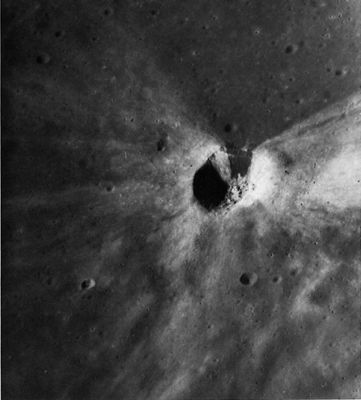
AS 16-4511 - Crater "Rays"
This picture shows the striking bilateral symmetry of the rays of a small (2-Km diameter) crater in the floor of the large crater Daguerre in Mare Nectaris. Continuous areas and narrow filaments of light-gray ejecta extend from the crater across the dark mare surface through 270°, but are entirely absent in the southern 90° sector. Within the crater, dark material occurs on the southern crater wall while the remaining walls are bright. (The reader may wonder about the material whose reflectivity cannot be observed because it lies in shadow on the East wall of this crater. Until the area is observed under high Sun conditions, we are forced to make the simplifying assumption that it is bright because most of the materials visible elsewhere in the walls are bright). 
This crater probably resulted from the impact of a projectile traveling from South to North along an oblique trajectory. 
Its pattern of ejecta distribution is similar to that of small craters produced by the impact of missiles along oblique trajectories at the White Sands Missile Range, N. Mex. Some observers postulate that the dark material is a talus deposit of mare material that has fallen into the crater.
Parole chiave: The Moon from orbit - Craters - Daguerre

AS 16-4511 - Crater "Rays"

This picture shows the striking bilateral symmetry of the rays of a small (2-Km diameter) crater in the floor of the large crater Daguerre in Mare Nectaris. Continuous areas and narrow filaments of light-gray ejecta extend from the crater across the dark mare surface through 270°, but are entirely absent in the southern 90° sector. Within the crater, dark material occurs on the southern crater wall while the remaining walls are bright. (The reader may wonder about the material whose reflectivity cannot be observed because it lies in shadow on the East wall of this crater. Until the area is observed under high Sun conditions, we are forced to make the simplifying assumption that it is bright because most of the materials visible elsewhere in the walls are bright).
This crater probably resulted from the impact of a projectile traveling from South to North along an oblique trajectory.
Its pattern of ejecta distribution is similar to that of small craters produced by the impact of missiles along oblique trajectories at the White Sands Missile Range, N. Mex. Some observers postulate that the dark material is a talus deposit of mare material that has fallen into the crater.

APOLLO 16 AS 16-4471.jpg APOLLO 16 AS 16-4502.jpg APOLLO 16 AS 16-4511.jpg APOLLO 16 AS 16-4530.jpg APOLLO 16 AS 16-4531.jpg
Informazioni sul file
Nome del file:APOLLO 16 AS 16-4511.jpg
Nome album:The Lunar Surface in HR
Valutazione (3 voti):55555(Mostra dettagli)
Parole chiave:The / Moon / from / orbit / - / Craters / - / Daguerre
Copyright:NASA - Apollo Programme - Apollo 16
Dimensione del file:90 KiB
Data di inserimento:Ago 16, 2006
Dimensioni:800 x 886 pixels
Visualizzato:54 volte
URL:https://www.lunexit.it/gallery/displayimage.php?pid=12310
Preferiti:Aggiungi ai preferiti


Powered by Coppermine Photo Gallery