Inizio Registrati Login

Elenco album Ultimi arrivi Ultimi commenti Più viste Più votate Preferiti Cerca

Inizio > MOON > The Moon through LRO
Ritorna alla pagina delle miniature FILE 1819/2195 Torna all'inizio Guarda foto precedente Guarda foto successiva Salta alla fine
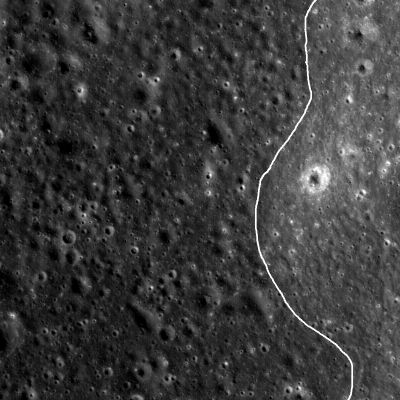
Mare - Highlands Boundary in Mare Moscoviense
Mare Moscoviense: a "Window" to the Lunar Far-Side Volcanism

It's clear from looking at pictures of the Moon that the Near-Side and the Far-Side are very different from a geologic standpoint. 
The darker, basaltic mare deposits dominate the Near-Side, whereas the Far-Side is dominated by bright deposits of anorthosite thought to be remnants of the Moon's original crust. Mare Moscoviense is one of the few (and also the largest) deposits of mare basalts on the Lunar Far-Side.

Why are there so many mare basalts on the Near-Side, but so few on the Far-Side? Lunar scientists simply don't know the answer to that question. One idea is that the Far-Side crust is simply thicker than the near side crust, and rising basaltic magma simply solidified before it was able to push through the thicker Far-Side crust. That's where Moscoviense comes in. We know enough about the Moscoviense Region from previous missions that we have a well-defined set of questions that potential future missions might be able to answer. For example, the Lunar Prospector mission showed that there are high concentrations of thorium in the Moscoviense Basin. Thorium acts as a tracer for the Lunar KREEP (Potassium - K -, Rare Earth Elements and Phosphorus) geochemical component found in abundance on the Near-Side but not on the Far-Side. 

Understanding the extent and distribution of thorium in the basin may tell us about the global distribution of the Lunar KREEP component and thus the evolution of the Lunar Mantle. We also know from the Clementine mission that the Moscoviense basalts are rich in both Iron and Titanium. Since basalts form by partial melting of the Lunar Mantle, sampling Moscoviense basalts provides lunar scientists with vital insights into how the Lunar Mantle on the Far-Side differs from the Near-Side one, which in turn would help us to learn why mare basalts are so much rarer on the Far-Side and provide key insights about the formation of all of the terrestrial planets, including Mars and Earth.

For these reasons, a Constellation Program region of interest is located within Mare Moscoviense. The region is at the edge of Moscoviense, allowing explorers to collect samples from both the mare basalts and the surrounding highlands terrain during their traverses. 
The materials at the edge of the basin provide important insights into the formation of the Moscoviense Basin itself. By exploring and sampling the Moscoviense Region, we would date the basalt flows and definitively determine their composition. This sampling would let us determine how Moscoviense basalts differ from the near side basalts sampled during Apollo. Age-dating Moscoviense basalts also provides important insights into the history of lunar volcanism by determining whether the Moscoviense basalts are older or younger than Near-Side basalts.

While the scientific goals of exploring the Moscoviense Region are certainly important, no less important is access to key lunar resources. The lunar regolith (the broken-up rocks and impact products that make up the first 10 meters or so of the Lunar Surface) in this region is derived in part from the local titanium-rich Moscoviense basalts. This regolith material could be used for a variety of vital purposes, including the construction of human habitats, radiation shielding, or as feedstock for local resource utilization. 
Taking a longer view, Titanium is an important industrial material on Earth, and it will be very important for indigenous lunar industrial development.
Parole chiave: The Moon from orbit - Mare Moscoviense

Mare - Highlands Boundary in Mare Moscoviense

Mare Moscoviense: a "Window" to the Lunar Far-Side Volcanism

It's clear from looking at pictures of the Moon that the Near-Side and the Far-Side are very different from a geologic standpoint.
The darker, basaltic mare deposits dominate the Near-Side, whereas the Far-Side is dominated by bright deposits of anorthosite thought to be remnants of the Moon's original crust. Mare Moscoviense is one of the few (and also the largest) deposits of mare basalts on the Lunar Far-Side.

Why are there so many mare basalts on the Near-Side, but so few on the Far-Side? Lunar scientists simply don't know the answer to that question. One idea is that the Far-Side crust is simply thicker than the near side crust, and rising basaltic magma simply solidified before it was able to push through the thicker Far-Side crust. That's where Moscoviense comes in. We know enough about the Moscoviense Region from previous missions that we have a well-defined set of questions that potential future missions might be able to answer. For example, the Lunar Prospector mission showed that there are high concentrations of thorium in the Moscoviense Basin. Thorium acts as a tracer for the Lunar KREEP (Potassium - K -, Rare Earth Elements and Phosphorus) geochemical component found in abundance on the Near-Side but not on the Far-Side.

Understanding the extent and distribution of thorium in the basin may tell us about the global distribution of the Lunar KREEP component and thus the evolution of the Lunar Mantle. We also know from the Clementine mission that the Moscoviense basalts are rich in both Iron and Titanium. Since basalts form by partial melting of the Lunar Mantle, sampling Moscoviense basalts provides lunar scientists with vital insights into how the Lunar Mantle on the Far-Side differs from the Near-Side one, which in turn would help us to learn why mare basalts are so much rarer on the Far-Side and provide key insights about the formation of all of the terrestrial planets, including Mars and Earth.

For these reasons, a Constellation Program region of interest is located within Mare Moscoviense. The region is at the edge of Moscoviense, allowing explorers to collect samples from both the mare basalts and the surrounding highlands terrain during their traverses.
The materials at the edge of the basin provide important insights into the formation of the Moscoviense Basin itself. By exploring and sampling the Moscoviense Region, we would date the basalt flows and definitively determine their composition. This sampling would let us determine how Moscoviense basalts differ from the near side basalts sampled during Apollo. Age-dating Moscoviense basalts also provides important insights into the history of lunar volcanism by determining whether the Moscoviense basalts are older or younger than Near-Side basalts.

While the scientific goals of exploring the Moscoviense Region are certainly important, no less important is access to key lunar resources. The lunar regolith (the broken-up rocks and impact products that make up the first 10 meters or so of the Lunar Surface) in this region is derived in part from the local titanium-rich Moscoviense basalts. This regolith material could be used for a variety of vital purposes, including the construction of human habitats, radiation shielding, or as feedstock for local resource utilization.
Taking a longer view, Titanium is an important industrial material on Earth, and it will be very important for indigenous lunar industrial development.

APOLLO_12_AS_12-57-8444_HR-c.jpg Luna17-Photomosaic-001a.jpg LRO-1002-392723-MainCabaeus_full.jpg LRO-2500-Epigenes_A_Crater-1.jpg LRO-2500-Marius_Crater~0.jpg
Informazioni sul file
Nome del file:LRO-2503-Mare_Moscoviense.jpg
Nome album:MareKromium / The Moon through LRO
Valutazione (3 voti):55555(Mostra dettagli)
Parole chiave:The / Moon / from / orbit / - / Mare / Moscoviense
Copyright:NASA - LROC Project
Dimensione del file:290 KiB
Data di inserimento:Feb 21, 2010
Dimensioni:1200 x 1200 pixels
Visualizzato:74 volte
URL:https://www.lunexit.it/gallery/displayimage.php?pid=26334
Preferiti:Aggiungi ai preferiti


Powered by Coppermine Photo Gallery