|
|
In the Night
|
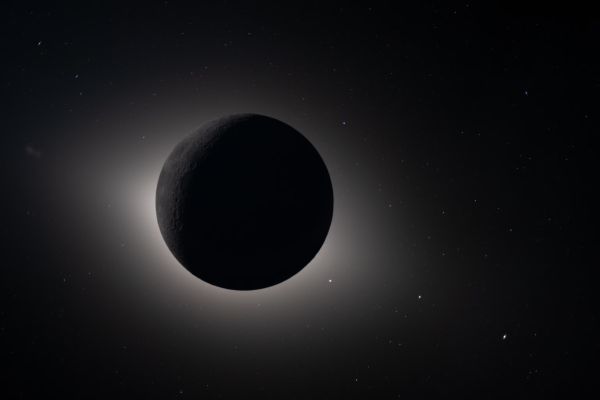
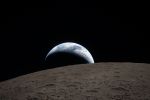
From the crew’s perspective, the Moon appeared large enough to completely block the Sun, creating nearly 54 minutes of eclipse totality. The corona forms a glowing halo around the dark lunar disk, revealing details of the Sun’s outer atmosphere typically hidden by its brightness. The faint glow of the nearside of the Moon is visible in this image, having been illuminated by light reflected off the Earth.
Moments to honor the past infused the entire day of the lunar flyby, the sixth of the mission. Upon waking, the crew heard a message from Jim Lovell, the astronaut who piloted Apollo 8 and commanded Apollo 13, and who recorded the missive for Artemis II before his death in August 2025. “Welcome to my old neighborhood!” Lovell said. “When Frank Borman, Bill Anders, and I orbited the moon on Apollo 8, we got humanity’s first up-close look at the moon and got a view of the home planet that inspired and united people around the world. I’m proud to pass that torch on to you.”
And in a particularly heartfelt moment, shortly after the crew reached the farthest point ever traveled in space, Canadian Astronaut Jeremy Hansen communicated the crew’s desire to name a crater close to the moon’s nearside-farside boundary after Commander Reid Wiseman’s late wife, Carroll Wiseman who died from cancer in 2020. “It’s a bright spot on the moon,” Hansen said. “We would like to call it Carroll.” And then the crew embraced.
|
|