|
|
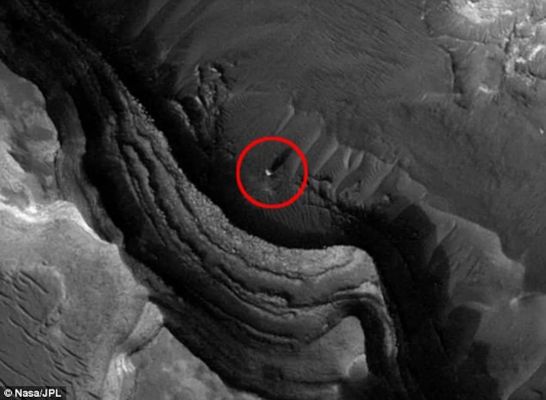
A new "Monolith-like Structure" on Mars...
|
With thousands of images taken by various probes sent to Mars, it would seem inevitable that unusual or puzzling objects might be seen in some of them. And of course, there have been, most notably the famous “Face on Mars� first seen in low-resolution Viking Orbiter images in the 1970s. Higher-resolution images taken later by other orbiters with better cameras showed it, and nearby interesting formations, to be just natural hills and mesas. Despite that, other curious things are seen in both orbital and ground images from time to time, although they almost always have a simple prosaic explanation. Another such oddity was seen in an image taken by the Mars Reconnaissance Orbiter (MRO), which has attracted some attention. Most likely it is a natural rock formation, but it’s also not, as described by the tabloid Daily Mail, a “spherule� either.
The image shows a bright object casting a long shadow across the Floor of what might be a dried-up lakebed. Some observers have said it might be a Tower (or "Spire"), judging by the long shadow, but the view is from directly above and not enough detail can be seen on the object itself. The object does stand out for its brightness, but little more can be said about it. Using Occam’s Razor, it is most likely a natural geological rock formation, and not an alien tower, but it also can’t be a round “spherule� as referred to. The spherules seen by the Opportunity and Curiosity rovers are tiny, only a few millimeters across, way, way too small to be seen from orbit. If at all sphere-shaped, it is much bigger than that. Simply being round or tall also wouldn’t prove it was something artificial.
|
|










Bradisismo, a Pozzuoli il suolo si solleva di 1,5 cm al mese
La direttrice del centro di vulcanologia dell'INGV, Francesca Bianco, parla anche delle scosse sul Vesuvio. "Entrambe le attività sismiche, rientrano in un normale contesto strutturale. Nulla di (...) di Alessandro Di Liegro - Montaggio di Gabriella Sansone
Le piccole scosse avvertite sul Vesuvio e a Forio, dal 20 dicembre scorso in poi, non devono preoccupare, così come quelle ai Campi Flegrei: secondo la direttrice del centro di vulcanologia dell'INGV, Francesca Bianco, entrambe le attività sismiche, rientrano in un normale contesto strutturale.
Per quanto riguarda il Vesuvio i lievi terremoti, di magnitudo modesta, se non irrisoria, sarebbero causati dal raffreddamento delle fratture causate dall'eruzione del '44, che hanno portato a un abbassamento e quindi a un movimento della crosta. Una questione di dinamica generale, così come sull'isola di Ischia, che niente ha a che fare con la risalita di magma.
Allo stesso modo, anche i Campi Flegrei, soggetti a un aumento dell'attività bradisismica e a un incremento in velocità di sollevamento, passata da 7 millimetri al mese a 15 millimetri al mese. Movimenti dovuti al sistema idrotermale del sottosuolo e che sfogano a livello superficiale, motivo per cui le scosse sembrano più evidenti ai cittadini. Anche qui, sottolinea la direttrice Bianco, nulla di cui preoccuparsi. Il magma che manda gas in superficie, deformando velocemente la crosta e aumentando la sismicità, non è detto che stia salendo: "non ne conosciamo la posizione" conclude Bianco "potrebbe essere anche a 10 o 12 km di profondità".
Mi scuso ancora per l'erroraccio. - paolo
Etna e tanti altri Vulcani docunt.