| Piú votate - MOON |

63-Guericke Crater.jpgGuericke Crater - The Crater117 visitenessun commento
(5 voti)
|
|

62-Guericke Crater.jpgGuericke Crater - The Crater151 visitenessun commento
(5 voti)
|
|

58-Luna13 - Q-Detail 1.JPGLunik 13: Oceanus Procellarum (4)230 visite...(una modesta depressione del terreno, ricolma di polvere) proprio davanti al Lander (frame 2). Per quanto attiene i 2 splendidi detail mgnf che Fabio Italiano ci ha messo davanti, il discorso diventa complesso.
Questo non vuol dire che non intendiamo esprimerci, si badi: il problema è che abbiamo veramente pochissimi dati fra le mani e le immagini sono enigmatiche al punto da lasciarci spazi interpretativi così ampi che, alla fine, il rischio che si corre è quello di dire delle enormi stupidaggini. Comunque sia, ci affidiamo alla nostra (modesta) esperienza e (speriamo notevole) sensibilità.
A nostro parere, questa prima Anomalìa non è, in realtà, un'Anomalìa, bensì un boulder dalla forma bizzarra. L'oggetto (che collocheremmo ad un 8/10 mt dal Lander), ci ricorda le pseudo-rocce Marziane ma, nello specifico, diremmo che si potrebbe trattare di una coppia di macigni (a forma di geode) molto vicini (sovrapposti, in parte, dall'angolo visuale del Lander) e, forse, divisi da un'altra roccia più piccola.
(5 voti)
|
|
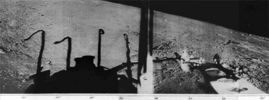
56-Luna13 - Panorama-02.jpgLunik 13: Oceanus Procellarum (2)139 visiteThe Luna 13 spacecraft was launched toward the Moon from an Earth-orbiting platform and accomplished a soft landing on December 24, 1966, in the Region of "Oceanus Procellarum". The petal encasement of the spacecraft was opened, antennas were erected, and radio transmissions to Earth began 4 minutes after the landing. On December 25 and 26, 1966, the spacecraft television system transmitted panoramas of the nearby lunar landscape at different sun angles. Each panorama required approximately 100 minutes to transmit. The spacecraft was equipped with a mechanical soil-measuring penetrometer, a dynamograph, and a radiation densitometer for obtaining data on the mechanical and physical properties and the cosmic-ray reflectivity of the lunar surface. It is believed that transmissions from the spacecraft ceased before the end of December 1966.
(5 voti)
|
|

Clavius-6.jpgClavius (3)110 visitenessun commento
(5 voti)
|
|

APOLLO 14 AS 14 64-9187.jpgAS 14-64-9187 - Lunar Horizon and pseudo-Misteries (4)189 visiteSoluzione del "mistero": l'altra feature - che abbiamo cerchiato in verde -, vagamente squadrata e che splende di luce metallica, alla Vostra Dx (ed accanto al boulder di forma apparentemente cupolare)...è il LM.
Attenzione: usando immagini come questa e caratterizzate da una simile (pessima) risoluzione, l'oggetto in questione potrebbe essere qualsiasi cosa! Noi abbiamo risolto - forse - il problema leggendo i commenti alle immagini (Apollo 14 - Lunar Surface Journal) e procurandoci il frame originale uncompressed.
E comunque, se ci fate caso, l'orizzonte Lunare (portate il frame sino al full-size per vedere bene) che attraversa il piano su cui giacciono boulder e Lunar Module, è palesemente rovinato dall'eccessiva compressione. Così rovinato da apparire ritoccato!
E questa, sicuramente, è la vera Anomalìa del frame...
(5 voti)
|
|

APOLLO 16 AS 16-120-19295.jpgAS 16-120-19295 - Moonscape from orbit (4)125 visitenessun commento
(5 voti)
|
|

50-The Shard-00.gifThe famous "Shard", on the Moon (1)146 visiteThe Shard is a very anomalous structure which rises above the Moon's surface by more than a mile (about 1750 mt). Its overall irregular spindly shape - containing a regular geometric pattern - with constricted nodes and swollen internodes, if natural, has got to be a real wonder of the Universe and no known natural processes can explain such a structure. Computer enhancement with about 190 feet (about 60 mt) resolution shows an irregular outline with more reflective and less reflective surfaces. The amount of sunlight reflecting from parts of the Shard indicate a composition inconsistent with that of most natural substances. Only crystal facets and glass can reflect that much light (polished metallic surfaces are unnatural). Single crystals the size of city blocks are currently unknown. Prof. Hoagland says that the Shard may be a highly eroded remnant of some sort of artificial structure made of glass-like material. Other larger structures and their reflectivity in the area support this theory.
(5 voti)
|
|

APOLLO 15 AS 15 85-11511 HR.jpgAS 15-85-11511 - Mount Hadley (HD)175 visitenessun commento
(5 voti)
|
|

APOLLO 15 AS 15 86-11606 HR.jpgAS 15-86-11606 - Glass Sphere on the ground279 visiteQuesta è la rubrica ufficiale usata anche dalla NASA per questo frame in HD. Ma, a parte quello strano oggetto color rosa e giallo (probabilmente fatto di plastica) che faceva parte dell'equipaggiamento degli Astronauti, questa enigmatica "Glass Sphere", dov'è?!?
A meno che, ovviamente, il termine Glass-Sphere non sia altro che un nick-name per indicare l'oggetto in questione il quale, nel frame 11608, viene rimosso.
Ad ogni modo, un'immagine come questa nasconde moltissime domande alle quali non è decisamente facile dare una (sensata) risposta...
(5 voti)
|
|

APOLLO 13 AS 13-62-9004.jpgAS 13-62-9004 - We need "air"!...235 visiteCome ottenere, su una nave spaziale in viaggio fra la Terra e la Luna ed in condizioni di stress estremo, un "marchingegno" capace di ripulire l'aria della capsula dall'anidride carbonica in eccesso e renderla nuovamente respirabile.
No, non è un miracolo: è solo tecnica, procedure e "sangue freddo".
(5 voti)
|
|

APOLLO 11 AS 11-40-5873.jpgAS 11-40-5873 (HR) - Men on the Moon...222 visiteUn'immagine unica e bellissima, a nostro avviso. Troppo bella per farci sopra commenti e speculazioni...
(5 voti)
|
|
| 2188 immagini su 183 pagina(e) |
 |
|
|
|
|
39 | |
|
|
|
|





