| Piú votate - MOON |

APOLLO_14_AS_14-77-10373a.JPGAS 14-77-10373 (a) - Soil-covered Rock (slightly sunstruck)61 visiteSoil-covered rock surface. Taken at the LM.MareKromium
(5 voti)
|
|

APOLLO_14_AS_14-77-10365a.JPGAS 14-77-10365 (a) - Thermal Degradation Sample63 visiteThermal Degradation Sample; taken in the vicinity of Station "A".MareKromium
(5 voti)
|
|

Mare_Imbrium.jpgMare Imbrium66 visiteCaption NASA:"Dark, smooth Regions that cover the Moon's familiar face are called by Latin names for oceans and seas. The naming convention is historical, though it may seem a little ironic to denizens of the space age who recognize the Moon as a mostly dry and airless world, and the smooth, dark areas as lava-flooded impact basins. For example, this elegant lunar vista, a careful mosaic of telescopic images, looks across the expanse of the North-Western Mare Imbrium, or Sea of Rains, into the Sinus Iridum - the Bay of Rainbows. Ringed by the Jura Mountains (montes), the bay is about 250 Km across, bounded at the bottom of the rugged arc by Cape (promontorium) Laplace.
The Cape's sunlit face towers nearly 3000 mt above the bay's surface. At the top of the arc is Cape Heraclides, at times seen as a moon maiden".MareKromium
(5 voti)
|
|
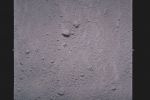
APOLLO_12_AS_12-57-8442_HR-a.jpgAS 12-57-8442 (a) - Soil surface disturbed by the LM descent engine exhaust (coloring: Lunexit)63 visitenessun commentoMareKromium
(5 voti)
|
|

APOLLO_12_AS_12-57-8442_HR-b.jpgAS 12-57-8442 (b) - Soil surface disturbed by the LM descent engine exhaust (coloring: NASA)60 visitenessun commentoMareKromium
(5 voti)
|
|

000-Kaguya.jpgThe Kaguya (SELENE) Probe72 visiteThe SELenological and ENgineering Explorer "KAGUYA"(SELENE), Japan’s 1st large Lunar Explorer, was launched by the H-IIA rocket on September 14, 2007 (JST). The mission, which is the largest Lunar Mission since the Apollo Program, is being keenly anticipated by many countries.
The major objectives of the Mission are to understand the Moon’s origin and evolution and to observe the Moon in various ways in order to utilize it in the future. The Lunar Missions that have been conducted so far have gathered a large amount of information on the Moon, but the mysteries of its origin and evolution have been left unsolved.
KAGUYA will investigate the entire Moon in order to obtain information on its elemental and mineralogical composition, geography, surface and sub-surface structure, the remnant of its magnetic field and its gravity field.
The results are expected to lead to a better overall understanding of the Moon’s evolution. At the same time, the observation equipment installed on the orbiting satellite will observe plasma, the electromagnetic field and high-energy particles. The data obtained in this way will be of great scientific importance for exploring the possibility of using the moon for human endeavors.MareKromium
(5 voti)
|
|

Z-111-The_Moon-CraterPentland.jpgIn the vicinities of Crater Pentland (HR)55 visiteCaption ESA:"This HR image, taken by the Advanced Moon Imaging Experiment (AMIE) on board ESA’s SMART-1 spacecraft, shows an area close to crater Pentland on the Moon.
AMIE obtained this sequence on 18 March 2006 from a distance of 573 Km from the surface, with a ground resolution of 52 mt per pixel. The imaged area is centred at a Latitude of 67,7º South and a Longitude of 18,3º East". MareKromium
(5 voti)
|
|

APOLLO_14_AS_14-66-9345_(HR).jpgAS 14-66-9345 (HR) - Looking for the Blue Flare... (20)59 visiteCaption NASA:"View of the CSM Kitty Hawk from the LM Antares during rendezvous".
MareKromium
(5 voti)
|
|

APOLLO_14_AS_14-66-9286_(HR).jpgAS 14-66-9286 (HR) - Looking for the Blue Flare... (1)68 visiteIl fascino discreto (ma non troppo) della Blue Flare ha colpito ancora e quindi, su richiesta di un nostro Amico Olandese, abbiamo deciso di riproporre in questa Sez. di Lunexit (secondo noi decisamente bella, ma certo poco visitata e dunque...oscura) una panoramica dell'orizzonte lunare che, nei suoi frames AS 14-66-9286, 9297 e 9299 (ben individuati dal Dr Gianluigi Barca, il quale sta riesaminando un enorme quantitativo di frames alla ricerca di "dettagli sfuggiti"), ci mostra la presenza, non molto lontano dagli Astronauti ed in prossimità della superficie, della nostra Fiaccola Blu.
MareKromium
(5 voti)
|
|
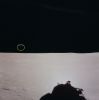
APOLLO_14_AS_14-66-9321_(HR).jpgAS 14-66-9321 (HR) - Looking for the Blue Flare... (17)59 visitenessun commentoMareKromium
(5 voti)
|
|

APOLLO_14_AS_14-66-9313_(HR).jpgAS 14-66-9313 (HR) - Looking for the Blue Flare... (15)59 visitenessun commentoMareKromium
(5 voti)
|
|
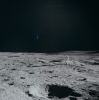
APOLLO_14_AS_14-66-9301_(HR).jpgAS 14-66-9301 (HR) - Looking for the Blue Flare... (13)60 visiteCaption NASA:"Ed is still doing a TV pan. Note the ridge behind him, still partially in shadow. Cone Crater is on a portion of this ridge that is off the picture to the right, virtually up-Sun (East) of the Landing Site".MareKromium
(5 voti)
|
|
| 2188 immagini su 183 pagina(e) |
 |
|
|
|
|
32 | |
|
|
|
|





