| Piú votate - MOON |

Zond-08-38.jpgThe "Terminator", from ZOND-885 visitenessun commento
(6 voti)
|
|
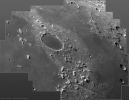
PlatoCrater-00.jpgPlato Crater (1)95 visiteThe dark-floored, 95 Km wide crater Plato (top) and Sunlit Peaks of the Lunar Alps are highlighted in this sharp digital mosaic of the Moon's surface. While the Alps of planet Earth were uplifted over millions of years as continental plates slowly collided, the Lunar Alps were likely formed by a sudden collision that created the giant impact basin known as the Mare Imbrium (Sea of Rains). The mare's generally smooth, lava-flooded floor is seen extending to the left. The prominent straight feature cutting through the mountain range (lower right) is the lunar Alpine Valley, about 160 Km long and up to 10 Km wide. Of course, the large, bright alpine mountain near bottom center is named Mont Blanc and reaches over 3 Km above the Lunar Surface.
(6 voti)
|
|

Zond-08-01.jpgEarthrise, from ZOND-8126 visiteZond-8 was launched from an Earth orbiting platform, Tyazheliy Sputnik (70-088B), towards the Moon, on October, 20, 1970. The announced objectives were the investigations of the Moon and Circum-Lunar Space and the testing of onboard systems and units. The spacecraft obtained photographs of the Earth on October 21, from a distance of 64.480 Km. The spacecraft transmitted flight images of the Earth for 3 days. Zond-8 flew past the Moon on October 24, 1970, at a distance of 1110,4 Km and obtained both b/w and color photographs of the Lunar Surface. Scientific measurements were also obtained during the flight.
Zond-8 reentered the Earth's atmosphere and splashed down in the Indian Ocean on October 27, 1970.
(6 voti)
|
|

Luna17-Horz02.jpgTracks on the Moon284 visiteAs with many Soviet space images, generation loss prevents us from seeing the original quality. Most Lunokhod images are derived from scanning printed images or second-generation film copies.
Each stage of photography, printing and scanning introduces noise, nonlinear brighness mapping, and (worst of all) clamping to white or black.
As a matter of fact, all these images only hint at the appearance of the original video signal.
Nota: oltre le tecnicalità sulla fotografia, guardate attentamente il "nido" e le "tracce" lasciate dal Rover Lunokhod-1. Eravamo nel 1970, in piena Era Apollo, lontanissimi dai giorni di Spirit ed Opportunity eppure...eppure la tecnologia di Spirit ed Opportunity c'era già: davanti a noi, in queste immagini, e sulla Luna.
Le considerazioni - inevitabili - che seguono, già le conoscete...
(6 voti)
|
|

C-La Condamine Crater 02.jpgRays of light through "La Condamine Crater" (3)122 visitenessun commento
(6 voti)
|
|
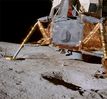
APOLLO 14 AS 14 66-9254 HR-1.jpgAS 14-66-9254 - LM and "disturbed" soil107 visiteOriginal caption:"114:53:38 MT. Frame from Al's 4 o'clock pan. Right side and aft section of the LM, looking South. An excellent picture of the LM with many structural details are visible. The area under, and slightly behind the engine bell shows evidence of disturbed soil resulting from the Descent Engine exhaust.
Also visible in the crater next to the rear (-Z) footpad is the track made by the probe as it scraped across the surface.
The right (+Y) footpad has dug into the soft rim of a crater, causing the LM to slide slightly. Refer, also, to AS 14-66-9269, a view of the left (-Y) footpad to see more evidence of this northward slide".
(6 voti)
|
|

APOLLO 11 AS11-44-6611 HR.jpgAS 11-44-6611 - Daedalus Crater (HR)141 visitenessun commento
(6 voti)
|
|

ZB-APOLLO 12 - Triple Crater.jpgTriple Crater101 visitenessun commento
(6 voti)
|
|

APOLLO 17 AS 17-147-22465 HR.jpgAS 17-147-22465 - CSM America or lift off from the Moon? (2) HR119 visiteIl "punto flash" del frame precedente adesso ci appare come una macchia scura, circondata da un alone biancastro e piuttosto mossa, posta circa a metà fra la collinetta e le pendici della montagna Lunare. Ma attenzione: secondo noi l'oggetto (se di oggetto si tratta) NON si sta muovendo SULLA superficie della Luna, dalla collina e verso la montagna. Secondo noi esso è in ASCESA, sulla verticale immaginaria che si solleva a partire dal punto in cui lo abbiamo visto nel primo frame.
E andiamo avanti...
(6 voti)
|
|

Clavius-3.jpgClavius (1)142 visiteClavius: uno spettacolare cratere, reso famoso dall'immortale "2001 - A Space Odyssey", così come ci appare dalla Terra, attraverso le eccellenti ottiche di un telescopio riflettore 'Celestron 11'.
Il seeing, con ogni probabilità, non era ottimale - come l'immagine dimostra ampiamente -; ma il risultato ottenuto (grazie anche al gioco di luci e di ombre che si ottiene scattando fotografie di Regioni Lunari che si trovano a ridosso o che sono prossime al terminatore) è - comunque - davvero notevole.
(6 voti)
|
|

U-APOLLO 13 AS 13 59-8500 LR.jpgThe "Odyssey": what happened to it? (2)243 visiteNoi siamo dei Ricercatori: lo è il Dr Feltri - che ha elaborato e proposto queste immagini - e lo sono coloro che formano il Gruppo di Studio Lunar Explorer. Lo è chi scrive queste righe. Da un Ricercatore (come da uno Scienziato), spesso, si pretendono risposte a domande tipo "che cosa è successo?", "che cosa significa questo?", "che cosa significa quello?" e così via. Purtroppo, nella vita professionale di un Ricercatore come di uno Scienziato (come di un Amateur Astronomer/Researcher), non è sempre possibile giungere a dare risposte definitive; non è sempre possibile arrivare alla Verità, anzi: la maggior parte delle volte, il lavoro del Professionista in questo campo si ferma quando l'indagine è ancora ben lungi dal concludersi. E allora, qual'è lo scopo di queste indagini?
Lo scopo di queste indagini, spesso, è nel determinare non tanto "che cosa si vede " e/o "che cosa è successo" quanto, piuttosto, "che cosa NON si vede" e/o "che cosa NON è successo".
(6 voti)
|
|

APOLLO_11_AS_11-40-5947-1.jpgAS 11-40-5947 - Domes at the horizon? (3D and extra-detail mgnf)258 visiteUn omaggio del Dr Feltri a Lunar Explorer Italia ed agli Amici di Spazio-UFO (FORUM) che sono stati attenti e bravi a trovare un particolare estremamente interessante: forse, a prima vista, si trattava del più "suggestivo", ma non dell'unico.
Infatti, se si guarda con molta attenzione "tutto" quello che gli Astronauti ci hanno messo a disposizione nell'AS-40-5947, potrebbero anche arrivare delle altre sorprese...
Ad ogni modo, questo 3D con extra-detail mgnf, è il nostro piccolo modo di dire "grazie" a tutti quelli che lavorano, si impegnano e provano a capire i misteri dello Spazio, sempre conservando equilibrio e Buona Fede.
Un caro saluto, quindi, a Spazio-UFO (FORUM) ed agli Amici Ricercatori ed Appassionati: "OldGrey", "Maxx", "DarkAlien", "Francesco" e tutti coloro che ricompensano, con il loro interesse e la loro partecipazione, i nostri sacrifici.
(6 voti)
|
|
| 2188 immagini su 183 pagina(e) |
 |
|
|
|
|
24 | |
|
|
|
|





