| Piú votate - MOON |

24-Mare Humorum-4.jpgMare Humorum (4)62 visitenessun commento
(1 voti)
|
|

24-Mare Humorum-3.jpgMare Humorum (3)57 visitenessun commento
(1 voti)
|
|

24-Mare Humorum-2.jpgMare Humorum (2)72 visite...La voglia di commentare questi poveri frames (poveri da svariati punti di vista...) messi a disposizione dall'ESA è forte ma, dato che il commento, in casi come questo, diventerebbe prima ironia e poi sarcasmo, riteniamo più giusto e saggio tacere.
Anzi no, una cosa va detta: se questi frames (assieme ai pochi altri messi a disposizione del Pubblico da parte dell'Agenzia Spaziale Europea in questi mesi) sono il risultato reale del mapping iper-dettagliato della Luna che SMART-1 avrebbe dovuto eseguire, allora ci tocca dire e ribadire che l'ESA ha ancora tantissima strada da percorrere prima di arrivare a produrre qualcosa di decente.
Se invece questi miseri frames sono solo una porzione del lavoro svolto da SMART-1 (come noi riteniamo), ci piacerebbe allora sapere come mai anche la "pacifica ed indipendente" Agenzia Spaziale Europea "gioca a nascondino" con le immagini che arrivano dallo Spazio.
Domande, domande, domande...
(1 voti)
|
|

16-Lichtenberg Crater.jpgLichtenberg Crater (HR)74 visiteAn image of the prominent crater Lichtenberg with a diameter of 20 Km. The crater shows a 1300 mt height difference between crater floor and surrounding lava plain. The actual target of this observation was the 'ghost' crater on the lower left of Lichtenberg. It is almost hidden by overflown lava from Oceanus Procellarum in which it is located. This area is of high geological interest and it was selected for the study of the most recent lunar volcanism. It is thought to contain the youngest basalts on the Lunar Surface, with an age of about 1000 MY. Recent data show that lunar volcanism was active for at least 2000 MY from 4000 MY ago, ceasing at about 2000 MY. In Oceanus Procellarum, it is thought that these basalts are the youngest basalts on the lunar surface with an age of less than 1000 MY. This should be compared with the age of the Moon at about 4500 MY. This crater is named after the German physicist Georg Christoph Lichtenberg (1742-1799) who was professor at the newly formed Goettingen University.
Nota: a nostro parere, questa caption ESA è - sostanzialmente - del tutto incomprensibile ed anche errata. Nel momento in cui si sostiene, infatti, che il vulcanismo lunare è cessato da svariate centinaia di milioni di anni (o anche di più), implicitamente si dice che alcuni grandissimi Astronomi della nostra Storia, da Galileo a Flammarion (i quali hanno assistito a possibili eventi vulcanici lunari classificati come TLP nel famoso NASA Technical Report R-277), erano e sono, in realtà, dei "visionari".
Triste, come sempre; molto triste.
(1 voti)
|
|

14-De Gasparis Crater.jpgDe Gasparis Crater74 visiteDe Gasparis is a small to medium sized crater 30 Km in diamater located on the western flank of Mare Humorum. The rim of the crater is worn and eroded. The interior has, at some point, been flooded by lava and sits around 0,8 Km below the surrounding surface. The crater is intersected by a number of rimae including, running from top-left to lower-right of the crater, a part of the 93 Km long Rimae De Gasparis.
Due to the consistent depth of the rimae it evidently formed after the crater and is possibly associated with the tectonic activity which saw the infilling of the crater.
The crater is named after the Italian Astronomer Annibale de Gasparis (1819-1892, director of the observatory in Naples, Italy and discoverer of 9 asteroids). Along with the crater and rimae, asteroid 4279 is also named in his honour.
The image represents raw data and no flat field or other corrections have been applied.
(1 voti)
|
|

APOLLO 14 AS 14 68-9452.jpgAS 14-68-9452 - "Weird" Lunar Outcrops120 visitenessun commento
(1 voti)
|
|

APOLLO 14 AS 14 68-9421.jpgAS 14-68-9421 - Lunar Surface Variety: rocks, hollows, small craters and depressions82 visitenessun commento
(1 voti)
|
|

APOLLO 14 AS 14 68-9405.jpgAS 14-68-9405 - Shepard and the MET101 visitenessun commento
(1 voti)
|
|

APOLLO 14 AS 14 68-9398.jpgAS 14-68-9398 - Moonscape72 visitenessun commento
(1 voti)
|
|
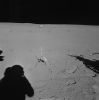
APOLLO 14 AS 14 64-9188.jpgAS 14-64-9188 - Gnomon and LM in the distance104 visitenessun commento
(1 voti)
|
|

APOLLO 14 AS 14 64-9140.jpgAS 14-64-9140 - Mitchell and the Modularized Equipment Transporter (MET)115 visiteUna nota di "colore": a noi non risulta che l'Astronauta Mitchell si sia mai calato all'interno di un qualche cratere o di un fosso, così come non c'è menzione di una sua "caduta" sulla superficie della Luna. Eppure...
Eppure guardate attentamente la sua tuta, diremmo dall'altezza delle ginocchia in giù: essa è diventata grigia, a causa di una traccia netta e definita di polvere.
Già, l'appiccicosissima ed assai fastidiosa (oltre che dall'odore strano ed impossibile da eliminare) "Moon Dust" ricopre, praticamente per intero, la parte inferiore delle gambe di Mitchell. Dove si è "calato" il nostro Amico Astronauta per ridursi in quello stato?!?
(1 voti)
|
|

APOLLO 15 AS 15-90-12310.jpgAS 15-90-12310 - Craters Herodotus and Wollaston "W"95 visitenessun commento
(1 voti)
|
|
| 2188 immagini su 183 pagina(e) |
 |
|
|
|
|
142 | |
|
|
|
|





