| |

| Piú votate - MOON |

APOLLO 15 AS 15-9254.jpgAS 15-9524 - Bright and Big "Streaks"57 visiteThis elliptical crater is 1 Km long with an unusual, winglike pattern of rays.
This ejecta pattern is similar to those around some small experimental impact craters produced by missiles traveling along low-angle trajectories at White Sands Missile Range, N. Mex.
From the shape of the crater and the distribution of the rays, it is difficult to tell whether the meteoroid was traveling from North to South or South to North.
The higher albedo (brightness) of the North wall and the concentration of high albedo ejecta on the North-West and North-East flanks suggest that it traveled from South to North.
(1 voti)
|
|

APOLLO 15 AS 15-1541.jpgAS 15-1541 - Archimedes and Aristillus58 visiteThe ejecta blanket and secondary impact craters of the mare-filled crater Archimedes (80 Km in diameter) are visible on the terrain toward the viewer (South) but not on the mare surface to the crater's left and right. Yet at one time ejecta like that to the south must have completely surrounded Archimedes because similar ejecta surrounds craters such as Aristillus (upper right). Thus, the mare lavas, in addition to filling the interior of Archimedes, obviously have covered the eastern and western parts of the ejecta. In turn, ejecta from Archimedes has covered materials of the Imbrium Basin like the rugged hills in the lower left of the picture. These stratigraphic relations prove that time elapsed between formation of the Imbrium basin and its filling by mare-time enough for impacts to create Archimedes, the deeply flooded crater to its right (arrow), and similar "Imbrian-age" craters elsewhere, as was pointed out by Eugene Shoemaker in 1962.
Archimedes has no visible central peak complex. Presumably the complex exists but has been completely inundated by the mare.
(1 voti)
|
|

36-AMI_EAE3_001775_00019_00020_H.jpgCrater Gruithuisen-B and Gruithuisen Montes67 visiteCaption ESA originale:"This image, taken by the Advanced Moon Imaging Experiment (AMIE) on board ESA's SMART-1 spacecraft, shows the Gruithuisen Area on the Moon.
AMIE obtained this image on 1 January 2006, from a distance of about 2154 Km from the surface, with a ground resolution of 195 mt per pixel.
The area shown in the image is centred at a Latitude of 34.8º North and Longitude 40º West.
The prominent bowl-shaped crater close to the left edge of the image is Gruithuisen-B. Gruithuisen itself is just visible at the right edge of the image. The mountains visible in the area are called Montes Gruithuisen.
It is possible to note the large number of similar sized craters to the right of the centre of the image. They are so-called secondary craters, produced by ejecta particles from a large impact which fell back to the Moon".
(1 voti)
|
|

34-Apollo 11 LS-1888_40L_Hi.jpgThe "Apollo 11 Landing Site"82 visiteCaption ESA originale:"This image, taken by the Advanced Moon Imaging Experiment (AMIE) on board ESA’s SMART-1 spacecraft, shows the Apollo 11 Landing Site in the Mare Tranquillitatis Region of the Moon.
AMIE obtained the image on 5 February 2006 from a distance of 1764 Km from the surface, with a ground resolution of 159 mt per pixel.
The imaged area is centred at a Long. of 23,9º East, close to the Moon Equator, at 1,7º North Latitude.
The area is close to crater Moltke (outside the field of view of this image) in the Mare Tranquilitatis Region. The arrow shows the Landing Site of Apollo 11, where the first men from Earth set foot on another object in our Solar System, on 20 July 1969. The two prominent craters nearby are named after two of the Apollo 11 Astronauts. The first man on the Moon, Armstrong, has a crater named after him outside the field of this image".
(1 voti)
|
|

33-SulpiciusGallus.jpgSulpicius Gallus' Region71 visiteThis mosaic of three images, taken by the advanced Moon Imaging Experiment (AMIE) on board ESA's SMART-1 spacecraft, shows the area close to the Sulpicius Gallus crater on the Moon.
AMIE obtained this sequence on 18 March 2006, from a distance of 1200 kilometres from the surface, with a ground resolution ranging from 110 to 114 metres per pixel.
The area shown in the top image is centred at a latitude of 19.7º North and longitude 12.2º East; the image in the middle is centred at a latitude of 18.2º North and longitude 12.3º East; the bottom image is centred at a latitude of 16.7º North and longitude 12.5º East.
The prominent crater on the upper left area of this mosaic is called Sulpicius Gallus. It is a fairly fresh, bowl-shaped crater with a diameter of roughly 12 kilometres. The flat lava plains surrounding it belong to the Mare Serenitatis (the 'Sea of Serenity') on the north-eastern side of the Moon facing Earth. The mountains going diagonally through the middle part of the mosaic are called Montes Haemus. They are denoting the edge of the huge impact crater which formed the Mare Serenitatis.
The area around Sulpicius Crater is very interesting for lunar scientists – it is one of the most geologically and compositionally complex areas of the nearside of the Moon. The geologic history of this region has been shaped by impacts of different scales and epochs, by volcanism of variable style and composition with time, and by limited tectonics. Specific findings (Bell and Hawke, 1995) include the detection of relatively fresh highlands materials in the crater.
Good spectroscopic data (that is relative to the mineralogical composition) are available both from the Clementine mission and from ground-based observations, allowing to better constrain the geological evolution of our closest cosmic neighbour.
The area has been suggested to contain mixtures of glassy and black beads generated when large impacts melted part of the lunar surface. However, modelling the spectral properties of material similar to lunar material does not allow to unambiguously match the composition of the material to the measured data.
Colour observations of the AMIE camera will help in further clarifying these issues. So, the combination of high spatial resolution imaging and high spectral resolution spectroscopy from datasets from SMART-1, Clementine and ground based telescopes will finally allow to better model mineral mixtures on the Moon.
The crater Sulpicius Gallus is named after a Roman general, state man and orator. He is famous for having predicted an eclipse of the moon on the night before the battle of Pydna (168 BC). A man of great learning, in his later years he devoted himself to the study of astronomy.
(1 voti)
|
|

32-MareHumorum.jpgMare Humorum63 visiteThis mosaic of three images, taken by the advanced Moon Imaging Experiment (AMIE) on board ESA's SMART-1 spacecraft, shows Mare Humorum on the Moon.
AMIE obtained the top frame on 1 January 2006, from a distance of 1087 kilometres from the surface, with a ground resolution of 98 metres per pixel. The remaining two frames were taken on 13 January 2006, from a distance of about 1069 (centre) and 1050 kilometres (bottom) from the surface, with a ground resolution of 97 and 95 metres per pixel, respectively.
The area shown in the top image is centred at a latitude of 40.2º South and longitude 25.9º West; the centre image is centred at a latitude of 40.2º South and longitude 27.3º West; the bottom image is centred at a latitude of 40.2º South and longitude 28.8º West.
Mare Humorum, or 'Sea of Moisture', is a small circular mare on the lunar nearside, about 825 kilometres across. The mountains surrounding it mark the edge of an old impact basin which has been flooded and filled by mare lavas. These lavas also extend past the basin rim in several places. In the upper right are several such flows which extend northwest into southern Oceanus Procellarum.
Mare Humorum was not sampled by the Apollo program, so its precise age could not been determined yet. However, geologic mapping indicates that its age is in between that of the Imbrium and the Nectaris basins, suggesting an age of about 3.9 thousand million years (with an uncertainty of 500 million years).
Humorum is filled with a thick layer of mare basalt, believed to exceed 3 kilometres in thickness at the centre of the basin. On the north edge of Mare Humorum is the large crater Gassendi, which was considered as a possible landing site for Apollo 17.
Mare Humorum is a scientifically interesting area because it allows the study of the relationships among lunar mare filling, mare basin tectonics, and global thermal evolution to the major mascon maria – regions of the moon's crust which contain a large amount of material denser than average for that area (Solomon, Head, 1980).
Past studies (Budney, Lucey) revealed that craters in the mare Humorum sometimes excavate highland material, allowing to estimate the thickness from below the mare cover. Thanks to this, it was also possible to determine that the ‘multiring’ structure of the Humorum basin has a diameter of 425 kilometres (results based on the US Clementine global topography data).
In general, the chronology of lunar volcanism is based on the analysis of landing site samples from the Apollo and Luna missions, from the study of the relationship between the stratigraphy (layering of deposits) in different regions, and from the analysis of lunar craters – how they degraded over time and how their distribution in number and size varies over the Moon’s surface. From crater statistics, in the year 2000 Hiesinger and colleagues found that in Humorum there was a peak of eruptions at about 3.3-3.5 thousand million years ago.
(1 voti)
|
|

29-KeplerCrater.jpgKepler Crater64 visiteCaption ESA originale:"The imaged area is centred at a Latitude of 37,8º South and Longitude 9,0º East. Kepler is a small young crater situated between Oceanus Procellarum and Mare Insularum. It has a diameter of 32 Km and it is 2,6 Km deep.
Kepler displays a ray system that overlaps with rays from other craters and which extends over 300 Km.
The outer wall of Kepler shows a slightly polygonal shape. The interior walls of the crater are slumped and slightly terraced, and descend to an uneven floor and a minor central rise".
(1 voti)
|
|

27-Zucchius Crater.jpgZucchius Crater86 visiteThis image of the central peaks of crater Zucchius was obtained by AMIE on 14 January 2006 from a distance of about 753 kilometres from the surface, with a ground resolution of 68 metres per pixel.
The imaged area is centred at a latitude of 61.3° South and longitude 50.8° West. Zucchius is a prominent lunar impact crater located near the southwest limb. It is 66 kilometres in diameter, but due to SMART-1's proximity to the surface, the AMIE field of view covers only the central 35 kilometres of the crater in this image.
Because of its location, the crater appears oblong-shaped due to foreshortening. It lies just to the south-southwest of the Segner crater, and northeast of the much larger Bailly walled-plain. To the southeast is the Bettinus crater, a formation only slightly larger than Zucchius.
Zucchius formed in the Copernican era, a period in the lunar planetary history that goes from 1200 million years ago to present times. Another example of craters from this period are Copernicus (about 800 milion years old) and Tycho (100 million years old). Craters from the Copernican era show characteristic ejecta ray patterns - as craters age, ejecta rays darken due to weathering by the flowing solar wind.
The hills near the centre of the image are the central peaks of the crater, features that form in large craters on the Moon. This type of feature is formed by the impact of a small asteroid onto the lunar surface. The surface is molten and, similarly to when a drop of water falls into a full cup of coffee, the hit surface bounces back and solidifies into the central peak.
The Zucchius crater is named after the Italian Mathematician and astronomer Niccolo Zucchi (1586-1670).
(1 voti)
|
|

26-Lunar Highlands.jpgLunar Highlands72 visiteThese two images, taken by the advanced Moon Imaging Experiment (AMIE) on board SMART-1, show the difference between lunar highlands and a mare area from close by.
The image on the left, showing highlands, was obtained by AMIE on 22 January 2006, from a distance of about 1112 kilometres from the surface, with a ground resolution of 100 metres per pixel. The imaged area is centred at 26° South and 157° West.
The image on the right, showing a mare, was taken on 10 January 2006, from a distance of about 1990 kilometres and with a ground resolution of 180 metres per pixel. The imaged area is centred at 27.4° North and 0.8° East.
Already when looking at the Moon with the naked eye, it can be seen that there are bright and dark areas on its surface. Centuries ago, the dark areas were called 'maria', presumably assuming that the observer would be seeing water oceans. Today we know that there is no liquid water on our satellite. However, telescopic observations showed that the maria are very flat, and are very different from the so-called highlands. The highlands are heavily cratered and mountainous.
We have learned that the maria are relatively young areas on the Moon which were generated after very large impacts penetrated the lunar crust and excavated basins. During later volcanic episodes, liquid magma came to the surface and filled these basins. When it cooled down and solidified, it formed the large flat areas we can still see today. As this happened in comparatively recent times, the number of impact craters is far less than in the highland areas.
From the two images it is possible to see how highlands present a very irregular topography and many craters, while the mare area is comparatively flat and shows a much smaller number of craters.
The images are raw data and no flat field or other corrections have been applied.
(1 voti)
|
|
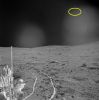
APOLLO 14 AS 14 64-9057.jpgAS 14-64-9057 - Star-like Objects183 visiteLa CASISTICA degli Star-Like Objects
In molti ci hanno domandato "che cosa sono gli Star-like Objects" e perchè non potrebbero essere semplici difetti ripetitivi (photoartifacts) di un numero impressionante di frames NASA.
Allora: Star-like Object vuol solo dire "Oggetto dall'Apparenza Stellare", nulla di più. Sulla Natura degli Star-like Objects si potrebbe scrivere un trattato di fotografia, ma non si verrebbe comunque a capo di nulla e allora – brevemente – diciamo che, sebbene non (ci) sia possibile risalire con certezza assoluta a quella che potrebbe essere la loro "causa", si può trattare di:
1) difetti originari della pellicola o delle ottiche;
2) difetti occorsi in sede di sviluppo delle pellicole originali;
3) difetti causati dall'iper-processing dei frames originali;
4) difetti susseguenti alla digitalizzazione dei frames originali;
5) difetti conseguenti ad una eccessiva compressione dei frames digitali originali;
6) stelle, effettivamente (anche se la NASA – da sempre – smentisce categoricamente questa possibilità);
7) oggetti reali, molto vicini agli Astronauti ed estremamente brillanti (se gli Star-like Objects si vedono in immagini Up-Sun – e cioè ottenute scattando con il Sole posto frontalmente o diagonalmente rispetto all’Astronauta, ma comunque compreso in un arco di circa 130/140° rispetto alla sua fronte);
8) oggetti reali, non necessariamente vicinissimi agli Astronauti, ma comunque molto brillanti (se individuati in immagini Down-Sun – e cioè ottenute scattando con il Sole alle spalle dell’Astronauta).
(1 voti)
|
|

25-Crater Hopmann.jpgA postcard from the Far-Side: Hopmann Crater73 visiteThis image, taken by the advanced Moon Imaging Experiment (AMIE) on board ESA’s SMART-1 spacecraft, shows one quarter of crater Hopmann - an impact structure about 88 Km in diameter.
AMIE obtained this image on January, 25th, 2006 from a distance of about 840 Km from the surface, with a ground resolution of 76 mt per pixel.
The imaged area, not visible from Earth because it is located on the Far-Side of the Moon, is positioned at Latitude of 51,7º South and Longitude 159,2º East. It covers a square of about 39 Km per side.
Nota: osservate con attenzione il bordo del cratere Hopmann e poi cercate di spiegare e di spiegarVi come un margine "infossato" come quello che vediamo in questa discreta (anche se leggermente sfuocata) immagine possa essere il semplice risultato di una, tutto sommato semplice, "meccanica di impatto".
Confrontate questo cratere, p.e., con Tsiolkowsky, Arago-C, Copernicus e Clavius e poi, se volete, provate a redigere una serie di elenchi di crateri lunari associati sulla base della loro apparenza esteriore (e cioè in base alla loro somiglianza): noterete che, delle due l'una:1) o le tipologie di impatti sono migliaia di migliaia di milioni (il che è vero solo in teoria) o 2) è ragionevole supporre che alcuni crateri potrebbero non essere il mero prodotto di un impatto.
E nel ragionarci sopra, tenete a mente il Rasoio di Okkam...
(1 voti)
|
|

24-Mare Humorum-5.jpgMare Humorum (5)65 visitenessun commento
(1 voti)
|
|
| 2188 immagini su 183 pagina(e) |
|
|
|
|
|
141 | |
|
|
|
|
|
|





