| Piú votate - MOON |

Kaguya-033-Haruyama2009Fig1_context.jpgWindow onto an abyss: Cave Skylight on the Moon! (CTX Frame)88 visiteSu segnalazione della nostra sempre attentissima Amica e Partner, Elisabetta Bonora (alias "2di7"), la recente possibile scoperta di un Collapse Pit situato sulla nostra Luna, nella Regione dell'Oceano delle Tempeste (Oceanus Procellarum) ed in prossimità del complesso collinare noto come "Marius Hills".
Eccovi l'interessante articolo scritto al riguardo da Emily Lakdawalla (Planetary Society):"This just in: researchers on JAXA's Kaguya Lunar Orbiter have discovered an open pit on the Moon that is likely a window onto a sublunar world -- a skylight into a subsurface cavern.
Junichi Haruyama, Kazuyuki Hioki, Motomaro Shirao, Tomokatsu Morota, Harald Hiesinger, Carolyn van der Bogert, Hideaki Miyamoto, Akira Iwasaki, Yasuhiro Yokots, Makiko Ohtake, Tsuneo Matsunaga, Seiichi Hara, Shunsuke Nakanotani, and Carlé Pieters describe the feature in a paper now in press in Geophysical Research Letters: "Possible lunar lava tube skylight observed by SELENE cameras.
"First, some context. The Moon will be a difficult, but not impossible, place to set up a permanent human outpost. Lacking a protective atmosphere, its surface is bathed in punishing solar radiation, not to mention a continuous rain of micrometeorites; and over the course of a lunar day (that is, about a month) its temperature ranges over more than 200 degrees Celsius (more than 450 degrees Fahrenheit). Many workers imagining future human habitation of the Moon have advanced the idea of setting up the colony inside a shelter that would provide some protection from the hazards of space radiation and the challenge of insulating against such extremes of temperature.
Digging such a shelter would be a major engineering project; we could get a head start on things if we could find a natural cave. The Moon doesn't have Earth-type limestone rocks bathed in acidic subsurface water, but there is another type of environment that might produce underground caverns: hollow lava tubes. The Moon once had active volcanic geology that has left its surface carved by numerous "sinuous rilles", some of which may once have been underground lava tubes like the ones that form on the flanks of Kilauea today. But while there are lots of rilles to be seen on the Moon, no one has ever confirmed the presence of an enclosed tube, with an intact roof, that could be used as a shelter. One study did find several possible locations where there were likely intact tubes present next to collapsed tube sections (link takes you to a 1.4 MB PDF of a paper by Cassandra Coombs and Ray Hawke), but could not confirm the presence of intact tubes. There are probably lots of intact tubes, but how to find where they're hidden?
The answer is to look for skylights, black holes in the lunar surface that are openings onto sublunar caverns. Skylights are common on Earth, and they've even been seen on the flanks of Martian volcanoes. But despite decades of searching, no one has ever discovered a lunar skylight.
Until now. Haruyama and his coauthors examined Kaguya Terrain Camera photos of an area on the Moon that is populated by numerous rilles, the volcanic complex of the Marius Hills on the lunar nearside. And their search was rewarded with the discovery of exactly one black hole too deep to be an impact crater. The hole is located at 303.3°E and 14.2°N and is, suggetively, in the middle of a small rille. It is nearly circular, 65 meters in diameter, and is equidistant from the rille walls, 250 meters on either side. Previous missions did not image it at high enough resolution to allow scientists to distinguish it from a small impact crater.
Kaguya imaged it nine times, five with the Terrain Camera and four with the lower-resolution Multi-band Imager, at a wide variety of solar incidence angles and camera look angles. A little trigonometry allowed Haruyama et al. to determine that the hole is 80 to 88 meters deep, with very steep walls. The fact that it's deeper than it is wide means it's definitely not an impact crater. But is it a cave skylight? Its location in the dead center of a rille is suggestive, but volcanic environments have a couple of other ways to make pits, such as volcanic vents. But Haruyama et al. determined that a skylight into an underground lava tube is the most likely explanation for this feature; moreover, they figured out that the cavern should be at least 370 meters wide. That's quite a lot of space to work with!
The team searched for more skylights in the region, but only found this one, and as far as they know, it's the only one anybody has ever spotted on the Moon. They concluded: "This is a potentially important discovery for both studies of lunar volcanology and future human outposts....the Marius Hills region has long been considered an important and accessible exploration target, both scientifically and technically. Indeed, the discovery of the Marius Hills Hole further supports the importance of the Marius Hills region as a future exploration target."
This hole is probably not the place we'd establish a permanent base. I imagine that a place that requires a vertical descent and ascent wouldn't be optimal. You'd probably really want one that you could drive into -- an intact tube next to a collapsed part, like the possible ones identified by Coombs and Hawke, and probably ideally with a North or South-facing opening so it wouldn't get blasted by Sunlight at either end of the Lunar Day. I'm smiling now, because I'm thinking about how far humans have come as a species: we're beginning to expand into space, but we're still doing what our forebears did hundreds of thousands (or more) years ago, looking for a nice cave to establish our hearth in.
I want to thank Carolyn van der Bogert for providing the Kaguya images from this paper. Carolyn is also on the Lunar Reconnaissance Orbiter Camera (LROC) team, and told me that LROC has this site on its list of things yet to photograph on the Moon. She said they'll try to photograph it, as Kaguya did, at a variety of solar incidence angles, to get good looks at both the walls of the pit and the floor it opens onto.
LROC should improve on the resolution of the Kaguya imaging by a factor of more than ten, so I'm looking forward to those photos!MareKromium
(1 voti)
|
|

ZZ-ZZ-ZZ-ZZ-APOLLO_11-LANDING_SITE-000.jpgThe Eagle has Landed: Apollo 11 Landing Site (from orbit - edited)101 visitenessun commentoMareKromium
(1 voti)
|
|

ZZ-ZZ-ZZ-ZZ-APOLLO_11-LANDING_SITE-002.jpgThe Eagle has Landed: Apollo 11 Landing Site (from orbit)86 visitenessun commentoMareKromium
(1 voti)
|
|
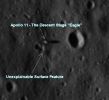
LRO-0003b-369440main_lroc_apollo11_lrg.jpgThe Apollo 11 Descent Stage and the "Mistery Cloud" (edm; credits: Lunar Explorer Italia)95 visiteA nostro parere non serve questionare - stupidamente - la realtà o meno delle Missioni Apollo per cercare "Mistero" (o "Complotto"...): guardate questo edm derivato dal frame precedente. Le ombre ci dicono tutto: altezze ipotetiche degli oggetti ripresi, inclinazioni, albedo etc.
L'ombra del Descent Stage dell'Apollo 11 è spettacolarmente chiara e va anche a dimostrare la correttezza della nostra ricostruzione (vecchia di 5 anni ormai) in ordine al motivo per cui alcuni frames Apollo 11 SEMBRAVANO presentare un orizzonte "tagliato".
E allora? Dov'è il "Mistero"?
Semplice: osservate il rilievo indicato dalla freccia e capirete. Visivamente si presenta come un piccolo "mound" - simile a quello prossimo all'area di Landing dell'Apollo 12 e fotografato più volte da Bean e Conrad - ma, in realtà, la sua texture lo rende simile ad una sorta di nuvola. Inoltre, se guardate con attenzione, noterete un'ombra incongrua fra il rilievo misterioso ed il cratere latistante.
Insomma: la Luna è vicina...Ma ancora ben lungi dall'essere pienamente compresa in tutte le sue sfaccettature e fenomenologie.MareKromium
(1 voti)
|
|

APOLLO_16_AS_16-121-19423_3D-MF.jpgAS 16-121-19423 - Lunar Limb (High-Def-3D - credits: Dr M. Faccin)80 visiteImage Collection: 70mm Hasselblad
Mission: 16
Magazine: 121
Magazine Letter: PP
Latitude: 30,4° South
Longitude: 94,7° East
Film Type: SO-368
Film Width: 70 mm
Film Color: color
Main Features: Curie and Sklodowska Crater
MareKromium
(1 voti)
|
|

Luna21-Photomosaic-001b.jpgLunar Panorama: disturbed soil and Rover Tracks73 visitenessun commentoMareKromium
(1 voti)
|
|
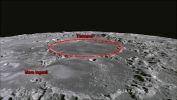
Kaguya-022-hdtv_004_3c.jpgSome Lunar Geography from Kaguya: Thomson Crater and Mare Ingenii (FarSide)61 visiteMare Ingenii - Coord.: 33,7° South Lat. and 163,5° East Long; Total length: about 318 Km
Thomson Crater - Coord.: 32,7° South Lat. and 166,2° East Long.; Diam.: about 112 Km
MareKromium
(1 voti)
|
|

Kaguya-010-20071113.gifRelative locations of the KAGUYA Probe, the Moon, and the Earth72 visitenessun commentoMareKromium
(1 voti)
|
|

APOLLO_15_-_AS_15-87-11697_HR.jpgAS 15-87-11697 - Mare Serenitatis187 visitenessun commentoMareKromium
(1 voti)
|
|
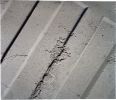
APOLLO_12_AS_12-57-8448_HR.jpgAS 12-57-8448 (HR) - Soil surface disturbed by Astronauts' boots60 visitenessun commento
(1 voti)
|
|

APOLLO 11 AS 11-40-5917.jpgAS 11-40-5917 - Foot-pad and Lunar soil (HR)76 visiteCaption NASA originale:"110:47:18 MT - Buzz still has the Hasselblad camera and is taking photographs while he does an inspection of the LM. This is a close-up of the north footpad, showing the buried probe. The triangular-shape imprint on the soil next to the footpad can also be seen in AS 11-40-5903 and appears to have been made by a cable or strap (...)".
(1 voti)
|
|

APOLLO 11 AS 11-40-5949 HR.jpgAS 11-40-5949 - Working on the Moon (HR)79 visiteCaption NASA originale:"Neil took this picture not long after taking 5948. He moved to his left between frames and this may be the moment when he goes out of the TV field-of-view. This picture gives us a good view of the split boulder that is between the two experiments. In the background, we can see the LM, the U.S. flag, and the TV camera. Note the footprints at the lower right. The astronaut who made them seems to have been moving from right to left. The rightmost footprint made with his left boot has a very deep toe imprint while the rightmost imprint made by his right boot is relatively flat and uniform. While bringing his left foot forward for the next step, he seems to have been dragging his heel, a clear indication that he was walking flat-foot, rather then hopping or running. The next left-boot toe print is deep while above it, we see that he was also scuffing his right heel along the surface. Note that the next prints made by both boots indicate that he turned to his right".
(1 voti)
|
|
| 2188 immagini su 183 pagina(e) |
 |
|
|
|
|
139 | |
|
|
|
|





