| Piú votate - THE LUNAR EXPLORER ARCHIVES |

Aeolian_Features-Windstreaks-V17253016-00.jpgWindstreaks, Pseudo-Windstreaks and Surface Striations (1 - False Colors)67 visiteUn grazie di cuore al Dr Gianluigi Barca per aver selezionato (assieme a molti altri) questi 3 frames MGS che, in accordo a quanto dice la NASA, dovrebbero tutti rappresentare dei "Windstreaks".
Ebbene, pur rendendoci conto si quanto spinosa sia la questione dei rilievi superficiali aventi una natura (presumibilmente) eolica, a noi sembra opportuno cercare di non "ammassare" sotto la medesima categoria una serie di fenomeni "visivamente" (e, forse, SOLO visivamente...) simili - talvolta, magari, anche MOLTO simili.
Una serie di fenomeni che, in realtà, potrebbero non solo essere il frutto di eventi sostanzialmente DIVERSI, ma che potrebbero anche costituire la rappresentazione visibile (quella che noi chiamiamo Evidenza Oggettiva) di un medesimo evento il quale, tuttavia, dopo aver influito sulla superficie del Pianeta Rosso (modellandola) in un certo modo all'atto del suo verificarsi, si è poi esaurito ed ha quindi lasciato che le sue tracce/conseguenze, in un certo senso, si evolvessero e degradassero, in accordo alle Leggi del Tempo ed agli accadimenti geologici ed atmosferici propri della realtà in cui esso ebbe a verificarsi.
Una storia di "nascita", "evoluzione" - "invecchiamento", se si vuole... - ed "estinzione", in fondo. Una storia che ci rammenta che tutto, in questo Universo (a nostro parere, ovviamente), ha una origine, si evolve - cambiando - e quindi si deteriora e scompare: sulla Terra, su Marte, nelle Stelle e Galassie più lontane.
Una storia molto simile a quella degli Esseri Umani, se volete...MareKromium
(12 voti)
|
|
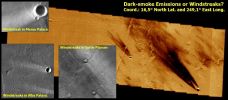
Aeolian_Features-Windstreaks-Comparison.jpgWindstreaks inside Becquerel Crater (CTX Frame: False Colors - insets: Original NASA/MGS/MSSS and NASA/JPL/ASU b/w Frames)61 visiteUn piccolo mosaico, tanto per evidenziare la notevole (sempre e solo a nostro avviso, naturalmente) diversità esistente fra alcuni Windstreaks.
Tanto per prevenire possibili malintesi, ribadiamo che il Windstreak, tecnicamente, è (o forse sarebbe meglio dire "dovrebbe essere") l'espressione visibile di un'area superficiale "protetta" da un rilievo la quale, di conseguenza ed a differenza delle aree ad essa latistanti, NON viene spazzata dal vento (diciamo che è "risparmiata").
Ma alcuni Windstreaks, a differenza di quanto detto qui di sopra, esprimono invece il risultato visibile di quanto il vento ha DIRETTAMENTE trasportato su una specifica area superficiale (il che vuol dire che essi non rappresentano un'area "coperta", bensì un'area "battuta").
Questa distinzione costituisce una mera "finezza/sottigliezza" interpretativa, forse? Secondo noi no. No perchè una cosa è guardare cosa accade ad un'area su cui il vento non arriva a battere direttamente (a causa della presenza di un ostacolo) ed un'altra osservare che cosa il vento ha trasportato su una certa superficie, battendo direttamente su di essa.
Osservate l'omogeneità iniziale del tre Windstreaks presenti nei frames in b/n (si tratta dunque di Windstreaks che evidentemente esprimono delle aree "protette") e la forma a "V" dei Windstreaks individuati nelle prossimità di Ascraeus (i quali, ora ed altrettanto evidentemente, esprimono aree "battute").
Le implicazioni derivanti da questa (sommaria, ma non insignificante) classificazione dei Windstreaks ci paiono talmente evidenti da non necessitare, in questa sede, di ulteriori spiegazioni.MareKromium
(12 voti)
|
|

as13-61-8795.jpgAS 13-61-8795 - Lost Moon (1)89 visitenessun commentoMareKromium
(12 voti)
|
|
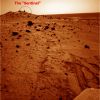
The_Sentinel-SOL1041-2N218780542EFFAS81P0700L0M1.jpgImagination: the Sentinel - Sol 104178 visitenessun commento
(12 voti)
|
|

Large Magellanic Cloud-1.jpgThe Large Cloud of Magellan (HR)63 visiteAn alluring sight in dark Southern skies, the Large Magellanic Cloud (LMC) is seen here through a narrow filter that transmits only the red light of Hydrogen Atoms. Ionized by energetic starlight, a Hydrogen Atom emits the characteristic red H-alpha light as its single electron is recaptured and transitions to lower energy states. As a result, this image of the LMC seems covered with shell-shaped clouds of Hydrogen gas surrounding massive, young stars. Sculpted by the strong stellar winds and ultraviolet radiation, the glowing Hydrogen clouds are known as "H-II" (such as Ionized Hydrogen) Regions. This HR mosaic view was recorded in 6 segments, each with 200 minutes of exposure time. Itself composed of many overlapping shells, the Tarantula Nebula, is the large star forming Region near top center. A satellite of our Milky Way Galaxy, the LMC is about 15,000 light-years across and lies a mere 180.000 LY away in the constellation known as Dorado.
(12 voti)
|
|

NGC-4696.jpgNGC 469695 visiteIn many cosmic environments, when material falls toward a Black Hole energy is produced as some of the matter is blasted back out in jets. In fact, such Black Hole "Engines" appear to be the most efficient in the Universe, at least on a galactic scale. This composite image illustrates one example of an elliptical galaxy with an efficient Black Hole Engine, NGC 4696. The large galaxy is the brightest member of the Centaurus galaxy cluster, some 150 MLY away. Exploring NGC 4696 in X-Rays (red) astronomers can measure the rate at which infalling matter fuels the supermassive Black Hole and compare it to the energy output in the jets to produce giant radio emitting bubbles. The bubbles, shown here in blue, are about 10.000 LY across. The results confirm that the process is much more efficient than producing energy through nuclear reactions - not to mention using fossil fuels. Astronomers also suggest that as the Black Hole pumps out energy and heats the surrounding gas, star formation is ultimately shut off, limiting the size of large galaxies like NGC 4696.
(12 voti)
|
|

ZZ-ZZ-ZZ-ZZ-ZZ-ZZ-ZZ-ZZ-ZZ-ZZ-050-2004221215640_bone.JPGSkull-Rock: pseudo-rock or pseudo-fossil? (4) - from Sol 44396 visiteQualche considerazione: innanzitutto si vede che è presente una linea centrale verticale che “taglia” il frame (ergo l’Anomalia) in due tronconi. Ritengo che si tratti di una linea di cosiddetto "stop-rendering".
La parte sinistra dell'Anomalìa poggia sulla superficie come se si trovasse su di un treppiedi; al di sotto sembra che filtri della luce (questa parte dell'Anomalìa la considero come la "parte frontale" del presunto scheletro); manca la parte mandibolare (sempre che vi sia mai stata...).
Suppongo che un'analoga/simile configurazione esteriore dell'Anomalìa esista anche dalla parte opposta rispetto al nostro angolo visuale (e mi riferisco alla parte di Anomalìa che potrebbe rappresentare le "orbite" - o cavità oculari - di questa "creatura").
Ma prendiamo in considerazione la parte sinistra dell'Anomalìa.
(12 voti)
|
|
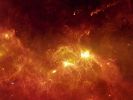
M 42~3.jpgM 42 - In Memory Of IRAS (infrared vision)146 visiteCaption NASA originale:"Do you recognize the constellation Orion? This striking but unfamiliar looking picture of the familiar Orion region of the sky was produced using survey data from the now-defunct InfraRed Astronomical Satellite (IRAS). The above image combines information recorded at three different invisible infrared wavelengths and covers about 30x24° on the sky. Most of Orion's visually impressive stars don't stand out, but bright Betelgeuse does appear as a small bright purplish dot on the lower left. The bright region on the right contains the Great Nebula in Orion, while the bright region just above the image bottom is the Rosette Nebula. Surrounding these regions are a jumble of chaotic glowing gas and dark dust jettisoned by stars forming and exploding over millions of years".
(12 voti)
|
|

Volcanoes-Elysium_Mons.jpgElysium Mons (NASA/JPL/MSSS)74 visitenessun commento
(12 voti)
|
|

Volcanoes-Ceraunius_and_Uranius-E14-1248-1249_ceraunius50.jpgCeraunius and Uranius (Over-Saturated Natural Colors; credits: NASA/MGS/MSSS)102 visiteCaption NASA originale:"Acquired in March 2002, this Mars Global Surveyor (MGS) Mars Orbiter Camera (MOC) wide angle view shows the martian volcanoes, Ceraunius Tholus (lower) and Uranius Tholus (upper). The presence of impact craters on these volcanoes, particularly on Uranius Tholus; indicates that they are quite ancient and are not active today. The light-toned area on the southeastern face (toward lower right) of Ceraunius Tholus is a remnant of a once more extensive deposit of dust from the global dust storm events that occurred in 2001. The crater at the summit of Ceraunius Tholus is about 25 Km (15,5 mi) across. Sunlight illuminates the scene from the lower left".
(12 voti)
|
|

Craters-Pollack_Crater-01.jpgThe "White Rock" inside Pollack Crater88 visiteCaption NASA originale:"The layering in White Rock suggests that the material is sediment deposited at some time in the distant past within Pollack Crater. The fact that the material erodes to form steep cliffs suggests that it is hard like rock. Thus, White Rock is interpreted to be an outcrop of sedimentary rock. It is probably a small remnant of a larger body of rock that may have once covered the entire floor of Pollack Crater; this view is supported by the observation that more extensive layered rocks are seen in other craters across the surface of the Red Planet (e.g., the crater at 8°N, 7°W)".
(12 voti)
|
|

Hellas_Planitia.jpgHellas Planitia in Winter (Natural Colors; credits: NASA/MGS/MSSS)138 visite"This picture captures two dust storms, each large enough to cover Arizona or New Mexico. One is located near the lower left, the other at the lower right. Taken on April 8, 2001 (Mid-Southern Winter), this is a mosaic of six MOC daily global images centered around Hellas Planitia in the Martian Southern Hemisphere. Hellas Planitia is the dominant elliptical feature just below the center of the picture. The bright, nearly white surfaces along the lower (southern) edge of the picture are covered by wintertime frost. The strong temperature difference between the winter frost and the warmer air just off the edge of this Polar Cap generates winds that - at this time of year - are often strong enough to lift Dust into large, reddish-brown, billowy clouds".
(12 voti)
|
|
| 3218 immagini su 269 pagina(e) |
 |
|
|
|
|
9 | |
|
|
|
|





