| Piú votate - THE LUNAR EXPLORER ARCHIVES |

W-5_Star_Forming_Region-PIA11726.jpgIn the Cosmic Hurricane...75 visiteThis image from NASA's Spitzer Space Telescope shows the nasty effects of living near a group of massive stars: radiation and winds from the massive stars (white spot in center) are blasting planet-making material away from stars like our sun. The planetary material can be seen as comet-like tails behind three stars near the center of the picture. The tails are pointing away from the massive stellar furnaces that are blowing them outward. The picture is the best example yet of multiple sun-like stars being stripped of their planet-making dust by massive stars.
The sun-like stars are about 2 three 3 million years old, an age when planets are thought to be growing out of surrounding disks of dust and gas. Astronomers say the dust being blown from the stars is from their outer disks. This means that any Earth-like planets forming around the sun-like stars would be safe, while outer planets like Uranus might be nothing more than dust in the wind.
This image shows a portion of the W5 star-forming region, located 6,500 light-years away in the constellation Cassiopeia. It is a composite of infrared data from Spitzer's infrared array camera and multiband imaging photometer. Light with a wavelength of 3.5 microns is blue, while light from the dust of 24 microns is orange-red.MareKromium
(4 voti)
|
|

ORIGINAL NASA - APOLLO 17 - AS 17-148-22727-A.jpgAS 17-148-22727 - Mother Earth78 visite
(9 voti)
|
|

Mars&Iran-5.jpgMars and Iran: where "nothing" becomes "something"! (6)632 visitenessun commento
(24 voti)
|
|

ZZ-ZZ-ZZ-ZZ-ZZ-ZZ-ZZ-ZZ-Z-Marsberries-TC-LEI.jpgThe "True Colors" of Mars (23)335 visite"...Alla fine degli anni '70 fu diffuso uno studio NASA che attribuiva all'azione dei raggi cosmici la presenza di vortici di sabbia sulla superficie lunare, definendo il tutto un fenomeno elettrostatico. Tale circostanza è possibile che si verifichi anche su Marte, dove dal Microscopic Imager sappiamo che le configurazioni che vediamo sono per lo più agglomerati di particelle la cui natura è, a mio parere, di origine bio-magnetica (in fondo anche il nostro DNA è un polielettrolita).
Capirai che entriamo nella biochimica e nelle alte energie e quindi in un campo minato dal punto di vista del cover-up.
Ed infine un'altra piccola notazione: i filtri colore della PanCam di destra (di cui al "popolo" vengono diffuse solo immagini ritoccate o fasulle in toto) sono fatti per agire sulla banda dell'infrarosso, ergo allo scopo precipuo di isolare con precisione un materiale dall'altro: il che rivela un totale disinteresse della NASA per i "colori reali" di Marte.
Ma è ovvio: loro li conoscono già..."
(24 voti)
|
|

Mars&Iran-0.jpgMars and Iran: where "nothing" becomes "something"! (1)825 visiteCome prevedibile – e sebbene a malincuore – inauguriamo la nostra Galleria di “Scemenze Spaziali” con una serie di frames proposti sul Sito del Prof. Richard Hoagland, “The Enterprise Mission”.
Si tratta di sei frames (MGS, Odyssey e MRO), estratti da un articolo dello stesso Prof. Richard Hoagland (“Mars Reconnaissance Orbiter...and the lost Cities of Barsoom”) i quali mettono a confronto (dobbiamo dire in maniera bella e graficamente accattivante, ma – ahinoi! – anche intrinsecamente scorretta, ingannevole e fuorviante) alcuni paesaggi Marziani con delle aree Archelogiche di indubbio fascino, situate nell’odierno Iran.
Dov’è la “baggianata”, ci chiederete?
Beh, di “baggianate” – a dire il vero – ce ne sono davvero parecchie in questi “arditi raffronti”, ma noi Vi suggeriamo di soffermarVi su queste semplici ed immediatissime riflessioni.
Come si legge nelle captions dei frames usati dallo stesso Hoagland per la sua speculazione, i frames relativi alle “Rovine Persiane” (riprese da un aereo) sono stati ottenuti da altezze comprese fra i 427 ed i 2000 mt.
Si tratta davvero di poca cosa se pensate che i frames relativi alle presunte “Rovine Marziane” sono stati invece ottenuti da altezze comprese tra i 550 ed i 2489 Km!
(13 voti)
|
|
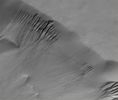
Craters-Lyell_Crater-00.jpgLyell Crater's Gullies (Original NASA/MGS/MSSS b/w Frame)65 visiteCaption originale:"This MGS-MOC image shows a suite of Gullies on a Scarp in Lyell Crater".
Location near: 69,7° South Lat. and 14,0° West Long.
Image width: ~3 Km (~1,9 mi)
Illumination from: upper left
Season: Southern Summer
(5 voti)
|
|
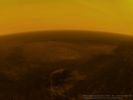
Huygens-Down-08.jpgHuygens' Descent to Titan: 25 Km from the Surface (credits: R. Pascal)76 visiteThe altitude, where Huygens' view of the Surface became distinctly clearer, was surprisingly low with respect to the atmosphere model.
Only about 10% of the Sunlight that is present at the Outer Atmosphere of Titan reaches the surface at the end.
Nota Lunexit: ed è proprio per il suddetto motivo che questa (comunque bellissima) sequenza di immagini è, a nostro parere, completamente errata dal punto di vista della luminosità dell'ambiente.MareKromium
(7 voti)
|
|
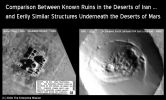
Mars&Iran-1.jpgMars and Iran: where "nothing" becomes "something"! (2)1145 visiteOra, l’idea di mettere a confronto delle immagini anche similari (alcune affinità nei rilievi superficiali, anche se non sono affatto nette come Hoagland vorrebbe farci credere, ci sono e non facciamo fatica ad ammetterlo), ma ottenute da distanze così profondamente diverse, significa tentare di stabilire un rapporto di “parentela” – o di somiglianza esteriore – tra rilievi superficiali il quale è non solo estremamente forzato, ma pure (logicamente e tecnicamente) scorrettissimo.
Se, infatti, volessimo anche ammettere che quanto si vede nei frames Marziani rappresenta effettivamente ciò che resta di una città o di un insediamento urbano affine a quelli presenti in Iran, come potremmo valutare il “rapporto dimensionale” esistente fra i diversi rilievi?
In altre parole: se le rovine Persiane sembrano avere una dimensione “X” (DA o Dimensione Apparente) da poche centinaia di metri di altezza, e questa DA rimane conservata allorché l’immagine viene scattata – diciamo – da 1000 Km di distanza, quanto grandi dovremmo supporre che sìano gli insediamenti Marziani?
Quanto grandi sarebbero le loro “case” (per non parlare delle loro “città”)?
Dovremmo forse dedurre che i Marziani sono/erano dei Ciclopi i quali avrebbero fatto impallidire anche il povero Polifemo?
(16 voti)
|
|

040-The Moon from Clem-Apollo 16 LandingSite.jpg216-0 - The Apollo 16 "Landing Site" (in natural colors)68 visiteThis is the Apollo 16 Landing Site as seen from Clementine. This is a natural color rendition of the site. Clementine images were deliberately taken at very low phase angles (which means high Sun angles) to emphasize color differences, so surface textures are much less apparent here than in the orbital Apollo view.
Note the very bright appearance of South Ray and North Ray Craters (center right).
Promemoria: l'angolo "di fase" è l'angolo formato da Sole, corpo/rilievo ripreso e Sonda.
(9 voti)
|
|

P-NASA_-Curiosity_Poster.jpgHow to uselessly spend (or waste?) 10 years on Mars...131 visiteSolo la NASA può spendere dieci anni su Marte senza arrivare a capo di niente (se non le solite quattro "belinate"). Complimenti!MareKromium
(8 voti)
|
|

Huygens-Down-01.jpgHuygens' Descent to Titan: 110 Km from the Surface (credits: R. Pascal)63 visiteThe haze of Titan's Atmosphere preferently scatters blue and UltraViolet light: this is the reason why the Outer Atmosphere of Titan appears blue in some Cassini images. In reality, the effect of a blue outer atmosphere on Titan may be less prominent than on this rendered image.
This was the altitude were the main parachute was jettisoned and first surface structures came into view for Huygens' cameras.MareKromium
(8 voti)
|
|
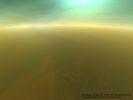
Huygens-Down-03.jpgHuygens' Descent to Titan: 90 Km from the Surface (credits: R. Pascal)67 visiteThe blue color of the sky slowly vanishes with decreasing distance to the Surface and is replaced by a brownish tint. Huygens is still above a layer of complex organic condensate haze, that prevents a clear view down to the Surface.MareKromium
(8 voti)
|
|
| 3218 immagini su 269 pagina(e) |
 |
|
|
|
|
|
265 | |
|
|
|





