| Piú votate - THE LUNAR EXPLORER ARCHIVES |

Crack.gifCrack!!! (GIF-Movie, by Dr Marco Faccin)160 visite"Smile: you're on Candid Camera!!!"
Un simpaticissimo GIF-Movie realizzato dal Grande Marco Faccin, dedicato a Tutti i nostri Amici (e specialmente a quelli che pensano che noi non amiamo scherzare!)...MareKromium
(14 voti)
|
|

M-087.jpgM 87 - Elliptical Galaxy88 visiteElliptical galaxy M 87 is a type of galaxy that looks much different than our own Milky Way Galaxy. Even for an elliptical galaxy, though, M 87 is peculiar. M 87 is MUCH bigger than an average galaxy, appears near the center of a whole cluster of galaxies (known as the Virgo Cluster) and shows an unusually high number of globular clusters. These globular clusters are visible as faint spots surrounding the bright center of M 87. In general, elliptical galaxies contain similar numbers of stars as spiral galaxies, but are ellipsoidal in shape (spirals are mostly flat), have no spiral structure and little gas and dust.
(14 voti)
|
|

Phobos-Phobos_Monolith-00.jpgThe "Phobos' Monolith" (CTX Frame)302 visitenessun commento
(36 voti)
|
|

Martian_Mountains-MGS-01.jpgCharitum Montes (Natural Colors; credits: NASA/MGS/MSSS)141 visiteCaption originale: "This is a perspective view of the Charitum Montes, the Mountain Range that bounds Southern Argyre Planitia, created by combining red and blue Mars Global Surveyor (MGS) Mars Orbiter Camera (MOC) wide angle images with topography from the MGS Mars Orbiter Laser Altimeter (MOLA). Carbon dioxide frost coats some of the hills, craters, and mountainsides in this southern springtime image. The picture is located near 57° South Lat. and 43°West Long. North is toward the top, South toward the bottom. Sunlight illuminates the scene from the upper left. The area shown is about 355 Km. A smaller portion of this image was previously released in July 2003 as "Frosty Mountains."
(22 voti)
|
|

as15-92-12502.JPGAS 15-92-12502 - The "cradle" of the TLP's: Vallis Schroteri (8)78 visiteImage Collection: 70mm Hasselblad
Mission: 15
Magazine: 92
Magazine Letter: OO
Latitude: approx. 25,5° North
Longitude: approx. 53° West
Lens Focal Length: 500 mm
Film Type: 3401
Film Width: 70 mm
Film Color: black & white
Feature(s): VALLIS SCHROTERIMareKromium
(11 voti)
|
|
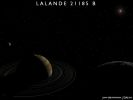
Lalande Solar System.jpgLalande 21185 and a possible extra-solar system157 visiteThe closest extrasolar planetary system could be made by the planets of the dim red dwarf star known as Lalande 21185: only 8 LY distant! This star is too faint to be seen by the naked eye and its planets have never been imaged directly but their presence is inferred by a long series of telescopic observations, tracking the star as it wiggles and wobbles in mutual gravitational response to the masses of its orbiting planets. University of Pitsburgh astronomer George Gatewood recently announced that much of Lalande 21185's wobble is most likely due to an unseen planet with approximately 90% of the mass of Jupiter and an orbital period of 5.8 years. His work also indicates that a second and possibly third planet of similar mass could well be present in the system.
(27 voti)
|
|
APOLLO 10 AS 10-29-4296.jpgAS 10-29-4296114 visite
(8 voti)
|
|

Phobos_from_MGS-002.jpgPhobos from Mars Global Surveyor (3)273 visiteIn tutta onestà noi pensiamo che queste stime siano da prendersi con pesantissimo beneficio d'inventario: la verità è che alcuni tipi di misurazioni possono essere effettuati solo (ed ovviamente) mediante evidenze indirette.
Che il suolo di Phobos sia polveroso è fortemente probabile.
Che esso sia "così tanto" polveroso è solamente un'ipotesi che si fonda sulla velocità di raffreddamento della sua superficie dopo il tramonto del Sole.
(8 voti)
|
|

Martian_Limb-MGS-E23-00100_limb-00.jpgMartian Limb and Outer Space (Original NASA/MGS/MSSS b/w Frame)174 visitecaption originale: "The Mars Global Surveyor (MGS) Mars Orbiter Camera (MOC) red and blue wide angle cameras provide daily coverage of the Red Planet "from Limb to Limb." The "Limbs" are the edges of the Planet as seen to the West and East of the spacecraft. Depending on weather conditions, Clouds or Haze can sometimes be seen above the Limb. This picture was taken by the blue camera in December 2002. It is an oblique view looking Westward across heavily Cratered Terrain at High Southern Latitudes. A thin line of Haze, high in the Martian Atmosphere, can be seen above the Planet's Surface. The view of Craters in the foreground is enhanced by the presence of bright, winter-time CO2 Frost. The darkness above the Limb is outer space".
(29 voti)
|
|

Martian_Mountains-MGS-02.jpgCharitum Montes (Natural Colors; credits: NASA/MGS/MSSS)159 visitenessun commento
(29 voti)
|
|

M 17.jpgM 17 - The "Omega Nebula" detail mgnf126 visiteIn the depths of the dark clouds of dust and molecular gas known as M 17, stars continue to form. Also known as the Omega Nebula and Horseshoe Nebula, the darkness of M17's molecular clouds results from background starlight being absorbed by thick filaments of carbon-based smoke-sized dust. As bright massive stars form, they produce intense and energetic light that slowly boils away the dark shroud. Colors in the above image were picked to highlight specific elements that emit nebular light: red indicates emission from sulfur, green from hydrogen, and blue from oxygen. The Swan Nebula is visible with binoculars towards the constellation of Sagittarius, lies 5000 LY away, and spans 20 LY across.
(26 voti)
|
|

Oklo_on_Earth-_Oklo_15.jpgOklo 15233 visiteCaption NASA, da "NASA - Picture of the Day" del giorno 12 Settembre 2010:"The remnants of nuclear reactors nearly two billion years old were found in the 1970s in Africa.
These reactors are thought to have occurred naturally. No Natural Reactors exist today (nota Lunexit: on Earth!), as the relative density of Fissile Uranium has now decayed below that needed for a sustainable reaction.
Pictured above is Fossil Reactor 15, located in Oklo, Gabon. Uranium Oxide remains are visible as the yellowish rock. Oklo by-products are being used today to probe the stability of the Fundamental Constants over Cosmological Time and Distance Scales and to develop more effective means for disposing of human-manufactured nuclear waste". MareKromium
(13 voti)
|
|
| 3218 immagini su 269 pagina(e) |
 |
|
|
|
|
263 | |
|
|
|
|





