| Piú votate - THE LUNAR EXPLORER ARCHIVES |

Volcanoes-Arsia_Mons-01-PIA04294.jpgArsia Mons and its "clouds" (1) - 19 June 2001, Ls 180° (Extremely Saturated Natural Colors; credits NASA/JPL/MSSS)74 visiteVariazioni e ripetitività climatiche osservate sulla Regione dove sorge il grande vulcano Arsia Mons.
Original caption:"A wide angle view taken by the Mars Orbiter Camera on NASA's Mars Global Surveyor. At intervals of approximately one Mars year apart, similar spiral dust clouds over a volcano named Arsia Mons can be seen. This image was taken on June 19, 2001, such as the first day of Southern Winter on Mars".
(12 voti)
|
|

Thaumasia_Region-The_Electric_Dunes-03.jpgThaumasia Dunes: the brightest dunes of Mars (EDM n.2)98 visiteDa questa immagine, la luminosità di queste "dune" appare davvero in maniera inequivocabile. La prudenza, come sapete, non è mai troppa, ma la nostra sensazione è che stiamo guardando del ghiaccio o del metallo. L'immagine è stata ottenuta da un'altezza di 370 Km e sono le 14:48 MLT (cioè l'ora locale del luogo ripreso). Il Sole, a quell'ora, è decisamente alto sull'orizzonte e quindi la possibilità che l'albedo elevatissima di queste strutture dipenda proprio da un fenomeno di riflessione diretta della luce solare ci sembra, tutto sommato, accettabile.
Ciò che non ci sembra accettabile è l'atteggiamento della NASA riguardo a questo e ad altri fenomeni similari (ed eclatanti): un atteggiamento di TOTALE INDIFFERENZA.
Ma questa, come sapete, è tutta un'altra storia...
(12 voti)
|
|

ORIGINAL NASA APOLLO 13 - AS13-62-8955.jpg edited.jpgAPOLLO 13 AS 13-62-8955 - A huge "light" near Apollo 13!2426 visiteMolti ritengono che questa "bolla di luce", apparsa in un finestrino dell'Apollo 13 durante il viaggio di rientro verso la Terra, non sia altro che un riflesso del Sole. Come già è accaduto e Vi abbiamo detto altre volte in passato, noi non possiamo sapere di che cosa si tratti però, in qualche frangente, sappiamo di che cosa NON può trattarsi. Abbiamo tante immagini del Sole (e dei relativi raggi e riflessi) visto attraverso i finestrini delle CSM (Navicelle Madri) e/o dei LM (Moduli Lunari) e, proprio in virtù del possesso di queste informazioni, Vi possiamo dire che la "bolla di luce" che vediamo adesso NON è un riflesso del Sole. Secondo noi c'era "qualcosa", all'esterno della Navicella Americana, che, di tanto in tanto, si mostrava. UFO? Chimere? Fenomeni connessi ai Raggi Cosmici? La NASA tace; evidenze migliori di questa non ne abbiamo; prove decisive a sostegno di una tesi piuttosto che dell'altra, neppure e quindi...Scegliete la tesi che Vi piace di più fra queste oppure createne una nuova!
(126 voti)
|
|

Beginnings.JPGBeginnings... (by Roberto Tremolada)179 visitenessun commentoMareKromium
(16 voti)
|
|
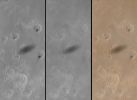
Martian_Eclipse-moc2_msss_3shadow100-01.jpgMOC Views of Martian Solar Eclipses (Original NASA/MGS/MSSS - Natural Color Frame)144 visiteThis picture shows wide angle red (left), blue (middle) and color composite (right) views of the shadow of Phobos (elliptical feature at center of each frame) as it was cast upon western Xanthe Terra on August 26, 1999, at about 2 p.m. local time on Mars. The image covers an area about 250 Km (155 miles) across and is illuminated from the left. The meandering Nanedi Valles is visible in the lower right corner of the scene. Note the dark spots on three crater floors - these appear dark in the red camera image (left) but are barely distingished in the blue image (middle), while the shadow is dark in both images. The spots on the crater floors are probably small fields of dark sand dunes.
(10 voti)
|
|
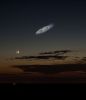
Andromeda.jpgIf our eyes were a CCD Camera... (Credits: Stephen Rahn - Tom Buckley-Houston)322 visiteThis is, of course, a photographic COMPOSITION, but the proportions are exact, and what we would see in the sky if the Andromeda Galaxy were bright enough, would be an object almost as wide as 7 full moons.
The Moon seen from Earth, in fact, occupies about half a degree in the sky. M31 on the other hand, over 2 million light years away, is over 3 degrees wide.MareKromium
(5 voti)
|
|
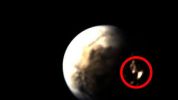
Proxima_Centauri_B_-_2.jpgProxima Centauri "b" - Alien City Lights or Super-volcanic Activity? (2)145 visiteE', a mio umile avviso, un Fenomeno di Super-vulcanismo che accade su scala (di fatto) planetaria. Guardate BENE! E guardate bene le foto di "Io"...MareKromium
(5 voti)
|
|

Z-03.jpgDoes it look "familiar" this thing to you? Yes it does: already seen!131 visiteImpossibile non notare l'estrema somiglianza tra questo fenomeno, ripreso dalla Terra, ed il frame AS 15-83-11218. Le ipotesi, a questo punto, sono solo due: o entrambi i frames sono falsi, oppure entrambi sono genuini. Scrivete. Decidete Voi. Ogni opinione sarà Apprezzata! Un immenso Grazie al Dr Gualtiero La Fratta per aver rinvenuto, in un libro del 1979, alcune "perle" che saranno qui di seguito pubblicate. Il resto NON è "Materia/Questione di Fede". E' solo Materia/Questione di "Occhio" ed "Oggettività". Ed Esperienza.MareKromium
(5 voti)
|
|
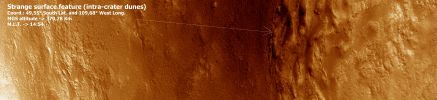
Craters-Unnamed_Crater_with_Intra-crater_Dunes-M0700566-00.jpgIntra-Crater Dunes (CTX Frame - Extremely Enhanced and Saturated Natural Colors; credits for the additional process. and color.: Dr Paolo C. Fienga - Lunexit Team)63 visitenessun commento
(5 voti)
|
|
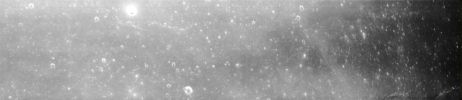
As15-p-9564-2.jpgAS 15-P-9564 (b) - Dawes Crater Region74 visitenessun commento
(5 voti)
|
|

APOLLO 11 AS 11-37-5480HR.jpgAS 11-37-5480 (HR)89 visite
(5 voti)
|
|

Volcanic_Features-Collapse_Pits-Pavonis_Mons_Area.jpgPit Chain on the Eastern Flank of Pavonis Mons (Original NASA/MGS/MSSS b/w Frame)87 visiteCaption NASA originale:"Pavonis Mons is the middle of the 3 large Tharsis Montes Volcanoes in the Martian Western Hemisphere.
Located on the Equator at about 113° West Longitude, Pavonis Mons stands as much as 7 Km above the surrounding Plain. The MGS-MOC recently spied the above Chain of Elliptical Pits on the lower East Flank of Pavonis Mons. The picture covers an area approx. 3 Km wide by 3,4 Km in length. The Pits are aligned down the center of a 485 meters-(approx. 530 yards)-wide, shallow Trough.
The straight Trough and the Pits were both formed by collapse associated with faulting. The Scarp on each side of the Trough is a "Fault Line" - Troughs of this type are known to geologists as "Graben". Such features are typically formed when the ground is being moved apart by tectonic forces, or when the ground is uplifted by molten rock injected into the near sub-surface from deeper underground. Both processes may be contributing to the features seen on Pavonis Mons. The Pits follow the trend of these Faults, and indicate the locus of collapse".
(5 voti)
|
|
| 3218 immagini su 269 pagina(e) |
 |
|
|
|
|
259 | |
|
|
|
|





